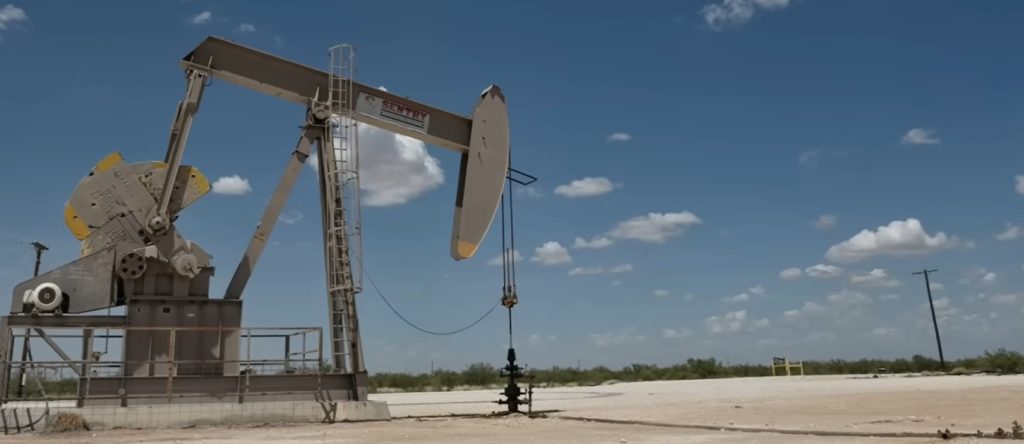



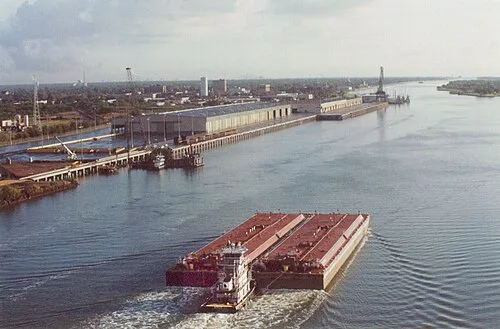
Port Arthur is a city in the state of Texas, United States of America, located 90 mi (140 km) east of metropolitan Houston. Part of the Beaumont–Port Arthur metropolitan area, the city lies primarily in Jefferson County, with a small extension in Orange County. The second-largest oil refinery in the US, the Motiva Refinery, is located in Port Arthur.
Its population was 53,818 at the 2010 census, down from 57,755 at the 2000 census. In 2020, its population was 56,039. In the 19th century, initial attempts to settle the area had all failed, mostly. However, in 1895, Arthur Stilwell founded Port Arthur, and the town quickly grew, being incorporated as a city in 1898. It soon developed into a seaport and eventually became the center of a large oil-refinery network. The Rainbow Bridge across the Neches River connects Port Arthur to Bridge City.
Due to its location on the Gulf of Mexico, Port Arthur is vulnerable to hurricanes and other intense tropical weather, as well as extreme heatwaves, high humidity, and tornadoes. Since its inception, the city has experienced several incidences of extreme weather resulting in significant damages and casualties.
Contents
History
Aurora was an early settlement attempt near the mouth of Taylor Bayou on Sabine Lake, about 14 miles (23 km) long and 7 miles (11 km) wide. It is a saltwater estuary formed by the confluence of the Neches and Sabine Rivers. Through its tidal outlet, 5-mile-long (8 km) Sabine Pass, Sabine Lake drains some 50,000 sq mi (100,000 km2) of Texas and Louisiana into the Gulf of Mexico. The town was conceived in 1837, and in 1840 promoters led by Almanzon Huston were offering town lots for sale. Some were sold, but Huston's project failed to attract many settlers. The area next was known as "Sparks", after John Sparks, who moved his family to the shores of Sabine Lake near the site of Aurora. The Eastern Texas Railroad, completed between Sabine Pass and Beaumont, Texas, passed 4 miles (6 km) west of Sparks. However, the American Civil War soon began, and rail lines were removed. In 1886, a destructive hurricane hit the coast, causing the remaining residents to dismantle their homes and move to Beaumont. By 1895, Aurora had become a ghost town.
Arthur Stilwell led the resettling of the area as part of his planned city as the southern terminus of his Kansas City, Pittsburg and Gulf Railroad, predecessor to the Kansas City Southern Railway. Stilwell named the city Port Arthur after himself, not the British Royal Navy lieutenant who gave his name to Port Arthur, China.
Pleasure Island now separates the city from the Gulf Intracoastal Waterway. The 18.5-mile (29.8 km) man-made island was created between 1899 and 1908 by the Corps of Engineers to support development of the port.
Arthur Stilwell founded the Port Arthur Channel and Dock Company to manage the port facilities. The port officially opened with the arrival of the British steamer Saint Oswald in 1899.
When oil was discovered at Spindletop, the J.M. Guffey Petroleum Company, later Gulf Oil, had run pipelines to Port Arthur as a shipping point and a location for an oil refinery. In November 1901, the first tanker, the Cardium, departed with Spindletop oil. The refinery was enlarged in 1902, and a pipeline connected to the Glenn Pool Oil Reserve in Oklahoma. The Texas Company, later Texaco, also started building a refinery in 1902. By 1916, the Port Arthur refinery was one of the three largest in the United States.
Geography
Port Arthur is located on the eastern edge of Jefferson County on the west side of Sabine Lake. It is bordered to the northeast by Orange County, Texas, and to the southeast, across Sabine Lake, by Cameron Parish, Louisiana. The Port Arthur city limits extend south along the west side of Sabine Pass, the outlet of Sabine Lake, as far as the Gulf of Mexico on the city's southern border. To the north, the city limits extend across the Neches River into Orange County. Port Arthur is bordered to the northwest by the cities of Nederland, Groves, and Port Neches, and to the northeast by Bridge City in Orange County.
According to the United States Census Bureau, the city has a total area of 144.1 square miles (373.1 km2), of which 76.9 square miles (199.2 km2) are land and 67.1 square miles (173.9 km2), or 46.61%, are covered by water.
Conservation
Port Arthur and the surrounding Gulf Coast area have several areas dedicated to conservation, as part of the 50 Wildlife Management Areas in Texas, comprising 748,768 acres (303,016 ha) of land. These include the 25,852 acres (10,462 ha) J.D. Murphree Wildlife Management area with the Big Hill Unit (8,312 acres), 4,074 acres (1,649 ha) Salt Bayou Unit (Lost Lake unit), and the Hillebrandt Unit (591 acres),, the 207 acres (84 ha) Candy Cain Abshier Wildlife Management Area (WMA), the Walter Umphrey Park (Keith Lake unit), the Sabine Woods sanctuary, McFaddin and Texas Point National Wildlife Refuges, and the Sea Rim State Park.
Communities
Communities in Port Arthur include:
El Vista
Griffing Park
Lakeview
Pear Ridge
Port Acres
Sabine Pass
West Side
Tropical cyclones
Celebrations in Port Arthur on completion of the Kansas City, Pittsburg and Gulf Railroad between Kansas City and Port Arthur occurred Saturday, September 11, 1897. The celebrations brought additional people into town. The next day, a major hurricane hit Port Arthur. Water flowed 5 ft deep in the streets. People loaded into the unfinished railroad roundhouse seeking shelter; the building promptly collapsed, killing four. In the end, 13 people died, homes were destroyed, and a pleasure pier was severely damaged.
In June 1957, Hurricane Audrey made landfall just east of Port Arthur in Cameron Parish, Louisiana, as a category 3 hurricane. The storm caused extensive wind damage around the city and significant storm surge flooding just east in Southwest Louisiana.
On September 24, 2005, Hurricane Rita made landfall between Sabine Pass, Texas, and Johnson Bayou, Louisiana, as a category 3 hurricane. A wind gust of 116 mph (187 km/h) was recorded in Port Arthur. The storm caused widespread significant wind damage throughout the city, with power outages lasting several weeks in some locations. Some areas of the city also received flooding due to Rita.
On September 13, 2007, Hurricane Humberto made landfall west of Port Arthur as a category 1 hurricane. The storm moved northeast across the Golden Triangle, causing widespread wind damage; however, most of the damage was relatively minor. An 84 mph (135 km/h) wind gust was recorded at the Southeast Texas Regional Airport just northwest of the city.
On August 5, 2008, Tropical Storm Edouard made landfall just west of Port Arthur. The effects felt in the city were light, but wind gusts up to 55 mph (89 km/h) were recorded.
On September 13, 2008, Hurricane Ike made landfall on Galveston Island as a category 2 hurricane. Due to the storm's unusually large size, effects were widespread and were felt across much of Southeast Texas. Port Arthur sustained significant wind damage and many of the city's residents lost power. The Port Arthur seawall protected the city from the major flooding that surrounding cities experienced.
On August 29, 2017, after Harvey made a second landfall at tropical storm status, and 26 inches of rain fell in a single day at the airport near Port Arthur, triggering widespread flash flooding in the city. According to the Port Arthur Mayor Derrick Freeman, 20,000 homes were flooded with up to 6 ft of water. On August 30, Freeman posted on Facebook, "Our whole city is underwater right now."
Climate
Somerville has a humid subtropical climate (Köppen: Cfa) with hot summers and mild winters. Port Arthur is tied with Lake Charles, Louisiana, and Astoria, Oregon, as the most humid city in the contiguous United States. The average relative humidity is 90% in the morning, and 72% in the afternoon.
Demographics
2020 census
As of the 2020 census, Port Arthur had a population of 56,039. The median age was 35.1 years; 27.0% of residents were under 18 and 13.8% were 65 or older. For every 100 females, there were 97.7 males, and for every 100 females 18 and over, there were 94.7 males 18 and over.
Almost all of the residents lived in urban areas, while 1.3% lived in rural areas.
Of the 20,990 households in Port Arthur, 35.9% had children under 18 living in them, 36.7% were married-couple households, 22.9% had a male householder and no spouse or partner present, and 34.4% had a female householder and no spouse or partner present. About 30.1% of all households were made up of individuals, and 11.1% had someone living alone who was 65 or older.
The city had 24,504 housing units, of which 14.3% were vacant. The homeowner vacancy rate was 1.5% and the rental vacancy rate was 13.8%.
2010 census
At the 2010 census, 53,818 people, 20,183 households, and 13,191 families resided in the city. The population density was 654.6 inhabitants per square mile (252.7/km2). The 23,577 housing units averaged 284.4 per square mile (109.8/km2). The racial makeup of the city was 41.7% African American, 37.9% White, 1.2% Native American, 6.3% Asian, 0.1% Pacific Islander, and 15.3% from other races. Hispanics or Latino Americans of any race were 29.6% of the population. Of the 20,183 households in 2010, 30.2% had children under 18 living with them, 39.2% were married couples living together, 19.8% had a female householder with no husband present, and 34.6% were not families; 30.1% of all households were made up of individuals, and 11.1% had someone living alone who was 65 or older. The average household size was 2.63, and the average family size was 3.31. In the city, the age distribution was 27.0% under the age of 18, 9.7% from 18 to 24, 24.7% from 25 to 44, 25.2% from 45 to 64, and 13.3% who were 65 or older. The median age was 35.3 years. For every 100 females, there were 96.9 males. For every 100 females 18 and over, there were 94.1 males.
2019 American Community Survey estimates
In 2019, the American Community Survey estimated 18.7% of the population was non-Hispanic White, 38.1% Black and African American, 0.2% Native American, 7.3% Asian, 0.1% Pacific Islander, 0.2% some other race, and 34.5% Hispanic or Latino American of any race.
From 2014 to 2019, the median household income was $36,557; families had a median income of $44,115; married families $56,304; and nonfamily households $24,280. Among the population, 27.2% lived at or below the poverty line, against the state's 13.6% impoverished population from 2014 to 2019 census estimates. In contrast, the nearby city of Beaumont had a poverty rate of 16.7%, down from 17.6%.
Economy
Home to a large portion of United States oil refining capacity, Port Arthur has seen renewed investment in several key installations. Motiva Enterprises began undertaking a major addition to its western Port Arthur refinery, expanding capacity to 600,000 barrels per day (95,000 m3/d). This $10.0 billion project is the largest US refinery expansion to occur in 30 years. Premcor Refining (now Valero) completed a $775 million expansion of its petrochemical plant, and BASF/Fina commenced operations of a new $1.75 billion gasification and cogeneration unit on premises of its current installation, which had just completed its own $1 billion upgrade. These operations are supported by the Port of Port Arthur, one of Texas' leading seaports.
The city was the site of an oil spill in 2010, when an oil tanker and barge collided, causing 450,000 gallons of oil to spill into the Sabine/Neches waterway alongside the city.
Central business district disintegration
The commercial center of Port Arthur was at its peak in the early 1900s. Together with the effects of suburbanization, which drew off wealthier residents to new housing away from town, gradually taking businesses with them, from 1960 until 1974, successive waves of economic recession caused much distress in the town. The central business district has many boarded up and vacant locations.
The Hotel Sabine opened at 600 Proctor Street in 1929 and operated as the Vaughn Hotel until the mid-1930s. At 118 feet, 10 stories, and the tallest building in Port Arthur, the building is of Beaux-Arts architecture style, built with steel-reinforced concrete and brick on 640 steel-laced wooden cypress pilings driven 60 ft into the ground. It was overdesigned and overbuilt due to lack of knowledge on the strength of concrete in the 1920s. The hotel closed down in the mid-1980s.
The Port Arthur News reported August 28, 2010, that "DWA (Digital Workforce Academy) Buys Sabine Hotel", By November 2011, the hotel was reported to be slated for demolition. The cost of renovations was estimated at $10–12 million and the demolition estimate was $500,000 to $1.2 million. As of April 2021, Motiva was still considering buying the hotel, but remained uncertain and uncommitted to it.
Hurricane Rita struck a direct hit on the Proctor Street Seawall and damaged many downtown businesses and homes. As economic activity picked up in the region, calls for downtown revitalization have been advanced. The true center of commercial activity has gravitated from downtown to other areas. The main shopping center is Central Mall, opened outside the downtown in 1982.
Arts and culture
Port Arthur's Museum of the Gulf Coast is recognized as the area's definitive collection of items and displays for figures from Port Arthur and the surrounding communities.
UGK, perhaps Texas's most influential hip-hop group, originated in Port Arthur before relocating to Houston.
Government
The city manager of Port Arthur is Ronald Burton. The mayor is Charlotte M. Moses.
The county operates the Jefferson County Sub-Courthouse in Port Arthur.
Politics
The United States Postal Service operates the Port Arthur Post Office, the Port Acres Post Office, and the Sabine Pass Post Office in Sabine Pass.
State and federal representation
In the Texas State Legislation, Port Arthur is in the 4th Senate District, represented by Republican Brett Ligon, and in the 22nd State House District, represented by Democrat Christian Manuel while the Sabine Pass portion of Port Arthur is within the 21st State House District, represented by Republican Dade Phelan.
In the United States House of Representatives, Port Arthur is in Texas' 14th congressional district, represented by Republican Randy Weber.
Education
Colleges
Lamar State College-Port Arthur, located in downtown Port Arthur, celebrated its 100th birthday in 2009. Offering a full variety of basic core curriculum classes in which credits are transferable throughout Texas public universities, Lamar State College is recognized for associate programs in commercial music, nursing, legal assistant, and process technology. The college also fields competitive teams in men's basketball and women's softball.
Galveston College
The sections of Port Arthur within the Hamshire-Fannett and Sabine Pass ISDs are assigned to Galveston College in Galveston. State legislation does not specify an assigned community college for the remainder of Jefferson County.
The Career and Technical Education Center, formerly named Stilwell Technical Center, is the second college in Port Arthur. In 2012, the school was relocated to a new building on the same property as Memorial High School at 3501 Sgt Lucian Adams Dr. The Port Arthur Independent School District is now headquartered at its former location on 9th Avenue.
Primary and secondary schools
Most of the city is served by the Port Arthur Independent School District. It operates a single high school, Memorial High School, formed in 2002 by the consolidation of three high schools: Stephen F. Austin, Abraham Lincoln, and Thomas Jefferson.
The portion around Southeast Texas Regional Airport is served by the Nederland Independent School District. Some parts are served by Port Neches-Groves Independent School District. The Sabine Pass community is served by the Sabine Pass Independent School District. Portions of Port Arthur are in Nederland ISD, Beaumont ISD, and Hamshire-Fannett ISD. In Orange County, the portions of Port Arthur are in Bridge City Independent School District.
The Bob Hope Charter School is located in Port Arthur.
The city had a Catholic high school, Bishop Byrne High School, which closed in 1983.
Public libraries
The Port Arthur Public Library, at 4615 9th Avenue at Texas State Highway 73, serves as the public library system for the city.
Media
Newspapers
The Port Arthur News is the only daily newspaper serving Port Arthur. Operating since 1897, The News is one of the oldest continually operated businesses in Port Arthur. It is currently owned and operated by Boone Newspapers. From 1932–1941, Port Arthur had a second newspaper called The Peoples Press.
Television
KBTV (Roar) channel 4
KGEW-LD (Telemundo) channel 33
Transportation
Air
The Jack Brooks Regional Airport in the northwest part of Port Arthur serves Beaumont and Port Arthur.
Bus
Local bus service is provided by Port Arthur Transit.
Rail
The nearest inter-city rail station to Port Arthur is Beaumont Amtrak station in nearby Beaumont, which serves the greater area. The station is served by Amtrak's Sunset Limited line, with a train arriving thrice weekly in each direction.
Major highways
U.S. Highway 69/U.S. Highway 96/U.S. Highway 287
State Highway 73
State Highway 82
State Highway 87
State Highway 347
Spur 93
Spur 215
Notable people
Athletics
Jonathan Babineaux, former professional football player, Atlanta Falcons
Jordan Babineaux, former professional football player, Seattle Seahawks and Tennessee Titans
Aaron Brown, professional football player
J'Covan Brown (born 1990), basketball player in the Israel Basketball Premier League
Ravin Caldwell (born 1963), former linebacker for the Washington Redskins.
Jamaal Charles, professional football player
Todd Dodge, American football coach
Earl Evans, college and professional basketball player
Kevin Everett, professional football player
Mitch Gaspard, college baseball coach
Danny Gorrer, professional football player
Jim Hurtubise (born in North Tonawanda, New York), race car driver, moved to Port Arthur as an adult.
Stephen Jackson (born in Houston, Texas), former professional basketball player, who played in the NBA for 14 seasons.
Jimmy Johnson, football broadcaster, player, coach, and executive
Bobby Leopold, professional football player
Kenneth Lofton Jr., college and FIBA U-19 Team USA player.
Business
Max Flatow, architect, was born in Port Arthur.
John Warne Gates (born Turner Junction, Ill), wire and steel magnate, railroad and oil financier
Tom Hicks, former owner of Texas Rangers, Dallas Stars, Liverpool FC, and Dr Pepper/7-UP
Movies, television, and media
G.W. Bailey, actor
Kree Harrison, runner-up on American Idol, 12th season
Evelyn Keyes, film actress
Amber Chardae Robinson, actress
Tad Tadlock, choreographer
Ken Webster, actor and director.
Music
Zachary Breaux, jazz musician
C. J. Chenier, musician
Ted Dunbar, jazz musician
Ralph Gean, singer/songwriter.
Jason Halbert, musical director for Kelly Clarkson.
Lee Hazlewood (born in Mannford, Oklahoma), musician, was raised in Port Arthur.
Janis Joplin, singer/songwriter
Pimp C & Bun B of UGK, rappers
Johnny Preston, pop singer.
J. P. Richardson a.k.a. The Big Bopper, singer and songwriter born in the Port Arthur neighborhood of Sabine Pass
Politics
Brian Babin, U.S. Representative for Texas
Carl A. Parker, former Texas House Representative, State Senator
Nelson R. Strong, Texas House Representative, First mayor of Port Arthur
Raymond Strother, political consultant
Miscellaneous
Lucian Adams, recipient of Medal of Honor, Bronze Star, and Purple Heart
Elroy Chester, racially motivated serial killer executed in 2013 for 5 murders
Robert Rauschenberg, painter and graphic artist
Leah Rhodes, Hollywood costume designer.