Second Trump presidency
On November 9, 2024, Witkoff was chosen to be co-chair of the Presidential Inaugural Committee for Trump's upcoming second presidency, along with former US Senator Kelly Loeffler.
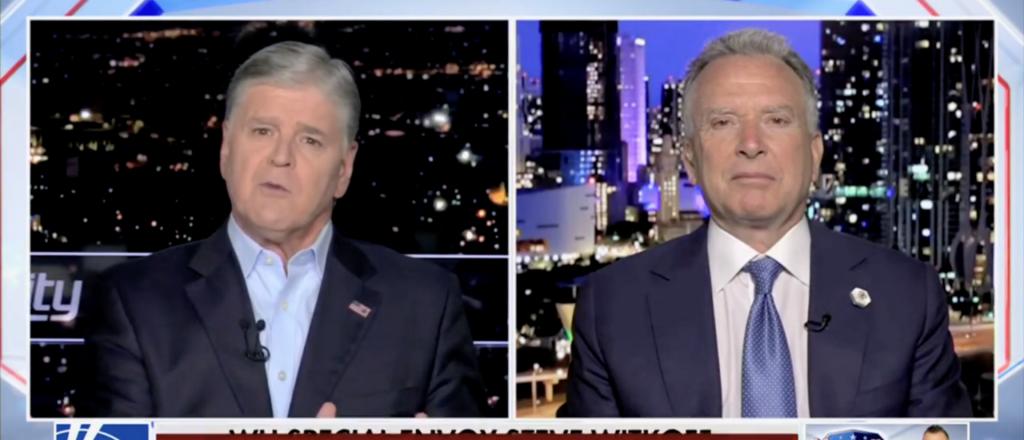
On November 12, 2024, President-elect Donald Trump announced that he had selected Witkoff to be his Special Envoy to the Middle East. Witkoff had no diplomatic experience.
During Trump's second term, he was appointed special envoy to the Middle East. In December 2024, before Trump formally took office, Witkoff worked to help push negotiations that led to a ceasefire and hostage exchange between Israel and Hamas in January and October 2025.
While in office, he played a role in key geopolitical negotiations, including on issues unrelated to the Middle East, and was appointed Special Envoy for Peace Missions on July 3, 2025.
Witkoff played a key role in negotiating a ceasefire and hostage exchange between Israel and Hamas in January 2025, along with Brett McGurk, President Biden's lead negotiator who invited Witkoff to join the negotiations, and Qatari prime minister Sheikh Mohammed bin Abdulrahman Al Thani, who it was agreed would be the one who would speak to Hamas. There followed a six-week ceasefire agreement, during which there would be a swap of 33 Hamas-held hostages taken in the October 7 attacks for approximately 1,000 Palestinian prisoners, some of whom were serving life sentences for murder, and steps toward further exchanges and ending a prolonged 15-month war.
Witkoff's approach differed from traditional diplomatic methods, as he, joined by McGurk on speakerphone from Qatar, applied pressure on Israeli Prime Minister Benjamin Netanyahu to finalize the deal, stressing that Trump wanted the deal done, achieving in the final weeks what had been in negotiation for nearly a year. The New York Times wrote, "It was a vivid example of cooperation between two men representing bitter political rivals. Rarely if ever have teams of current and new presidents of different parties worked together at such a high-stakes moment, with the fate of American lives and the future of a devastating war hanging in the balance."
On January 29, 2025, Witkoff arrived in Israel and made a rare entry by an American official into Gaza to personally oversee the ceasefire between Israel and Hamas.
On March 2, 2025, the Israeli government stopped the entry of goods and supplies into the Gaza Strip. The office of prime minister Netanyahu claimed they were acting upon a proposal Witkoff had originally presented. The new plan did not mention an Israeli retreat from positions in Gaza after half of the hostages had been released in phase one of the 2025 Gaza war ceasefire. The existence of a "Witkoff-plan" had not been confirmed by Washington as of March 3, 2025.
Instead of continuing to the second phase of the ceasefire per the original agreement, Israel proposed a new plan (called the "Witkoff plan" after Steve Witkoff), in which Hamas would release the Israeli captives in exchange for a 50-day extension of the ceasefire, with Israel retaining the option of returning to war. Hamas rejected this new proposal, which differed from the terms agreed in January 2025.
On March 23, 2025, Witkoff blamed Hamas for renewed fighting in Gaza, saying that "Hamas had every opportunity to demilitarize, to accept the bridging proposal that would have given us a 40- or 50-day ceasefire where we could have discussed demilitarization and a final truce."
In April 2025, Witkoff had an unannounced meeting in Paris with two Israeli officials ahead of the US-led nuclear talks with Iran. He represented the Trump administration's push for a diplomatic resolution.
The first round of high level-meetings was held in Oman on April 12, 2025, led by Witkoff and Iranian Foreign Minister Abbas Araghchi. Following the June 2025 Israeli strikes in Iran, diplomatic talks about nuclear energy between US and Iran were indefinitely suspended.
Witkoff held a high-level secret meeting with Reza Pahlavi, the exiled crown prince of Iran, to discuss the 2025–2026 Iranian protests. This was the first such contact between the Trump administration and the Iranian opposition since the protests escalated.
In mid-January 2026, reports emerged that Iranian Foreign Minister Abbas Araghchi sent a personal message to Witkoff stating that Iran had canceled the planned execution of 800 anti-regime protesters. This communication reportedly played a key role in dissuading President Trump from ordering immediate military strikes against Iran.
In early 2026, the United States and Iran engaged in high-stakes negotiations led by Witkoff and Presidential Advisor Jared Kushner. These talks were ended by the U.S. and Israel joint attack on Iran on 28 February 2026. According to The Guardian, a Gulf diplomat described Witkoff and Kushner as acting like "Israeli assets", accusing them of manipulating Trump into the 2026 Iran war and engaging in "unorthodox and destructive diplomacy" during nuclear talks.
President Trump made Witkoff his de facto envoy to Russian president Vladimir Putin. By March 2025, Witkoff had become the main channel of communication between the Trump administration and the Russian presidency. Lacking formal training in diplomacy, he conducted key meetings in ways that breached standard diplomatic protocol, raising concerns about the accuracy, trustworthiness, and effectiveness of such engagements.
On February 11, 2025, Trump sent Witkoff to Moscow, where he met with President Putin and was responsible for the negotiations that led to a prisoner swap and the release of U.S. citizen Marc Fogel from a Russian prison, in exchange for Russian citizen Alexander Vinnik. Witkoff said that Putin and Trump "had a great friendship, and I think now it's going to continue, and it's a really good thing for the world". Witkoff said he "spent a lot of time with Putin" during the secret trip and had developed a "friendship and relationship" with Putin.
On February 16, 2025, Witkoff rejected concerns that Ukraine and Europe would be excluded from any future peace negotiations in the Russian invasion of Ukraine. On February 18, American and Russian delegations, headed by U.S. Secretary of State Marco Rubio and Russian Foreign Minister Sergey Lavrov, respectively, met in Riyadh, Saudi Arabia, to develop a framework for further peace negotiations. Rubio was accompanied by Steve Witkoff and former U.S. National Security Advisor Mike Waltz.
On March 21, 2025, in a podcast interview with Tucker Carlson, Witkoff said that the biggest issue in negotiations are the "so-called four regions: Donbas, Crimea, Lugansk . . . and there's two others". Russia occupied and annexed Crimea in 2014, then occupied and annexed four more Ukrainian provinces during its 2022 invasion. (Donbas in not a Ukrainian region, but a collective name for the regions of Donetsk and Luhansk.) He said that the populations in those provinces were Russian-speaking and "there were referendums where the vast majority of people indicated that they wanted to be under Russian rule"; the polls were considered a "sham" by the U.S., Ukraine, and most of the international community.
In the interview, Witkoff spoke positively of Vladimir Putin. He called Putin a "great guy" and "super smart." Witkoff said, "I liked him, I think he was honest" and "I don't regard Putin as a bad guy". According to Witkoff, Putin told him that he prayed for "his friend" Donald Trump following the assassination attempt in Pennsylvania. He recalled that "President Putin had commissioned a beautiful portrait of President Trump, from the leading Russian artist, and actually gave it to me and asked me to take it home to President Trump". Ukraine's president, Volodymyr Zelenskyy, said that Ukrainians were "very disturbed" by Witkoff's comments and believed he had been influenced by Russian disinformation. Journalist Stephen Pollard commented that Witkoff may mean well, but was embarrassingly out of his depth dealing with Putin.
In April 2025, Witkoff met with Putin in Moscow. Witkoff did not bring his own interpreter to the meetings, instead relying on Kremlin-provided translators. The decision was noted as a departure from standard diplomatic protocol, with former U.S. ambassador Michael McFaul commenting that "the language is never the same" when using only host-country interpreters.
In early August 2025, Witkoff traveled to Moscow for another round of talks with Putin. During the meeting, Witkoff reportedly misunderstood Putin’s remarks—interpreting a suggestion that he was open to a “peaceful withdrawal” of Ukrainian forces from occupied territories as an offer for Russian forces to withdraw from regions such as Kherson and Zaporizhzhia. This misinterpretation, conveyed back to Washington, seemingly prompted President Trump to pause new sanctions and extend an invitation to Putin for a summit in Alaska. Critics argue that Putin "was rewarded not with debilitating sanctions but with an invitation to meet," reflecting the fallout from this diplomatic confusion.
Before co-founding Stellar Management, Witkoff practiced real estate law at Dreyer & Traub and Rosenman & Colin.
The Alaska 2025 summit took place on August 15, 2025. Coverage of the meeting highlighted that the summit was marked more by symbolic pageantry, such as flyovers and photo-ops, than substantive progress. Commentators further argued that entrusting such responsibilities to a real estate executive instead of trained diplomats not only compromised the talks but set a precedent for sidelining expertise in critical foreign policy negotiations.
On August 17, 2025, Witkoff claimed that, during the Alaska summit, Putin had promised to enshrine a non-aggression pledge in Russia’s constitution. His statements were dismissed as naïve and dangerously misguided, given Russia’s history of using constitutional amendments to consolidate power and justify territorial expansion rather than promote peace.
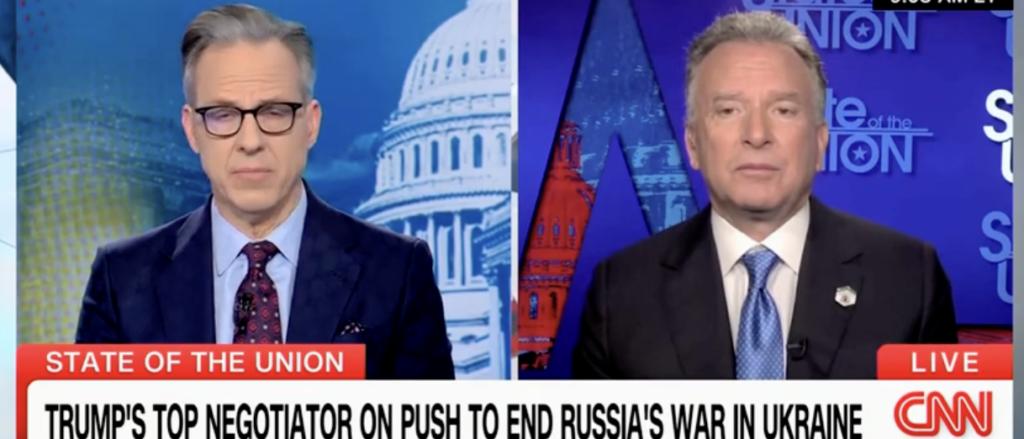
On November 19, 2025, Axios reported that Witkoff had drafted a 28-point U.S. peace plan with Russian envoy Kirill Dmitriev. The document called for significant Ukrainian concessions, including ceding territory, limiting the size of its armed forces, and renouncing NATO membership. The plan generated confusion and controversy, particularly regarding its authorship. Analysts noted that certain phrases in the English version appeared to reflect Russian syntax or translation artifacts, suggesting that the text may have been drafted originally in Russian before being translated into English. The plan includes provisions for using Russian state assets frozen in the EU to fund U.S.-led reconstruction efforts in Ukraine, with the United States receiving up to 50% of the investment profits; critics have accused the U.S. of war profiteering as a result. Western officials observed that the proposal might serve as a basis for negotiation but required substantial revision, citing its alignment with Russian demands. Several U.S. senators, including Mike Rounds and Angus King, stated that Secretary of State Marco Rubio had told them the plan "was not the administration's plan" and resembled "a wish list of the Russians." Rubio denied this characterization. This episode has been cited as further evidence that the involvement of an inexperienced and unofficial negotiator like Witkoff introduced significant risks, raising concerns about the potential implications of unauthorized diplomacy. Witkoff was criticized by diplomats and politicians alike for taking a pro Russian position in the 28-points and forwarding a plan which would divert substantial amounts of frozen Russian funds held in Europe by Belgium, from Ukraine to the USA.
On November 25, 2025, Bloomberg published a transcript of a 5-minute phone call on October 14, 2025, between Witkoff and Yuri Ushakov, Vladimir Putin's most senior foreign policy adviser. The transcript showed Witkoff giving Ushakov advice on negotiating with President Trump. The leak led to condemnation of Witkoff by several members of Congress, including Representative Ted Lieu, who wrote Witkoff was a "traitor" on X. Representative Don Bacon called for Witkoff's immediate dismissal, writing "For those who oppose the Russian invasion and want to see Ukraine prevail as a sovereign & democratic country, it is clear that Witkoff fully favors the Russians," on X, and Representative Brian Fitzpatrick wrote "This is a major problem. And one of the many reasons why these ridiculous side shows and secret meetings need to stop." Anne Applebaum wrote that Witkoff's interventions kept helping Russia in the Ukraine War. Trump later defended Witkoff's call, describing it as a "very standard form of negotiations".