





The Strait of Hormuz () is a waterway between the Persian Gulf and the Gulf of Oman. On the north coast lies Iran, and on the south coast lies the Musandam Peninsula under the Musandam Governorate of Oman, with a portion of the southwest of the peninsula under the United Arab Emirates (UAE). The strait is about 104 miles (90 nmi; 167 km) long, with a width varying from about 60 mi (52 nmi; 97 km) to 24 mi (21 nmi; 39 km).
It provides the only sea passage from the Persian Gulf to the open ocean and is one of the world's most strategically important choke points. During 2023–2025, 20% of the world's liquefied natural gas and 25% of seaborne oil trade passed through the strait annually. It is a major route of petroleum products for Europe and Asia and is critical for Europe's energy supply. It is also the only maritime route for several Gulf countries including the UAE, Qatar, Bahrain, Kuwait, and Iraq, and disruption to the strait can cause severe supply shortages.
Before the 2026 Iran War, the strait had not been closed for any extended time during Middle East conflicts, although Iran occasionally threatened to close the strait. The closure of the strait caused by Iranian blockades became a major focus during the war, resulting in the 2026 Strait of Hormuz crisis.
Contents
Etymology
The origins of the name of Hormuz are vague. One theory is the name derives from the local Persian language word Hur-Mogh هورمغ 'Place of Dates', while another theory suggests "Hormuz" from the Middle Persian pronunciation of the name of the Zoroastrian god هرمز Hormoz (Ahura Mazda). Some sources suggest the former is more likely, while others lean towards the latter. Another theory claims that the strait of Hormuz may have been named after Ifra Hormizd, the mother of King Shapur II of Persia, who ruled between 309 and 379 AD. Yet another theory is that it comes from ὅρμος hormos, the Greek word for 'cove, bay'.
Historiography
The opening to the Persian Gulf was described, but not given a name, in the Periplus of the Erythraean Sea, a 1st-century mariner's guide:
At the upper end of these Calaei islands is a range of mountains called Calon, and there follows not far beyond, the mouth of the Persian Gulf, where there is much diving for the pearl-mussel. To the left of the straits are great mountains called Asabon and to the right there rises in full view another round and high mountain called Semiramis; between them the passage across the strait is about six hundred stadia; beyond which that very great and broad sea, the Persian Gulf, reaches far into the interior. At the upper end of this gulf, there is a market-town designated by law called Apologus, situated near Charaex Spasini and the River Euphrates.
In the 10th–17th centuries AD, the Kingdom of Ormus was located here.
From the 15th century onward, from a strategic point of view, the geography of the strait maintained and expanded its importance with the arrival of foreign powers such as Portugal, which maintained its presence between the 16th and 18th centuries, also provoking disputes with other emerging powers such as England when it arrived in the region in the 17th century.
Geography
The Strait of Hormuz is a strait lying between the Persian Gulf and the Gulf of Oman. On the north coast lies Iran, and on the south coast lies the Musandam Peninsula under the Musandam Governorate of Oman, with a portion of the southwest of the peninsula under the United Arab Emirates (UAE). The strait is about 104 miles (90 nmi; 167 km) long, with a width varying from about 60 mi (52 nmi; 97 km) to 24 mi (21 nmi; 39 km).
Islands
Several islands lie within the Strait of Hormuz, including Hormuz Island, Qeshm Island, Larak Island, and Hengam Island. Some of the people living on these islands are descended from enslaved people from Africa. The Naaz islands (also spelt Naz) are joined to Qeshm at low tide, and part of the Qeshm Global Geopark.
Navigation
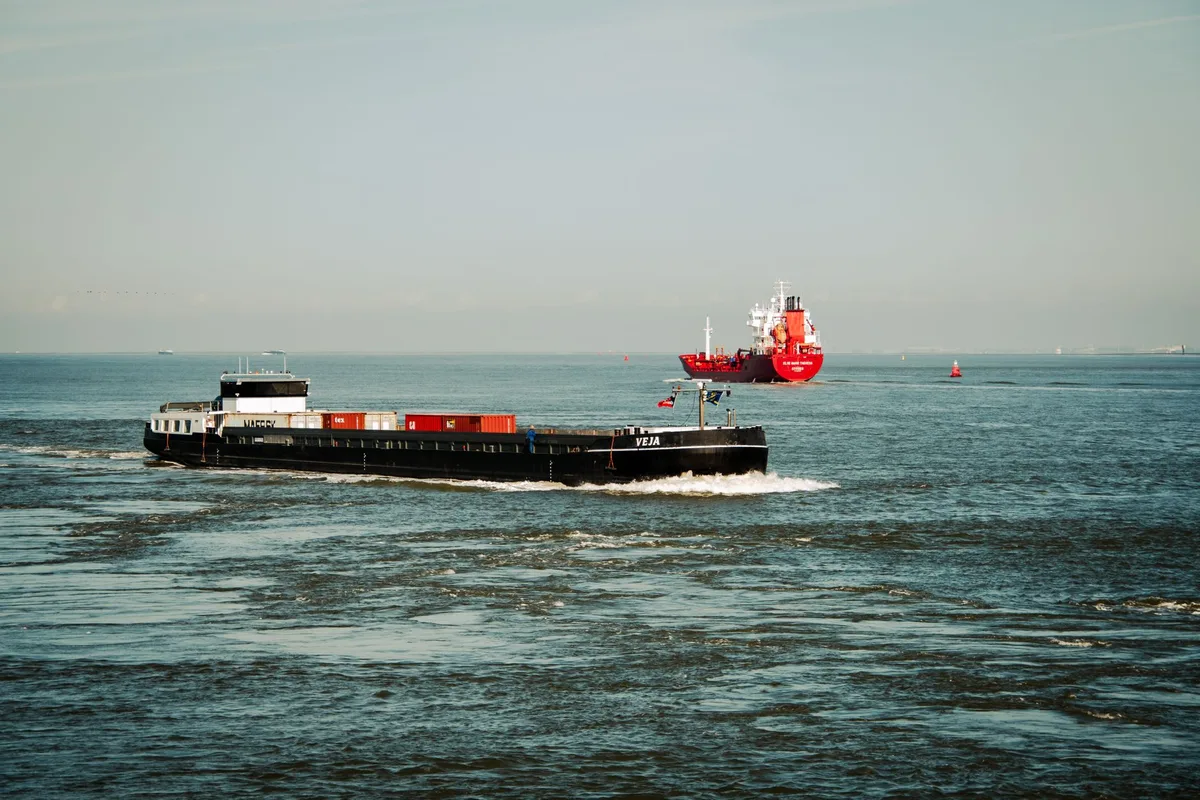
To reduce the risk of collision, ships moving through the strait follow a traffic separation scheme (TSS): inbound ships use one lane, outbound ships another, each lane being 2 nautical miles (3.7 km) wide, with the two lanes separated by a similarly wide "median". Commercial ships of countries party to UNCLOS are obliged to follow the TSS during transit passage. The TSS is in Omani territorial waters, however, to the south-east of the strait, very large vessels need to use Iranian waters as alternative waters closer to the United Arab Emirates coastline are relatively shallow.
To traverse the full length of the strait, ships pass through the territorial waters of Iran and Oman. Although Iran has not ratified the UNCLOS convention, most countries, including the U.S. which also has not ratified it, claim the right of passage as codified in the convention.
In 1959, Iran altered the legal status of the strait by expanding its territorial sea to 12 nmi (22 km) and declaring it would recognize only transit by innocent passage through the newly expanded area. In 1972, Oman also expanded its territorial sea to 12 nmi (22 km) by decree. Thus, by 1972, the Strait of Hormuz was completely "closed" by the combined territorial waters of Iran and Oman in its narrowest section between the Omani Great Quoin Island and the Iranian Larak Island. In 1971, Iran took over the Greater and Lesser Tunbs islands west of Hormuz against Arab wishes, thereby extending control of the navigation channels.
During the 1970s, neither Iran nor Oman attempted to impede the passage of warships, but in the 1980s, both countries asserted claims that were different from customary (old) law. Upon ratifying UNCLOS in 1989, Oman submitted declarations confirming its 1981 royal decree that only innocent passage is permitted through its territorial sea. The declarations further asserted that prior permission was required before foreign warships could pass through Omani territorial waters.
Upon signing the convention in 1982, Iran entered a declaration stating "that only states parties to the Law of the Sea Convention shall be entitled to benefit from the contractual rights created therein", including "the right of transit passage through straits used for international navigation". In 1993, Iran enacted a comprehensive law on maritime areas, provisions of which conflict with UNCLOS provisions, including a requirement that warships, submarines, and nuclear-powered ships obtain permission before exercising innocent passage through Iran's territorial waters. The U.S. does not recognize any of the claims by Oman and Iran and has contested each of them.
Trade significance
The Strait of Hormuz provides the only sea passage from the Persian Gulf to the open ocean and is one of the world's most strategically important choke points. It is a major route of petroleum products for Europe and Asia and is critical for Europe's energy supply. It is also the only maritime route for several Gulf countries including the UAE, Qatar, Bahrain, Kuwait, and Iraq, and disruption to the strait can cause severe supply shortages.
During 2023–2025, 20% of the world's liquefied natural gas and 25% of seaborne oil trade passed through the Strait, illustrating its important location for trade.
According to the U.S. Energy Information Administration, in 2011, an average of 14 tankers per day left the Persian Gulf through the strait carrying 17 million barrels (2,700,000 m3) of crude oil. More than 85% of these crude oil exports went to Asian markets, with Japan, India, South Korea and China the largest destinations. In 2018, 21 million barrels a day passed through the strait, worth $1.2 billion in 2019 prices.
If shipping through the Strait of Hormuz were significantly disrupted for an extended period, it could lead to a major oil supply crisis for major Asian importers such as Japan, India, South Korea, and China.
The Persian Gulf is also a major hub for global fertilizer production and exports. Countries such as the Islamic Republic of Iran, Qatar, Saudi Arabia, and Oman are among the world's leading exporters of nitrogen fertilizers, including urea and ammonia. In the 2020s the region has accounted for roughly 30–35 percent of global urea exports and around 20%–30% of ammonia exports. Overall, up to 30% of internationally traded fertilizers normally transit the Strait of Hormuz.
Smuggling
The Strait of Hormuz is a major route for illicit trade between the Musandam Peninsula, an exclave of Oman, and the southern coast of Iran. The city of Khasab in Musandam is the primary hub for this cross-strait contraband economy. The geographic proximity of the two coastlines, separated by approximately 50 km (31 mi) at the strait's narrowest points, allows for the rapid transit of small, high-powered speedboats operated by smugglers.
Goods such as electronics, home appliances, cigarettes, and luxury vehicles are typically purchased in the United Arab Emirates, transported overland to Khasab, and shipped across the strait to evade the international sanctions against Iran. In the opposite direction, Iranian boats transport livestock, primarily sheep and goats destined for markets in the UAE and Saudi Arabia, particularly during Islamic holidays such as Eid al-Adha. Illicit drugs and undocumented migrants are also transported from Iran to Oman.
Omani authorities generally tolerate the trade in Khasab, as it provides a significant source of income for the geographically isolated Musandam region. Conversely, Iranian authorities officially combat the practice. The Iranian Customs and Excise Department has estimated that smuggling across the strait costs the Iranian economy tens of thousands of jobs and circumvents billions of dollars in customs duties annually. The volume of this black market changes depending on the severity of international sanctions on Iran; tighter sanctions increase the demand for smuggled consumer goods in the country. After a reduction of activities towards the end of the Barack Obama presidencies, smuggling has picked up in later years thanks to the intensifying regional conflict.
Events
Tanker War
In May 1981, Iraq began attacking commercial shipping to undermine Iran's war effort. At first, Iraqi forces targeted vessels transporting military supplies to the Iranian ground forces. Later, Iraq expanded the campaign and attacked ships carrying Iranian exports. Iran retaliated by attacking Iraq's trading partners vessels.
In 1984, Iraq broadened the tanker war by attacking the oil terminal and oil tankers at Kharg Island. In response, Iran began attacking tankers traveling to and from Kuwait and other Gulf Arab states that supported Iraq's war effort.
Both sides had declared an "exclusion zone", meaning areas in which they had warned ships from entering. Iraq declared the area around Iran's Kharg Island to be an exclusion zone.
Operation Praying Mantis
Operation Praying Mantis was an attack on 18 April 1988 by the United States Armed Forces against Iranian targets within Iranian territorial waters in retaliation for the Iranian naval mining of international waters in the Persian Gulf during the Iran–Iraq War and the subsequent damage to an American warship. The U.S. Navy attacked with several groups of surface warships, plus aircraft from the aircraft carrier USS Enterprise, and her cruiser escort, USS Truxtun. The attack began with coordinated strikes by two surface groups.
Downing of Iran Air 655
On 3 July 1988, 290 people were killed when an Iran Air Airbus A300 was shot down over the strait by the U.S. Navy guided missile cruiser USS Vincennes (CG-49) when it was wrongly identified as a jet fighter.
Collisions
In January 2007, the nuclear submarine USS Newport News struck MV Mogamigawa, a 300,000-ton Japanese-flagged crude oil tanker, south of the strait. There were no injuries and no oil leaked. On 20 March 2009, U.S. Navy Los Angeles-class submarine USS Hartford collided with the San Antonio-class amphibious transport dock USS New Orleans in the strait. The collision ruptured a fuel tank aboard New Orleans, spilling 95 cubic metres (25,000 US gal) of marine diesel fuel.
Iranian navy problems
In May 2020, Iran launched missiles at one of their own ships in a friendly fire accident, killing 19 sailors. On 2 June 2021, the IRIS Kharg, a modified Ol-class replenishment oiler of the Iran Navy, sank in the Strait of Hormuz after catching fire. It was the navy's largest vessel.
Iranian ship seizures
On 28 April 2015, IRGCN patrol boats contacted the Marshall Islands–flagged container ship MV Maersk Tigris, which was westbound through the strait, and directed the ship to proceed further into Iranian territorial waters, according to a spokesman for the U.S. Defense Department. When the ship's master declined, one of the Iranian craft fired shots across the bridge of Maersk Tigris. The captain complied and proceeded into Iranian waters near Larak Island. The U.S. Navy sent aircraft and a destroyer, USS Farragut, to monitor the situation. Maersk says it agreed to pay an Iranian company $163,000 after an Iranian court ruling over a dispute about 10 container boxes transported to Dubai in 2005. An appeal court raised the fine to $3.6 million.
On 4 January 2021, the Tasnim News Agency reported that a South Korea–flagged oil vessel headed from Saudi Arabia to the United Arab Emirates was seized for allegedly causing pollution violations. The ship was said to be carrying roughly 7,000 tons of ethanol. South Korea refused to comment on the accusation of causing oil pollution in the Strait of Hormuz. The ship, Hankuk Chemi, was headed to the UAE port Fujairah after loading oil from Jubail, Saudi Arabia on 2 January 2021, as per ship-tracking data gathered by Bloomberg.
In April 2024, the Iranian Navy seized MSC Aries, a Portuguese-flagged container ship sailing through the Gulf of Oman off the UAE coast of the Emirati port city of Fujairah, then steered the container ship through the strait, with 25 personnel on board, claiming that it had violated maritime laws. The crew of 25 included 17 Indian nationals, Filipinos, Pakistanis, a Russian, and an Estonian.
Iranian preparations to mine the strait
As of 2019, the U.S. Defense Intelligence Agency estimated that Iran possessed over 5,000 naval mines capable of rapid deployment via high-speed boats. In June 2025, it was reported that U.S. intelligence detected, possibly through satellite imagery or human informants, that Iranian military forces loaded naval mines onto vessels in the Persian Gulf, an act which was interpreted as a preliminary step to blockading the strait. The mines were ultimately not deployed, though their presence raised alarms in Washington about Tehran's intent to escalate the conflict. It is unclear whether the mines were later removed.
U.S.–Iran disputes, threats to close the Strait
Naval stand-offs between Iranian speedboats and U.S. warships in the strait occurred in December 2007 and January 2008. U.S. officials accused Iran of harassing and provoking their naval vessels, but Iran denied the allegations. Later reports from U.S. Navy officials appeared to contradict the Pentagon version of the event, in which the Pentagon had reported that U.S. vessels had almost fired on approaching Iranian boats. The Navy's regional commander, Vice Admiral Kevin Cosgriff, said the Iranians had "neither anti-ship missiles nor torpedoes" and he "wouldn't characterize the posture of the US 5th Fleet as afraid of these small boats".
On 29 June, the commander of Iran's Revolutionary Guard, Mohammad Ali Jafari, said that if either Israel or the U.S. attacked Iran, it would seal off the strait to wreak havoc in the oil markets. Cosgriff warned that such Iranian action would be considered an act of war, and the U.S. would not allow Iran to hold hostage a third of the world's oil supply. On 8 July, Ali Shirazi, a mid-level clerical aide to Supreme Leader of Iran Ayatollah Ali Khamenei, was quoted telling the Revolutionary Guards, "The Zionist regime is pressuring White House officials to attack Iran. If they commit such a stupidity, Tel Aviv and U.S. shipping in the Persian Gulf will be Iran's first targets and they will be burned."
In the last week of July, in Operation Brimstone, dozens of U.S., and naval ships from other countries, came to undertake joint exercises for possible military activity in the shallow waters off the coast of Iran. By 11 August, more than 40 U.S. and allied ships were en route to the strait.
On 27 December 2011, Iranian vice president Mohammad Reza Rahimi threatened to cut off oil supply from the strait should economic sanctions limit, or cut off, Iranian oil exports. A U.S. Fifth Fleet spokeswoman said the Fleet was "always ready to counter malevolent actions", whilst Admiral Habibollah Sayyari of the Islamic Republic of Iran Navy claimed cutting off oil shipments would be "easy". Despite an initial 2% rise in oil prices, markets ultimately did not react significantly to Iran's threat, with oil analyst Thorbjoern Bak Jensen concluding "they cannot stop the flow for a longer period due to the amount of U.S. hardware in the area".
On 3 January 2012, Iran threatened to take action if the U.S. Navy moved an aircraft carrier back into the Persian Gulf. Iranian Army chief Ataollah Salehi said the U.S. had moved a carrier out of the Persian Gulf because of Iran's naval exercises, and Iran would take action if the ship returned. "Iran will not repeat its warning ... the enemy's carrier has been moved to the Gulf of Oman because of our drill. I recommend and emphasize to the American carrier not to return to the Persian Gulf", he said.
Ability of Iran to hinder shipping
Millennium Challenge 2002 was a major war game exercise conducted by U.S. armed forces in 2002. It simulated an attempt by a country (likely to be Iran) to close the strait. Iran's simulated strategy beat the materially superior U.S. armed forces.
A 2008 article in International Security contended that Iran could seal off or impede traffic in the strait for a month, and an attempt by the U.S. to reopen it would be likely to escalate the conflict. In a later issue, however, the journal published a response which questioned key assumptions and suggested a much shorter timeline for re-opening.
Moreover, due to Iran's own dependence on oil exports through the strait as well as imports, (due to its inability to refine oil on its own) a closure of the strait is unlikely. Not only Iran's own dependence on the strait for imports and exports is indicative that a prolonged closure is unlikely, but also the dependence of its allies on the trade that flows through it suggest the logistical infeasibility of such closure.
A neoclassical-realist analysis describes Iranian policy regarding the strait as "double-faced": in non-existential threat environments Tehran tends to act as a security provider by keeping the strait open, whereas under threats perceived as existential it takes calculated risks and incorporates the waterway into a wider deterrence and brinkmanship strategy. This interpretation portrays Iran as a reactive actor that employs interference or brinkmanship to gain concessions and trigger de‑escalatory measures from the international community.
This literature also emphasizes that Iran's strategy with respect to the strait is constrained by its own reliance on the waterway, that of key partners, material limits and sanctions, which lowers its freedom to take risks and suggests that any prolonged closure would be particularly damaging for Iran itself and its allies.
In December 2011, Iran's Navy began a ten-day exercise in international waters along the strait. Iranian Rear Admiral Habibollah Sayyari stated that the strait would not be closed during the exercise; Iranian forces could easily accomplish that but such a decision must be made at a political level. Captain John Kirby, a Pentagon spokesman, was quoted in December 2011 saying: "Efforts to increase tension in that part of the world are unhelpful and counter-productive. For our part, we are comfortable that we have in the region sufficient capabilities to honor our commitments to our friends and partners, as well as the international community." Suzanne Maloney, an expert at the Brookings Institution, said, "The expectation is that the U.S. military could address any Iranian threat relatively quickly." General Martin Dempsey, Chairman of the Joint Chiefs of Staff, said in 2012 that Iran "has invested in capabilities that could, in fact, for a period of time block the Strait of Hormuz." He stated, "We've invested in capabilities to ensure that if that happens, we can defeat that."
Alternative shipping routes
By 2025, around 15 million barrels (2.4 million cubic metres) of oil per day were transported through the strait. Onshore pipelines have a maximum capacity of around 3 million barrels. All LNG must be transported by ship through the strait.
In June 2012, Saudi Arabia reopened the Iraq Pipeline through Saudi Arabia (IPSA), which was confiscated from Iraq in 2001 and travels from Iraq across Saudi Arabia to a Red Sea port. It has a capacity of 1.65 million barrels (262,000 m3) per day.
In July 2012, the UAE began using the new Habshan–Fujairah oil pipeline from the Habshan fields in Abu Dhabi to the Fujairah oil terminal on the Gulf of Oman, effectively bypassing the Strait of Hormuz. It has a maximum capacity of around 2 million barrels (320,000 m3) per day, over three-quarters of the UAE's 2012 production rate. The UAE is also increasing Fujairah's storage and off-loading capacities.
The UAE is building the world's largest crude oil storage facility in Fujairah with a capacity of holding 14 million barrels (2,200,000 m3) to enhance Fujairah's growth as a global oil and trading hub. The Habshan – Fujairah route secures the UAE's energy security and has the advantage of being a ground oil pipeline transportation which is considered the cheapest form of oil transportation and reduces insurance costs as oil tankers would no longer enter the Persian Gulf.
In a July 2012 Foreign Policy article, Gal Luft compared Iran and the Strait of Hormuz to the Ottoman Empire and the Dardanelles, a choke point for shipments of Russian grain a century ago. He indicated that tensions involving the Strait of Hormuz are leading those currently dependent on shipments from the Persian Gulf to find alternative shipping capabilities. He stated that Saudi Arabia was considering building new pipelines to Oman and Yemen, and that Iraq might revive the disused Iraq–Syria pipeline to transport crude oil to the Mediterranean. Luft stated that reducing Hormuz traffic "presents the West with a new opportunity to augment its current Iran containment strategy."