




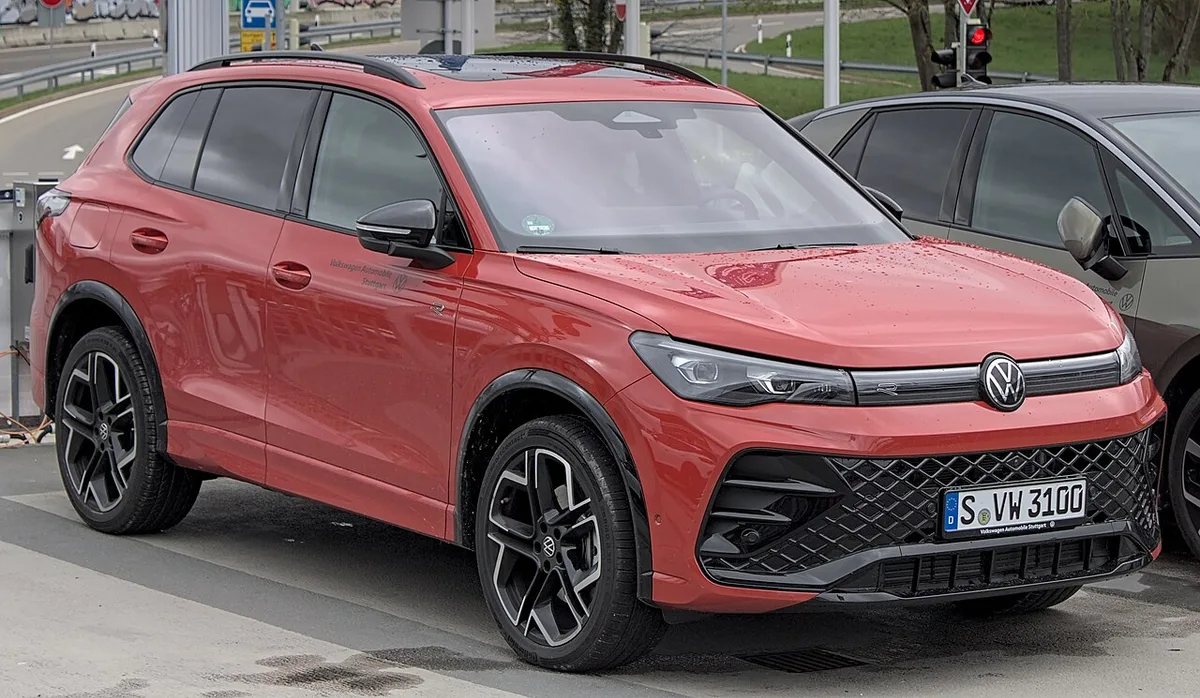
The Volkswagen Tiguan (German pronunciation: [ˈfɔlksˌvaːɡn̩ ˈtiːɡu̯aːn]) is a sport utility vehicle produced by German manufacturer Volkswagen since 2007, sitting between the smaller T-Roc and the larger Touareg in the company's crossover SUV range. The first generation was based on the PQ46 platform, while the second generation, released in 2016, utilizes the Volkswagen Group MQB A2 platform. It is generally considered to be a medium-sized SUV in Europe, while in North America it is considered to be a compact crossover SUV.
The name Tiguan is a portmanteau of the German words Tiger ("tiger") and Leguan ("iguana") and won a naming contest by German car magazine publisher Auto Bild—from a field of names that also included Namib, Rockton, Samun and Nanuk.
As of the spring of 2020, six million units had been sold worldwide, with 910,926 units being manufactured in 2019 alone, making the Tiguan the best-selling car overall in the Volkswagen Group. It was also the best-selling SUV in Europe.
Contents
First generation (5N; 2007)
The first generation Tiguan was initially shown as a concept vehicle at the LA Auto Show in November 2006. The production form of the Tiguan was revealed online in June 2007 following a prototype preview in Namibia, before being officially launched at the Frankfurt International Motor Show in September 2007.
The Tiguan went on sale in Europe in early 2008, and was initially available with two engines, a 2.0-litre 140 PS (138 hp; 103 kW) TDI and a 1.4-litre 150 PS (148 hp; 110 kW) TSI petrol unit. All first generation Tiguans featured two-row seating and transversely mounted four-cylinder engines. Production began in the end of 2007 at Volkswagen's subsidiary Auto 5000 in Wolfsburg and continued subsequently under the company's standard contract arrangements, at Wolfsburg and in Kaluga, Russia.
The first generation Tiguan is based on the PQ46 platform, which is shared with the four corporate siblings, Volkswagen Passat (B6), Volkswagen Sharan (7N), Škoda Superb (3T) and SEAT Alhambra (7N). A common misconception is that the Tiguan is built on the PQ35 chassis that underpins the Mk5 and Mk6 generation Volkswagen Golf. While the PQ46 chassis is based upon the PQ35 platform, there are several differences between the more entry level PQ35 and the mid range PQ46. It shares the same dashboard design with the Golf Plus.
It has a 0.37 drag coefficient.
Europe
The Tiguan in Europe was offered worldwide in various trim levels. In the United States, trim levels included S, SE, and SEL. In the United Kingdom, trim levels were S, Match, Sport, and Escape. In Canada, trim levels were Trendline, Comfortline, and Highline with an optional sport package. In Russia and other markets, trim levels included Trend & Fun, Sport & Style, and Track & Field. European markets received an R-Line trim level beginning in 2010.
The Trend & Fun specification offered a maximum approach angle of 18 degrees. Features included six airbags, ESP, Trailer Stability Program integrated with the ESP, ISOFIX child seat anchorages on the rear bench and electronic parking brake with auto hold function, RCD 210 radio with integrated CD player, semi automatic climate control system, four electric window lifts, electrically adjustable and heated outside mirrors, trip computer, RF remote control of central locking and various storage compartments and bins.
Sport & Style offered additional features, including 17-inch alloy wheels, chrome roof rail, chrome strips on front bumper and surrounding side window lining, tinted windows, sport seats with height adjustable lumbar supports centre console with folding and height adjustable armrest, folding front passenger seat, drawers under the front seats, folding table and storage pockets on the backs of the front seats, leather for steering wheel, gear shift knob and gear shift boot, fabric seats with Alcantara accents, cruise control system and tire pressure indicator.
The Track & Field package featured a redesigned front module, with a 28-degree approach angle (instead of 18-degree), hill descent assistant, modified driving pedal characteristic, EDS adaptation (electronic differential locks are activated at the slightest slip), ABS adaptation (which aids with braking on loose substrates), hill ascent assistance, automatic transmission gear level pre-selection (including optimal engine braking effect), 16-inch alloy wheels, tire pressure indicator, black roof rails, engine underbody protection, compass display, special door impact guard strips and seats with adjustable lumbar support.
China
The import version of Tiguan appeared on the Chinese market in 2009, with a locally built version (aka Shanghai-Volkswagen Tiguan) debuting at 2009 Guangzhou Motor Show. The Chinese built Tiguan is LWB(2684mm)uses 1.8-litre TSI 160 PS (158 hp; 118 kW) and 2.0-litre TSI 200 PS (197 hp; 147 kW), and has a revised front fascia. At the same time, the import Tiguan is still sold in China, which has 2.0 TSI and R-Line kit as highlights.
The basic design of the import model is the same as the international one. Due to the regulations, Shanghai-VW Tiguan is given a Chinese name, known as 途观 (tiguan), and the import one keeps the original letter name to differ locally built and import models.
Since the launch of the second generation Tiguan, the first generation Tiguan continued to be sold in China as the Tiguan Silk Road until it was discontinued in 2020.
North America
The Tiguan was launched in United States and Canada in May 2008 for the 2009 model year. It was powered by a direct-injected and turbocharged 200 PS (197 hp; 147 kW) 2.0-litre petrol engine. Imported from Germany, Volkswagen of America had positioned the first generation Tiguan as a niche product due to its high price tag impacted by a crippling dollar-euro exchange, with annual sales of 20,000 to 25,000 units. As the result, sales were proved lackluster compared to its rivals, with only 175,606 Tiguans sold in the United States between 2008 and 2015.
In April 2017, Volkswagen of America announced that it would continue to sell its outgoing Tiguan alongside the second generation model, rebranding it as the Volkswagen Tiguan Limited. Due to slow sales compared to the second generation model, the Tiguan Limited was discontinued after the 2018 model year.
Facelift (2012)
Volkswagen updated the Tiguan with a facelift for 2012 models, which was revealed at the 2011 Geneva Motor Show. The headlights were made bolder and more angular, and the prominent horizontal grille bars of the Golf and new Passat were incorporated, as were the angular line design in the two-part taillight clusters. Performance was also enhanced. The interior trim was revised with an updated three spoke steering wheel and gear selector.
Pre-facelift styling
Post-facelift styling
HyMotion
At the November 2007 Michelin Challenge Bibendum, in Shanghai, China, Volkswagen showed the Tiguan HyMotion study powered by a hydrogen fuel cell.
The fuel cell produces 80 kW (107 hp) which, when combined with energy stored in the battery, allows the electric motor to output a total of 100 kW (134 hp). These figures allow the Tiguan HyMotion to reach a top speed of 150 km/h (93 mph) and accelerate from 0 to 100 km/h (0 to 62 mph) in about 14 seconds.
The 6.8 ampere hour lithium-ion battery can be charged by the fuel cell or by recovered braking energy. Power output from the lithium-ion battery is 22 kW (30 hp).
Second generation (AD/BW; 2016)
The second generation Tiguan was unveiled at the Frankfurt International Motor Show in September 2015 for the 2016 model year, now built on the Volkswagen Group MQB A2 platform. It was initially revealed in its short-wheelbase model, which is 50 kg (110 lb) lighter than the outgoing Tiguan, while also 60 mm (2.4 in) longer, 30 mm (1.2 in) wider, and its wheelbase is extended by 77 mm (3.0 in). As a result, VW claimed interior space has been improved, with rear passengers having 29 mm (1.1 in) more knee room. Furthermore, the rear bench seat is asymmetrically split and can be adjusted up to 180 mm (7.1 in) longitudinally.
The Tiguan Mk2 is available in two wheelbase variants: a short-wheelbase (SWB) version (referred to as "normal wheelbase" (NWB) by Volkswagen) seating up to five passengers; and a long-wheelbase (LWB) version with standard (or optional in some market) third-row seats, seating up to seven passengers. The latter was revealed in March 2017, offering 109 mm (4.3 in) longer wheelbase and the 215 mm (8.5 in) longer body. In some markets where the Tiguan is sold in both SWB and LWB variants, the LWB Tiguan is sold as the Tiguan Allspace or Tiguan L (in China). The LWB version is manufactured in Mexico to supply worldwide markets (except China), with some countries importing them as knock-down kits. The LWB Tiguan will be succeeded by the Tayron Mk2, except in China where the Mk3 Tiguan is offered in a sole LWB version called the Tiguan L Pro.
Facelift
The updated Tiguan was released on 30 June 2020, along with the introduction of the Tiguan R and Tiguan eHybrid. The updated Tiguan features newly designed headlamps, radiator grille, and broader bumper intakes similar to the Mk8 Golf, along with a new bonnet, LED tail lights, and rear diffuser. A new multifunction 'digital' steering wheel is offered and a redesigned centre dashboard incorporates a new touchscreen display with VW’s MIB3 software. It is also equipped with Volkswagen's IQ Drive feature for the first time, which can take over the steering, braking and acceleration of the vehicle.
Tiguan R
For the first time, the Tiguan line-up also includes the performance-oriented R variant. Released in 2020 alongside the facelifted model, the Tiguan R is powered by a new 2.0-litre turbocharged inline-4 that delivers 320 PS (235 kW; 316 hp) and 420 N⋅m (310 lb⋅ft), shared with the Arteon R and the Mk8 Golf R. The engine is mated to an all-wheel-drive system which has the ability to split torque between the axles and between the rear wheels. Other performance upgrades of the Tiguan R include lowered suspension, 21-inch wheels, upgraded brakes, and an available Akrapovič exhaust. A driving mode selector is included complete with a “Race” setting which can be prompted by a dedicated button on the steering wheel.
Tiguan X
A coupé SUV version of the Tiguan was revealed in China as the Tiguan X in September 2020. The styling is based on the facelifted Tiguan and the chassis is based on the long wheelbase version of the Tiguan which means it retains its 2,791 mm (109.9 in) wheelbase. The variant is offered with a 2.0-litre TSI petrol engine with 190 PS (187 hp; 140 kW) and 320 N⋅m (33 kg⋅m; 236 lb⋅ft) or the range-topping 220 PS (217 hp; 162 kW) and 380 N⋅m (39 kg⋅m; 280 lb⋅ft), both paired with a 7-speed DSG transmission.
Markets
The second-generation Tiguan was unveiled for the North American market at the 2017 North American International Auto Show, with sales starting in summer 2017 for the 2018 model year. It is solely available in with a long-wheelbase body, known as the Tiguan Allspace in most markets. At launch in the US, it was offered in four trim levels: S, SE, SEL and SEL Premium and 3 in Canada: Trendline, Comfortline and Highline. The R-Line Package later became available for the SEL and SEL Premium models (Highline in Canada) in early 2018, and was showcased at the 2017 Los Angeles Auto Show. In the US market, it was available in front-wheel drive or Volkswagen's 4Motion all-wheel drive system, with third-row seats being standard on front-wheel drive models and optional on all-wheel drive models. Only one engine choice was available for the North American-spec Tiguan, a 2.0-litre TSI four-cylinder gasoline engine, mated with an 8-speed torque converter automatic transmission.
The Tiguan was updated for the North American market in 2021 for the 2022 model year, with similar exterior and interior changes as the short wheelbase European model. Standard LED lights, a different grille, as well as new wheel designs are present. On the interior, there is a new steering wheel as well as a standard 8-inch digital gauge cluster. The infotainment system was updated with wireless Apple CarPlay and Android Auto being offered on all but the base model. The Tiguan's powertrain remains unchanged, and the third row option is no longer being offered on AWD models.
The 2022 Tiguan has new standard safety features: blind-spot monitoring, forward-collision warning, and rear traffic alert. Other safety features are available, for instance automatic high beam, parking assist, and dynamic road sign recognition. All trims but the base 2022 Tiguan come with the "IQ.Drive" safety suite, which includes features such as forward-collision warning, autonomous emergency braking with pedestrian monitoring, blind-spot monitoring, lane keep assist, adaptive cruise control, and travel assist (semi-automated or Level 2 driving assistance).
The second generation Volkswagen Tiguan was launched in Mexico, around the same time as the North American launch, with sales starts at the same time as the US models for the 2018 model year. Like the US and Canadian models, it was only available as a LWB variant with optional third-row seats and initially available in four trim levels: Trendline, Trendline Plus, Comfortline, and Highline. The R-Line was later added to the Mexican lineup as a separated trim level. The lower trim levels of the Tiguan were powered by a 1.4-litre TSI engine, a 2.0-litre TSI engine was only available to the Highline model. The Mexican-built Tiguan was qualified 5 stars by Latin NCAP 2.0 in 2019 in both infant and adult passengers, and was awarded two Latin NCAP Advanced Awards, one for its pedestrian safety system and other for AEB (Autonomous Emergency Braking).
Safety
In its most basic Latin American market configuration with 6 airbags and ESC, it received 5 stars for adult occupants, 5 stars for infants and Advanced Award from Latin NCAP 2.0 in 2019.
The 2022 Tiguan was tested by the IIHS and earned a Top Safety Pick+ award:
Third generation (CT1; 2024)
On 14 June 2023, Volkswagen unveiled a prototype of the third-generation Tiguan, which was officially launched in 2024. The production version was officially presented on 19 September 2023.
Markets
The third-generation Tiguan is marketed as the Tiguan L Pro in China. Compared to the global model, the Tiguan L Pro has a longer wheelbase and body length. It is sold alongside the previous generation Tiguan L.
The MIIT released photos of the Tiguan L ePro on February 6, 2026. On February 7, Volkswagen unveiled exterior images of the vehicle online the same day. For powertrains, the Tiguan L PRO comes standard with the 1.5-litre mild hybrid turbocharged four cylinder unit for the 300TSI and the 2.0-litre turbocharged four cylinder for the Tiguan R-Line. Both options are paired to the 7 speed DSG as standard.
In North America, the third-generation Tiguan is nearly identical to the Chinese market Volkswagen Tayron L, rather than the European-market Tiguan. The Tayron shares the same MQB Evo platform as the Tiguan. Unlike the previous model, the third-generation Tiguan for North America is only available with two-row seating.
Sales
† excluding imported models