



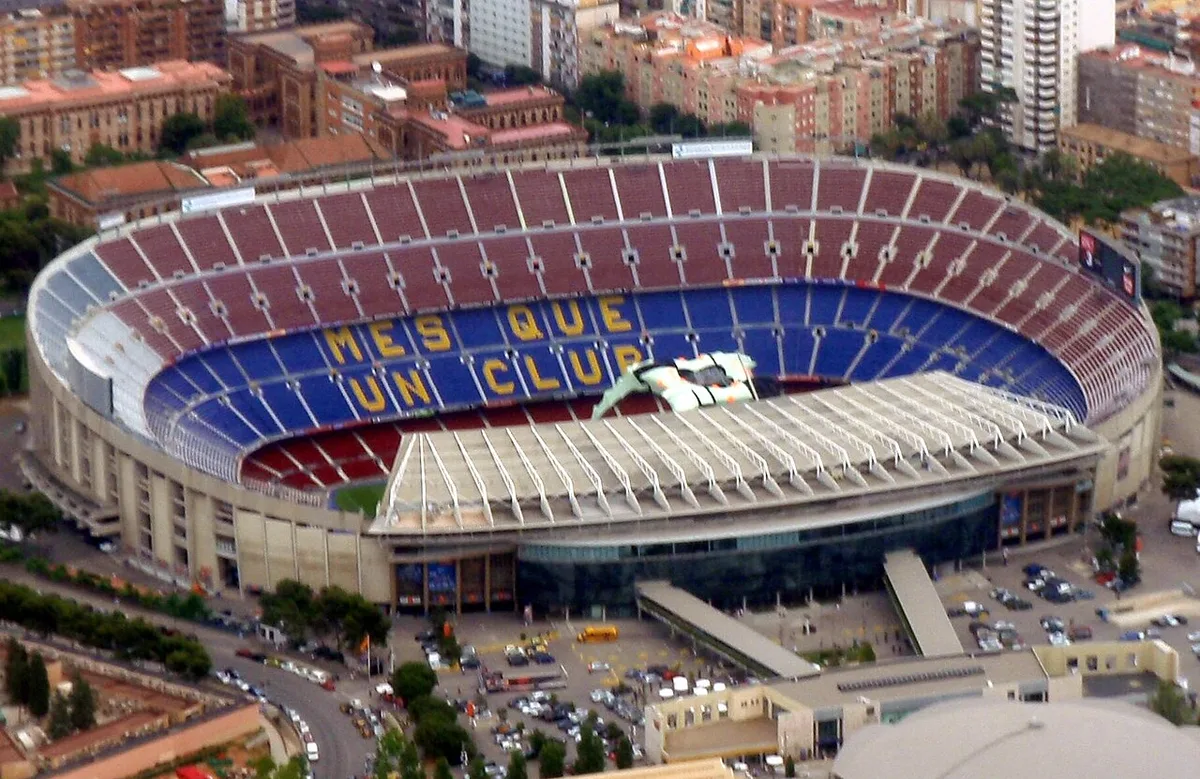
Wembley Stadium, branded as Wembley Stadium connected by EE for sponsorship reasons, is an association football stadium in Wembley, London, England. It opened in 2007 on the site of the original Wembley Stadium, which had stood from 1923 until 2000. The stadium is England's national football stadium, and thus hosts the majority of the England national team home matches and the FA Cup Final – the final of England's primary domestic club football competition. It is considered one of the most well known football stadiums in the world, and is considered a hub for the English game. Wembley Stadium is owned by the governing body of English football, the Football Association, whose headquarters are in the stadium, through its subsidiary Wembley National Stadium Ltd (WNSL). With 90,000 seats, it is the largest stadium in the UK and the second-largest stadium in Europe, behind Barcelona's Camp Nou.
Designed by Populous and Foster and Partners, the stadium is crowned by the 134-metre-high (440 ft) Wembley Arch which serves aesthetically as a landmark across London as well as structurally, with the arch supporting over 75% of the entire roof load. The stadium was built by Australian firm Multiplex at a cost of £798 million (£1.41 billion today). Two partially retractable roof structures over the east and west ends of the stadium can be opened to allow sunlight and aid pitch growth.
In addition to England home games and the FA Cup final, the stadium also hosts other major games in English football, including the season-opening FA Community Shield, the finals of lower tiered cup competition – the FA Trophy, the FA Vase, finals of the EFL Cup and EFL Trophy, the FA Cup semi-finals, and the promotion play-off finals of the tiers two, three, four, and five of the English football league system. The stadium also hosts the Women's FA Cup finals and an increasing number of home games of the England women's national football team.
A UEFA category four stadium, Wembley hosted the 2011, 2013 and the 2024 Champions League Finals, eight games at UEFA Euro 2020 (including the final and both of the semi-finals), and hosted the final of the UEFA Women's Euro 2022. The stadium hosted the gold-medal matches at the 2012 Olympic Games football tournament. The stadium also hosts the Rugby Football League's Challenge Cup, Women's Challenge Cup, and 1895 Cup finals, in addition to various music concerts. The stadium also hosts NFL London Games and was the temporary home of Premier League football club Tottenham Hotspur between August 2017 and March 2019, while White Hart Lane was being demolished and their new stadium was constructed. Wembley has also been chosen as one of the host stadia for UEFA Euro 2028.
In 2014, Wembley Stadium entered into a six-year sponsorship agreement with mobile provider EE, under which it provides technology and infrastructure services for the venue. Under the agreement, the facility is officially referred to as "Wembley Stadium connected by EE". The deal was renewed in 2019 and again in 2025 for a further four years, through to 2028.
Contents
Stadium
Wembley was designed by architects Foster + Partners and HOK Sport (now Populous) and with engineers Mott Stadium Consortium, who were a collection of three structural engineering consultants in the form of Mott MacDonald, Sinclair Knight Merz and Aurecon. The design of the building services was carried out by Mott MacDonald. The construction of the stadium was managed by Australian company Multiplex and funded by Sport England, WNSL (Wembley National Stadium Limited), the Football Association, the Department for Digital, Culture, Media and Sport and the London Development Agency. It is one of the most expensive stadia ever built at a cost of £798 million in 2007, and has the largest roof-covered seating capacity in the world. Nathaniel Lichfield and Partners was appointed to assist Wembley National Stadium Limited in preparing the scheme for a new stadium and to obtain planning and listed building permission for the development.
The all-seater stadium is a bowl design with a capacity of 90,000, protected from the elements by a sliding roof that does not completely enclose it. The stadium's signature feature is a circular section lattice arch of 7 m (23 ft) internal diameter with a 315 m (1,033 ft) span, erected some 22° off true, and rising to 133 m (436 ft). It supports all the weight of the north roof and 60% of the weight of the retractable roof on the southern side. The arch is the world's longest unsupported roof structure.
A platform system was designed in order to temporarily convert the stadium to athletics use, but its use would decrease the stadium's capacity to approximately 60,000. No athletics events (track and field) have taken place at the stadium; the conversion for athletics use was a condition of part of the lottery funding the stadium received, but to convert it would take weeks of work and cost millions of pounds. Instead, with the awarding of the 2012 Summer Olympic Games to London in 2005, the London Olympic Stadium has been used for major athletics events since 2012.
Construction
The initial plan for the reconstruction of Wembley Stadium was for demolition to begin before Christmas 2000, and for the new stadium to be completed some time during 2003, but this work was delayed by a succession of financial and legal difficulties. In 2004, London Mayor Ken Livingstone and Brent Council also announced wider plans for the regeneration of Wembley, taking in the arena and the surrounding areas as well as the stadium, to be implemented over two or three decades. Demolition officially began on 30 September 2002, with the Twin Towers being dismantled in December 2002.
Delays to the construction project started as far back as 2003. In December 2003, the constructors of the arch, subcontractors Cleveland Bridge & Engineering Company of Darlington, warned Multiplex about rising costs. Cleveland Bridge withdrew from the project and were replaced by Dutch firm Hollandia, with all the attendant problems of starting over. 2004 also saw errors, most notably a fatal accident involving carpenter Patrick O'Sullivan for which construction firm PC Harrington Contractors were fined £150,000 in relation to breaches of health and safety laws.
In October 2005, Sports Minister Richard Caborn announced: "They say the Cup Final will be there, barring six feet of snow or something like that". By November 2005, WNSL were still hopeful of a handover date of 31 March, in time for the cup final on 13 May. However, in December 2005, the builders admitted that there was a "material risk" that the stadium might not be ready in time for the final. In February 2006 these worries were confirmed, with the FA moving the game to Cardiff's Millennium Stadium.
On 20 March 2006, a steel rafter in the roof of the new development fell by 1+1⁄2 ft (46 cm), forcing 3,000 workers to evacuate the stadium and raising further doubts over the completion date which was already behind schedule. On 23 March 2006, sewers beneath the stadium buckled due to ground movement. GMB Union leader Steve Kelly said that the problem had been caused by the pipes not being properly laid, and that the repair would take months. A spokesman for developers Multiplex said that they did not believe this would "have any impact on the completion of the stadium", which was then scheduled to be completed on 31 March 2006.
On 30 March 2006, the developers announced that Wembley Stadium would not be ready until 2007. All competitions and concerts planned were to be moved to suitable locations. On 19 June 2006, it was announced that the turf had been laid. On 19 October 2006 it was announced that the venue was now set to open in early 2007 after the dispute between the Football Association and Multiplex had finally been settled. WNSL was expected to pay around £36m to Multiplex, on top of the amount of the original fixed-price contract. The total cost of the project (including local transport infrastructure redevelopment and the cost of financing) was estimated to be £1 billion.
Handover and opening
The new stadium was completed and handed over to the FA on 9 March 2007. The official Wembley Stadium website had announced that the stadium would be open for public viewing for local residents of Brent on 3 March 2007, however this was delayed by two weeks and instead happened on 17 March.
While the stadium had hosted football matches since the handover in March, the stadium was officially opened on Saturday 19 May, with the staging of the 2007 FA Cup Final. Eight days before that on Friday 11 May, the statue of Bobby Moore had been unveiled by his former England team-mate Sir Bobby Charlton outside the stadium entrance, as the "finishing touch" to the completion of the stadium. The twice life-size bronze statue, sculpted by Philip Jackson, depicts England's 1966 World Cup winning captain Bobby Moore, looking down Olympic Way.
Structure
The stadium contains 2,618 toilets, more than any other venue in the world.
The stadium has a circumference of 1 km (0.62 mi).
The bowl volume is listed at 1,139,100 m3 (1,489,900 yd3), somewhat smaller than the Millennium Stadium in Cardiff, but with a greater seating capacity.
At its peak, there were more than 3,500 construction workers on site.
4,000 separate piles form the foundations of the new stadium, the deepest of which is 35 m (115 ft).
There are 56 km (35 mi) of heavy-duty power cables in the stadium.
90,000 m3 (120,000 yd3) of concrete and 23,000 tonnes (25,000 short tons) of steel were used in the construction of the new stadium.
The total length of the escalators is 400 metres (1⁄4 mi).
The arch has a cross-sectional diameter greater than that of a cross-channel Eurostar train.
Pitch
The pitch size, as lined for association football, is 115 yd (105 m) long by 75 yd (69 m) wide, slightly narrower than the old Wembley, as required by the UEFA stadium categories for a category four stadium, the top category.
In a period after the completion of the new Wembley, the pitch came into disrepute. It was described as being "no good" and "not in the condition that Wembley used to be known for" by Slaven Bilić before a game between England and the team he managed, Croatia, in November 2007. The pitch was cut up during the game, which was blamed by some as the reason England did not qualify for UEFA Euro 2008. The Football Association admitted in April 2009, after the FA Cup semi-finals, that improvements were needed to the Wembley pitch, after criticism of the surface by coaches Alex Ferguson, Arsène Wenger and David Moyes.
In March 2010, the surface was relaid for the tenth time since opening. In April 2010, the pitch was again criticised following the FA Cup semi-finals, during which the players found it difficult to keep their footing and the surface cut up despite the dry conditions. The then Tottenham Hotspur boss, Harry Redknapp, labelled it a "disgrace" after his side's semi-final defeat to Portsmouth. After the 2010 FA Cup Final, Chelsea captain John Terry said: "The pitch ruined the final. It's probably the worst pitch we've played on all year. It was not good enough for a Wembley pitch." The stadium was then relaid with a Desso GrassMaster semi-artificial pitch, ahead of the 2010 community shield game between Chelsea and Manchester United. Michael Owen, who previously criticised the pitch for causing him injury, said that it was much improved.
In 2023, the stadium switched to a carpet lay and play system.
Wembley has been used for American football matches in the National Football League's International Series. Tottenham Hotspur hosted Manchester City in a Premier League match on 29 October 2018, a day after Wembley hosted the Philadelphia Eagles and Jacksonville Jaguars. Due to the short turnaround, faded gridiron markings and the NFL logo were clearly visible on the pitch along with worn grass along the centre of the pitch and the touch-lines. Tottenham were forced to hold the match at Wembley due to construction delays to their new ground. Despite the pitch's condition, UEFA allowed a Champions League leg to be played at Wembley on 6 November 2018 with Tottenham hosting Dutch side PSV Eindhoven.
Covering
The stadium roof has an area of 40,000 m2 (430,000 ft2), of which 13,722 m2 (147,700 ft2) is movable. The primary reason for the sliding roof was to avoid shading the pitch, as grass demands direct sunlight to grow effectively. The sliding roof design minimises the shadow by having the roof pulled back on the east, west and south. Angus Campbell, the chief architect, also said that an aim was for the pitch to be in sunlight during matches played between 3 pm and 5 pm from the beginning of May to the end of June, when the FA and World Cups would be played. However, it was mentioned during live commentary of the mid-May 2007 FA Cup Final that the pitch was in partial shade at the start at 3 pm and also during the match.
The stadium roof rises to 52 metres (171 ft) above the pitch and is supported by an arch rising 133 m (436 ft) above the level of the external concourse. With a span of 315 m (1,033 ft), the arch is the longest single-span roof structure in the world.
Safety and security
Safety and security at Wembley Stadium are managed in partnership with the Metropolitan Police, Brent Council and other agencies, with event day operations including extensive pre event planning and coordination. Measures introduced at the venue have included enhanced turnstiles, a new command and control room, additional CCTV coverage and strengthened perimeter doors and fencing, together with a Public Space Protection Order in the surrounding area that restricts street drinking, ticket touting and the use of pyrotechnics on event days. Stadium information and spectator guides describe the use of stewards and security staff, controlled entry points, bag checks and limits on prohibited items such as flares and smoke devices.
Following serious disorder at the UEFA Euro 2020 final between England and Italy, when numbers of ticketless supporters breached cordons and entered Wembley, an independent review led by Baroness Cassey described the day as "a source of national shame" and recommended stronger physical and operational safeguard. Brent Council subsequently approved plans to reinforce the security line around the stadium, including a higher perimeter fence and other measures intended to prevent similar incursions.
In May 2026, the FA Cup final at Wembley took place on the same day as a pro-Palestinian Nakba Day march and the "Unite the Kingdom" rally in central London. As part of a wider "significant public order policing operation," officers monitored CCTV feeds from the FA Cup final to identify supporters travelling towards the demonstrations. The Metropolitan Police reported 22 arrests at the FA Cup final itself, alongside 43 arrests connected to the two marches, and said four officers were assaulted and six were subjected to hate crime offences.
Litigation
The Australian firm Multiplex, which was the main contractor on Wembley Stadium, made significant losses on the project. In an attempt to recoup some of those losses, the firm initiated a number of legal cases against its sub-contractors and consultants. The largest of these – the largest construction claim in UK legal history – was a claim for £253 million against the structural engineering consultants Mott MacDonald.
In preliminary hearings the two architecture practices which worked for Multiplex on the project were ordered to allow Multiplex access to their records for them to build a case. The practices, Foster + Partners and Populous, estimated the costs of providing access and answering Multiplex's queries at £5 million. Mott MacDonald issued a counter-claim for unpaid fees of £250,000.
The dispute between Multiplex and Mott MacDonald was settled out of court in June 2010, ahead of a January 2011 trial. The terms of the settlement not disclosed, but it was reported that Multiplex "would not be out of pocket".
Multiplex also took the original steel contractor, Cleveland Bridge, to court claiming £38 million compensation for costs resulting from Cleveland Bridge withdrawing from the project. Cleveland Bridge, in turn, claimed up to £15 million from Multiplex. The case was resolved in September 2008 with Cleveland Bridge ordered to pay £6.1 million in damages and 20% of Multiplex's costs, after the court found against Cleveland Bridge. The judge criticised both sides for allowing the case to reach court, pointing out that total costs were £22 million, including £1 million for photocopying. Multiplex's ultimate bill is estimated to be over £10 million. In 2007, Multiplex also contested a claim from its concrete contractor, PC Harrington, that Multiplex owes £13.4 million to PC Harrington.
Bid to buy
In April 2018, Shahid Khan, the owner of Fulham and the Jacksonville Jaguars, put forward an offer to purchase Wembley Stadium from the FA. The deal included not only the purchase of the stadium, but also providing the FA full rights to keep control of the Club Wembley business. On 18 July 2018, a parliamentary select committee was held to discuss the possible sale, with evidence being given by former player, Gary Neville, and Katrina Law of the Football Supporters' Federation. The offer was withdrawn on 17 October 2018.
Sport
Given the ownership of the stadium by the Football Association (the governing body of English football), the England national football team is a major user of Wembley. In 2007, the League Cup final moved back to Wembley from Cardiff following the FA Cup final and FA Community Shield. Other showpiece football matches that were previously staged at Wembley, such as the Football League promotion play-offs and the Football League Trophy final, have returned to the stadium. In addition, the Conference National (now National League) play-off final is held at Wembley since 2007, and the FA Women's Cup final since 2015.
The new Wembley was a significant part of the plan for the 2012 Summer Olympics in London; the stadium was the site of several games in both the men's and women's football tournaments, with the finals being held there. The FA offices at Wembley Stadium, with social areas and boardroom, were designed by architects Gebler Tooth – who were also responsible for Team GB House at the London 2012 Olympics.
Additionally, the Rugby League Challenge Cup Final returned to Wembley Stadium in 2007, and the stadium also hosted both semi-finals of the 2013 Rugby League World Cup. Wembley was one of the 13 venues for the 2015 Rugby World Cup.
The Race of Champions staged their 2007 and 2008 events at the stadium.
Tottenham Hotspur agreed with the operators (Wembley National Stadium Ltd) to use the stadium for all of their European fixtures during the 2016–17 season, before using the stadium for the entire 2017–18 season. They also played most of their home games of the 2018–19 season at Wembley and continued until April 2019 when they moved to their new stadium.
Regular events
Wembley has a series of annual events that under normal circumstances are hosted at the stadium every year. These events cover the sports of football, rugby league and American football.
Football
The first match at the stadium was a game played behind closed doors between Multiplex and Wembley Stadium staff. The first game in front of spectators was between the Geoff Thomas Foundation Charity XI and the Wembley Sponsors Allstars on 17 March 2007. The Geoff Thomas Foundation Charity XI won 2–0 (scorers Mark Bright and Simon Jordan). The first official match involving professional players was England U21s vs Italy U21s on 24 March 2007, which finished 3–3. Official attendance was 56,700 (although all of the 60,000 tickets that were made available were sold in advance). The first player to score in a FIFA-sanctioned match was Italian striker Giampaolo Pazzini after 28 seconds of the same game; he also scored the first hat-trick at Wembley. The first English player to score in a full-scale match was David Bentley with a free kick in the same game.
The first club game, competitive game, and cup final held at the new Wembley took place on 12 May 2007 when Kidderminster Harriers met Stevenage Borough in the FA Trophy final. Kidderminster striker James Constable was the first player to score a goal in a final at the new Wembley. Kidderminster became the first team to play at both the old and new stadium. Stevenage Borough were the first team to win a final at the new Wembley beating Kidderminster 3–2, despite trailing 2–0 at half time. The first players to play at both the old and new Wembley Stadiums were Steve Guppy (for Stevenage Borough) and Jeff Kenna (for Kidderminster Harriers). Ex-England international Guppy is also the first player to win a final at both stadia (with Wycombe Wanderers and Leicester City in the old Wembley, then Stevenage Borough in the new one). Ronnie Henry is the first ever player to lift a competitive club trophy at the new Wembley.
The first penalty save and first red card came in the Conference National playoff final between Exeter City and Morecambe. The penalty was saved by Paul Jones of Exeter City from Morecambe striker Wayne Curtis. The red card was given to Matthew Gill of Exeter for a headbutt on Craig Stanley of Morecambe.
The first Football League teams to play at Wembley in a competitive fixture were Bristol Rovers and Shrewsbury Town in the 2007 Football League Two play-off final on 26 May 2007. Shrewsbury Town became the first league team to score at Wembley via a Stewart Drummond goal, they also the first league team to have a player sent off, in this case – Marc Tierney.
Rugby league
The rugby league Challenge Cup Final had been played annually at the old Wembley Stadium since 1929. In 2007, the cup final returned to its traditional home after the rebuilding of Wembley. When Catalans Dragons played St. Helens in the 2007 Challenge Cup final, they became the first non-English rugby league team to play in the final. The result saw St Helens retain the cup by a score of 30–8 before 84,241 fans. The first rugby league team to win a game at the new Wembley Stadium, were Normanton Freeston. The West Yorkshire secondary school beat Castleford High School in the Year 7 boys Carnegie Champion Schools final, which was played immediately prior to the 2007 Challenge Cup Final. The first official try at the renovated Wembley was scored by James Roby of St Helens, although Luke Metcalfe of Castleford High School scored the first try in the schools game that took place before the 2007 Challenge Cup final.
Castleford Academy (formerly Castleford High School) currently hold the record for the most rugby league appearances at the new Wembley Stadium. On 24 August 2013 their Year 7 Rugby team played RGS High Wycombe in the annual schools curtain-raiser to the Challenge Cup final. This was Castleford Academy's 4th appearance at the stadium since 2007. This puts them joint with Leeds and one appearance ahead of Warrington.
In 2015, a second statue was erected outside Wembley, depicting Rugby League legends Martin Offiah, Alex Murphy, Eric Ashton, Gus Risman and Billy Boston.
In 2011, international rugby league returned to Wembley for the first time since 1997 when Wales lost to New Zealand 0–36 and Australia beat host nation England 36–20 in the 2011 Rugby League Four Nations. The semi-finals of the 2013 Rugby League World Cup were played at Wembley Stadium where defending champions New Zealand beat England 20–18, and eventual tournament champions Australia defeated Fiji 64–0. The double header drew 67,575 fans to Wembley, the second highest crowd for an international rugby league game at either the original or the new stadium.
Rugby union
The first top level rugby union match was a non-cap match between the Barbarians and Australia on 3 December 2008.
Between 2009 and 2017, the stadium was used regularly by Saracens for some major Aviva Premiership and Heineken Cup matches. Their Aviva Premiership clash with Harlequins in 2012 was played before a crowd of 83,761, a world record for a rugby union club match. The same two teams set further records of 83,889 spectators in 2014, and 84,068 in 2015.
The stadium was used during the 2015 Rugby World Cup, during which it hosted two pool matches. The 89,019 crowd for the New Zealand versus Argentina game set a new record attendance for a Rugby World Cup game. The Ireland versus Romania match one week later improved this record again to 89,267. Although the 90,000 seat Wembley was the largest stadium used during the 2015 Rugby World Cup, the World Cup Final was held at the 82,000 seat Twickenham Stadium, the traditional home of the tournament's host, England's Rugby Football Union.
American football
Wembley has had a long association with American football. A United States Football League game was staged there in 1984, and between 1986 and 1993 the old Wembley Stadium hosted eight National Football League exhibition games featuring 13 different NFL teams. Between the opening of the new stadium in 2007 and 2019, Wembley hosted games during the NFL regular season. As a result of this, NFL commissioner Roger Goodell stated in October 2009 that "he expected the NFL will start playing multiple regular-season games in Britain in the next few years, an expansion that could lead to putting a franchise in London."
On 28 October 2007, in front of 81,176 fans, the New York Giants defeated the Miami Dolphins by a score of 13–10 in the first NFL regular season game ever to be played in Europe, and the first outside of North America. The first touchdown scored at Wembley was on a run by Giants' quarterback Eli Manning.
On 20 January 2012, the league announced that the St. Louis Rams would become a temporary tenant of Wembley, playing an annual game at the stadium every year from 2012 to 2014; part of the reason the Rams were chosen was that the team is owned by Stan Kroenke, who also is majority shareholder in a local Premier League team, Arsenal. However, the Rams later cancelled their 2013–2014 games, leading to the Jacksonville Jaguars becoming new temporary tenants and agreeing to host games in London from 2013 to 2016.
On 16 October 2012, the NFL announced there were to be two NFL regular season games played at Wembley during the 2013 season. The Pittsburgh Steelers at Minnesota Vikings on 29 September 2013, and the San Francisco 49ers at Jacksonville Jaguars on 27 October 2013. This is an attempt by the NFL to strengthen the NFL fanbase in London and internationally. Future plans to have a permanent NFL team in London have been suggested.
Another first was recorded in 2014 as three regular season NFL games were played at Wembley. The Oakland Raiders hosted the Miami Dolphins on 28 September at 6 pm BST, the Atlanta Falcons hosted the Detroit Lions on 26 October at 1:30 pm GMT and the Jacksonville Jaguars hosted the Dallas Cowboys on 9 November at 6 pm GMT. At 9:30 am ET, the Detroit-Atlanta game was the earliest kick off in NFL history and gave fans a unique four game window on this day. In 2015, another first occurred as the first ever divisional match took place at Wembley between the American Football Conference – Eastern Division's Miami Dolphins and New York Jets.
Boxing
On 31 May 2014, Wembley Stadium hosted its first boxing event, featuring the rematch between Carl Froch and George Groves for the WBA and IBF super-middleweight titles. The contest was held in front of a crowd of 80,000, a British post-war attendance record for a boxing event, surpassing the crowd at the City of Manchester Stadium when it hosted Ricky Hatton vs. Juan Lazcano in May 2008.
The WBA (Super) and IBF heavyweight championship fight, Anthony Joshua vs. Wladimir Klitschko, broke the attendance record on 29 April 2017, with an attendance of approximately 90,000.
In 2018, Joshua returned to Wembley and defeated Alexander Povetkin for the WBA (Super), IBF and WBO heavyweight titles in front of 80,000.
The WBC and The Ring heavyweight title fight, Tyson Fury vs. Dillian Whyte, took place on 23 April 2022 in a sold-out Wembley Stadium with 94,000. Fury emerged victorious with a 6th-round TKO.
The stadium hosted Anthony Joshua vs Daniel Dubois on 21 September 2024 as part of the Riyadh Season with Dubois emerging victorious by knockout in front of 85,644.
Oleksandr Usyk vs. Daniel Dubois heavyweight boxing rematch for the Undisputed Championship was held on 19 July 2025 at the stadium. Usyk emerged victorious by knockout in front of 90,000.
Professional wrestling
On 5 April 2023, Tony Khan, president of American professional wrestling promotion All Elite Wrestling (AEW), announced that they would stage an event at the stadium on 27 August 2023, promoted as "All In London at Wembley Stadium". It would be the promotion's debut in the United Kingdom, as well as their first event held outside of North America, and the first professional wrestling event overall to be held at the modern Wembley Stadium; WWE's SummerSlam was held at the original Wembley in 1992. Wembley hosted All In on 25 August 2024, where Bryan Danielson won the AEW World Championship in the main event. AEW returned to Wembley for All In on 30 August 2026.
Music
Besides football, Wembley can be configured to hold other events, particularly major concerts. This was designed at the outset in order to provide funding for the construction of the new stadium.
The first concert at the new stadium was given by George Michael on 9 June 2007. Bon Jovi, the last act to perform at the original Wembley, were scheduled to be the first artists to perform at the new Wembley but the late completion of the stadium saw the concerts relocated to the National Bowl and the KC Stadium. Muse became the first band to sell out the new stadium on 16 and 17 June 2007, and released a live DVD of the performance. Other acts to have performed at the stadium are The Stone Roses, Beyoncé, Adele, Rihanna, Ed Sheeran, The Weeknd, Mötley Crüe, Metallica, U2, The Killers, Linkin Park, Green Day, the Foo Fighters, Eminem, Madonna, Taylor Swift, Jeff Lynne's ELO, the Spice Girls, Harry Styles, Oasis, Take That, BTS, One Direction, AC/DC and Guns N' Roses. Wembley hosted Take That Present: The Circus Live for four nights in summer 2009.
In the first week of July 2007, two large charity concerts were held at the new Wembley Stadium, the Concert for Diana, a memorial concert to commemorate ten years since the death of Diana, Princess of Wales and celebrating what would have been her 46th birthday, and Live Earth, a concert hosted at Wembley as part of the Live Earth Foundation, committed to combatting climate change.
Rock band Foo Fighters performed at the stadium in two sold-out shows in June 2008 and were captured on the DVD Live at Wembley Stadium. U2 continued their 360° tour at Wembley on 14 and 15 August 2009 in front of 164,244 fans.
95.8 Capital FM's Summertime Ball, which was previously hosted with 55,000 spectators at the Arsenal Emirates Stadium and slightly fewer in Hyde Park (as Party in the Park), was hosted at Wembley Stadium on 6 June 2010, and was headlined by Rihanna and Usher. The move to Wembley allowed many more fans to watch the annual music event which has previously lasted over 5 hours with more than 15 performers. It has since returned to the Stadium every year since, usually in early June. Rock band Green Day continued their world tour, playing at Wembley on 19 June 2010. The gig was Green Day's biggest audience yet with over 90,000.
Transport connections
The stadium is described as a "public transport destination" for which parking is available on a very limited basis. To alleviate the impact of vehicular traffic on the local residents and businesses, Brent Council have introduced a number of measures in relation to on street parking and to access restrictions of roads that surround the stadium. The "Wembley Stadium Protective Parking Scheme" sets a boundary in which parking on street is restricted to only those that hold an event day parking permit. Road closures are in force from 10:00 am on the event day until midnight and apply to Fulton Road, Engineers Way and South Way.
Rail and Underground
The stadium is connected to two London Underground stations: Wembley Park Station (on the Metropolitan and Jubilee lines) via Olympic Way, and Wembley Central (Bakerloo line) via the White Horse Bridge. Rail links are provided at Wembley Central (London Overground, Southern and London Northwestern Railway services) and Wembley Stadium railway station (Chiltern Railways services).
Stations near by:
Onsite parking
The onsite parking facility is shared with Wembley Arena, essentially being the open air surface parking surrounding the eastern flank of Wembley Stadium and the multi-storey car park. These are called Green Car Park and Red Car Park, respectively. There is disabled parking available onsite, at the Green Car Park, at a reduced rate but on a first come first served basis. On some football event dates, opposing team supporters have been separated into the two different car parks.
Bus
London bus routes near by: