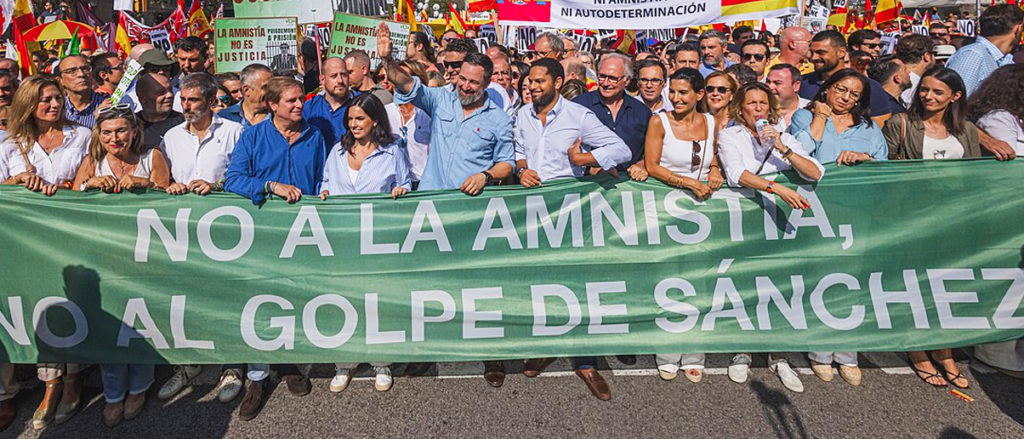
‘Accelerate The Invasion’: Spain’s Socialist Government Expedites Mass Amnesty For Illegals
Spain’s socialist government announced Tuesday it will provide amnesty to potentially hundreds of thousands of immigrants living in the country without authorization. Spain’s Council of Ministers announced that it will…
Spain’s socialist government announced Tuesday it will provide amnesty to potentially hundreds of thousands of immigrants living in the country without authorization.
Spain’s Council of Ministers announced that it will use an expedited decree to amend existing 🛂Immigration laws, providing illegal migrants with one-year residency permits and the right to work legally. Estimates suggest the measure could benefit roughly 500,000 people, though some studies place the number closer to 800,000, according to the AP.
Spain “will not look the other way,” Spanish Minister of Migration Elma Saiz told reporters during a press conference, adding that the government is “dignifying and recognizing people who are already in our country,” the outlet reported.
Prime Minister Pedro Sánchez of the Socialist Workers’ Party has touted the economic benefits of 🛂Immigration
Sponsored
Sponsored
‘Accelerate The Invasion’: Spain’s Socialist Government Expedites Mass Amnesty For Illegals — IJR
while downplaying concerns about its impact on public services and social cohesion.
“I’ll say it clearly. No one is expendable in Spain. On the contrary, we lack people,” Sánchez said in January, according to Bloomberg. “Faced with the choice between being a closed and poor nation, Spain is opening itself to the world to ensure prosperity.”
Many immigrants to Spain come from Latin America and Africa and are concentrated in sectors such as agriculture and tourism. Since the COVID-19 pandemic, the number of foreign workers registered with the social security system — a measure of formal employment — has risen 45%, accounting for 14% of the total workforce, according to Bloomberg.
The expedited decree circumvents a stalled 🛂Immigration bill in parliament, and comes after a last-minute agreement between Sánchez’s Socialist Party and the left-wing Podemos party, the AP reports.
Alberto Núñez Feijóo, leader of the conservative Popular Party, accused Sánchez on social media of using the 🛂Immigration decree to divert attention from a Jan. 18 high-speed train crash that killed 46 people.
“Up to 46 dead. Hundreds injured. Not a single resignation,” Feijóo wrote on X. “Sánchez’s first response is a massive regularization to divert attention, boost the pull effect, and overwhelm our public services.”
“In socialist Spain, illegality is rewarded,” he added. “Sánchez’s migration policy is as absurd as his railway policy.”
Vox party leader Santiago Abascal denounced the measure as an “accelerated invasion.”
“The tyrant Sánchez hates the Spanish people. He wants to replace them. That’s why he intends to promote the pull effect by decree, to accelerate the invasion,” Abascal wrote on X. “We must stop him. Repatriations, deportations, and remigration.”
Meanwhile, Irene Montero, a Podemos lawmaker in the European Parliament, explicitly cast the move as a rebuttal to U.S. immigration policies under President Donald Trump.
“In the United States at the moment there are millions of people who are afraid in their own homes because Trump’s migration policy enters people’s homes and takes them away,” Montero said, according to the AP. “If they kidnap children, murder and terrorize people, we give them papers.”
The move by Spain’s socialist government contrasts with some other European nations that have moved to tighten refugee entry requirements and expel illegal migrants.
The Trump administration’s National Defense Strategy (NDS), released in December, warned that Europe is at risk of “civilizational erasure” due to policies that “undermine political liberty and sovereignty, migration policies that are transforming the continent and creating strife, censorship of free speech and suppression of political opposition, cratering birthrates, and loss of national identities and self-confidence.”
“Over the long term, it is more than plausible that within a few decades at the latest, certain NATO members will become majority non-European,” the NDS reads. “We want Europe to remain European.”
All content created by the 🏢Daily Caller News Foundation, an independent and nonpartisan newswire service, is available without charge to any legitimate news publisher that can provide a large audience. All republished articles must include our logo, our reporter’s byline and their DCNF affiliation. For any questions about our guidelines or partnering with us, please contact [email protected].