


Daily Caller News Foundation

Amazon’s new ā€œVulcanā€ warehouse robot — capable of picking, stowing and rearranging three-quarters of the items Amazon stocks — could put a vast swath of America’s blue collar workforce in the crosshairs.

Vulcan, already operating in Spokane, Washington, and Hamburg, Germany, uses a sense-of-touch system to navigate shelves that once required the human mind and hand, reaching bins eight feet high or inches from the floor — all while learning from its missteps. Amazon plans to roll out the machines across the U.S. and Europe within ā€œthe next couple of years.ā€

ā€œFitting an item into or plucking one out of this crowded space has historically been challenging for robots that lack the natural dexterity of humans,ā€ the company wrote in a press release. ā€œVulcan is our first robot with a similar kind of finesse. Vulcan can easily manipulate objects within those compartments to make room for whatever it’s stowing, because it knows when it makes contact and how much force it’s applying and can stop short of doing any damage.ā€

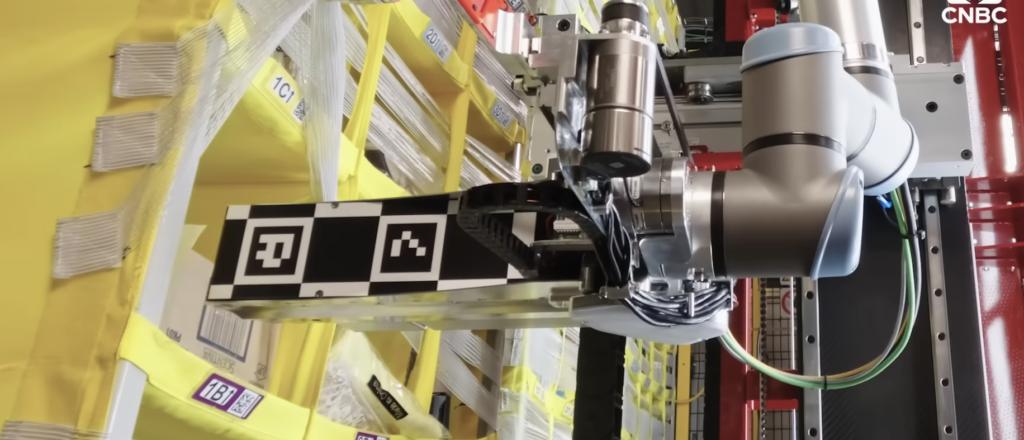
An articulated arm tipped with a spatula-like ā€œpaddleā€ slides into crowded cubbies, guided by force-feedback sensors that measure pressure in real time, while a second arm’s suction cup and AI vision system pluck single items without grabbing extra merchandise. The robot can detect when it can’t grasp an object and flags a nearby coworker; otherwise it rearranges existing inventory, ā€œzhoopsā€ new goods into place via miniature conveyor belts, and logs each move for a machine learning review.

The hardware is backed by physical-environment AI software trained on thousands of real-world touch scenarios — from toothpaste tubes to fragile electronics — so Vulcan steadily refines its grip and speed. Amazon says it already relies on more than 750,000 mobile bots to ferry shelves around its network; adding dexterous handling machines closes one of the last gaps between human and robotic labor on the warehouse floor.

Amazon said in September it employed over 800,000 U.S. workers on its ā€œfront-line team,ā€ and the company claimed Vulcan could process orders at human-comparable speeds for 75% of stock, leaving only odd-shaped items for people. But one such front-liner insisted the bot ā€œwork alongsideā€ employees, sparing them ladder climbs and repetitive bending.

ā€œWorking alongside Vulcan, we can pick and stow with greater ease,ā€ Kari Freitas Hardy, an employee at the Spokane warehouse, said in the press release. ā€œIt’s great to see how many of my coworkers have gained new job skills and taken on more technical roles, like I did, once they started working closer with the Technology at our sites.ā€

Advertisement

Economists have long painted Amazon’s distribution network as a bellwether for broader labor disruption. Amazon counters that robots create ā€œhundreds of new categories of jobs.ā€ An Amazon spokesman told the Daily Caller News Foundation that ā€œsince introducing robots within Amazon’s operations, we’ve continued to hire hundreds of thousands of employees to work in our facilities and created many new job categories worldwide,ā€ stressing that Vulcan is meant for ā€œaugmenting — not replacing — human capabilities.ā€

The company pointed to a mechatronics and robotics apprenticeship that it says boosts graduates’ pay ā€œabout 40%ā€ and claimed its heavily automated Shreveport, Louisiana, fulfillment center, which has ā€œ10x more automation,ā€ will still require ā€œ30% more skilled laborā€ and eventually employ 2,500 people. CEO Andy Jassy credited the device with ā€œcreating opportunities for our teammates to grow their skills in robotics maintenanceā€ in a Wednesday post.


A 2024 Senate investigation, using internal Amazon logs, emphasizes the pressure on human workers: injury rates rise during peak seasons when workers trudge through 10-hour shifts; machines that heave merchandise into high and low-level shelving slots could trim those risks — while simultaneously trimming payroll.

But Parness concedes full automation is still out of reach.

ā€œI don’t believe in 100% automation,ā€ he told CNBC, adding that Vulcan alerts humans whenever it encounters an unfamiliar product.

All content created by the Daily Caller News Foundation, an independent and nonpartisan newswire service, is available without charge to any legitimate news publisher that can provide a large audience. All republished articles must include our logo, our reporter’s byline and their DCNF affiliation. For any questions about our guidelines or partnering with us, please contactĀ [email protected].