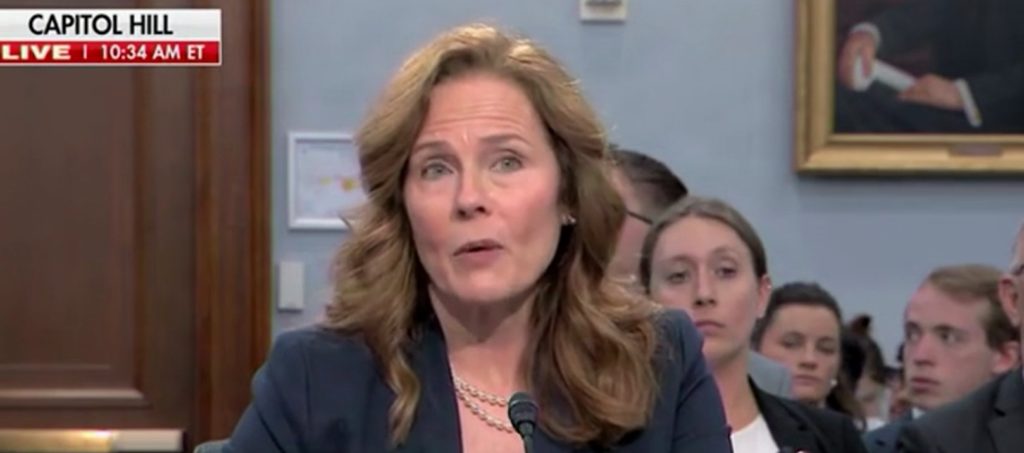
Justice Amy Coney Barrett sat in July before a House subcommittee, alongside Justice Elena Kagan, making the case to prioritize funding to protect the justices and their families.
Justice Amy Coney Barrett sat in July before a House subcommittee, alongside Justice Elena Kagan, making the case to prioritize funding to protect the justices and their families.
She described a recent swatting call at her home — someone phoning in a fake report of gunfire, one of her teenage sons opening the door to find the street filled with squad cars — and of also having to explain to her then-12-year-old son why she needed a bulletproof vest.
“I didn’t expect that performing this service was going to put me in the position of explaining to my children what a bulletproof vest was and why I had to wear one,” she said.
Kagan, who has no children, sat beside her making the same case about rising threats to the judiciary. You don’t need to be a parent to see that danger.
But it’s Barrett, a Catholic mother of seven, who’s also sitting closest to a different, quieter question the Court has been answering: how parents protect their children when the threats they face come not only from violence, but from government policies that intrude on family life. It clearly helps to have a parent part of making that call.
Start with Mahmoud v. Taylor last year, which Barrett joined. Montgomery County, Maryland parents wanted an opt-out from LGBTQ-themed storybooks in their kids’ classrooms, and they got it. Justice Alito’s opinion grounded the win in the right to direct your child’s religious upbringing. Limited, but real: the win belonged to families whose objection was specifically religious.
out of California, where parents challenged the state’s policy to keep hidden students’ “gender transitions” at school. That case could have been a carbon copy of
Mahmoud
. Instead, the Court, with Barrett concurring, also found that California’s policy violated something in addition to Free Exercise: the basic due-process right every parent has to be involved in decisions about their own kid.
An agnostic parent could bring that claim as easily as a devout one. The theory stepped outside the church door.
And now a third case pushes further still. This coming term the Supreme Court will hear St. Mary Catholic Parish v. Roy, out of Colorado. This one might be the most relatable yet.
Colorado rolled out a “universal” preschool program, a tuition subsidy for basically every family in the state wanting to enroll their child in preschool. Except if you want to send your child to a Catholic preschool that still teaches Catholic doctrine on marriage and gender, you’re out. Any preschool taking the money must admit every child on identical terms, no exceptions for a school’s religious convictions.
So a parish like St. Mary’s in Littleton either abandons what it believes or forfeits the same benefit every secular preschool down the road keeps. Families are already feeling it. Archdiocese enrollment has dropped, and a couple of schools have closed outright.
Notice the pattern. Mahmoud was about what your kid reads in class. Mirabelli was about what your kid’s teacher is allowed to tell you. St. Mary is about whether your family gets locked out of a benefit everyone else qualifies for, purely because your school takes its faith seriously.
Each dispute asks whether parents remain free to protect and form their children according to their own convictions or whether the state gets the final word. And each of these cases includes religious families stepping up first to test the ground, clearing the path every other parent eventually gets to walk down too.
Storybooks. Confidential school policies. Preschool tuition. These may seem like separate controversies, but they all ask who bears the first responsibility for safeguarding children.
Again and again, it has been religious parents willing to take on the criticism and financial costs of defending their ability to protect and guide the children entrusted to them. In doing so, they have secured protections that extend well beyond the faithful to every American family.
Perhaps that’s why Justice Barrett’s testimony lingers. Her story wasn’t simply about the dangers of public service. It was about a Catholic mother trying to shield her children while carrying out her responsibilities to the country.
The instinct that leads a parent to protect a child from physical danger is the same instinct that leads parents to defend their children’s education, moral formation, and religious upbringing.
The Constitution doesn’t depend on judges being religious or being parents, but it surely benefits from judges who understand, not just in theory but in life, why the law has long recognized parents as their children’s primary protectors.
As the Court continues to hear cases testing the limits of government authority over family life, religious Americans remain at the forefront not by seeking special treatment, but by preserving a principle as old as the Republic: that parents bear the first responsibility for protecting their children — a principle that ultimately safeguards families of every faith and of none.
Andrea Picciotti-Bayer is director of the Conscience Project.
The views and opinions expressed in this commentary are those of the author and do not reflect the official position of the Daily Caller News Foundation.
All content created by the Daily Caller News Foundation, an independent and nonpartisan newswire service, is available without charge to any legitimate news publisher that can provide a large audience. All republished articles must include our logo, our reporter’s byline and their DCNF affiliation. For any questions about our guidelines or partnering with us, please contact [email protected].