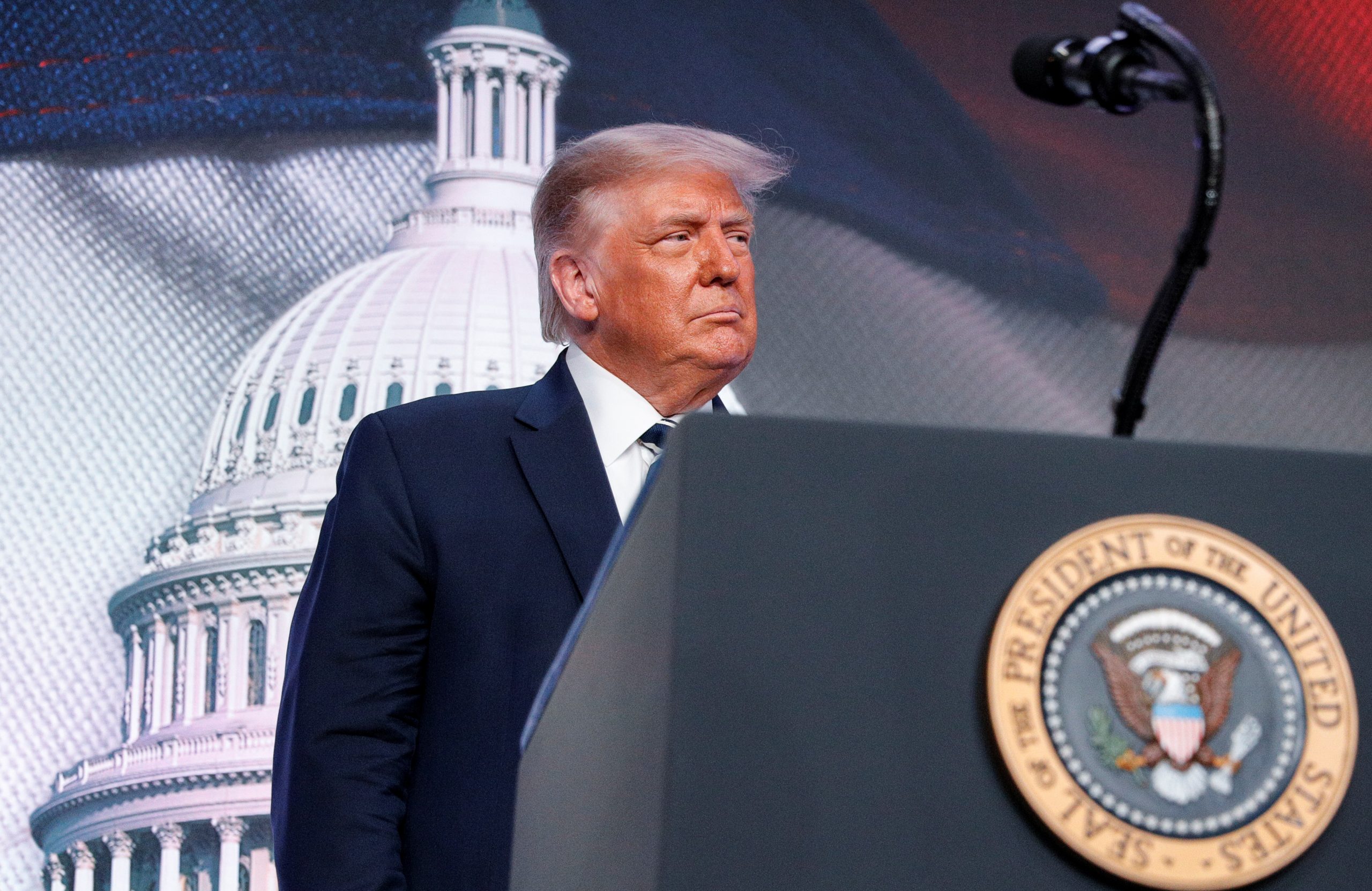



After being accused by Democrats of being a chaotic and dishonest leader, President Donald Trump countered on Friday that Democrats, not he, would bring chaos to the United States if Joe Biden wins the White House in November.
âIf our opponents prevail no one will be safe in our country,â Trump told conservative activists in his first speech since the Democratic National Convention ended late on Thursday.
âIâm the only thing standing between the American dream and total anarchy, madness and chaos,â Trump said.
In a preview of what Republicans will argue at their own convention next week, Trump hammered at the law-and-order theme he has embraced in response to anti-racism and police brutality protests in U.S. cities including Portland, Oregon.
He said police had been weakened in âDemocrat-runâ cities and cited a spike in murders in Chicago, Minneapolis, New York and Philadelphia. He urged Americans to turn back âradical left socialists and Marxists.â
He called protesters in Portland âcrazy.â
âSo the future of our country and indeed our civilization is at stake on Nov. 3,â he said in the speech in Arlington, Virginia, to the 2020 Council for National Policy.
Biden and his running mate, U.S. Senator Kamala Harris, accepted their partyâs nomination at the four-day Democratic convention, where speaker after speaker characterized Trumpâs four years in office as chaotic.
The convention, held virtually because of the coronavirus pandemic, showcased scathing criticism of Trumpâs character and his handling of the health crisis, in which more than 170,000 people in the United States have died.
Democrats sought to present a diverse, united front with the integrity and faith they said Trump lacks.
Biden opened his acceptance speech on Thursday night by saying, âThe current president has cloaked America in darkness for much too long. Too much anger. Too much fear. Too much division.â
In his speech on Friday, Trump called it âthe darkest and angriest and gloomiest convention in American history.â
He also suggested, without providing an explanation or evidence, that the Democratic speaker of the House of Representatives could become president if the results of the Nov. 3 election were not clear by the end of the year.
âI donât think youâll know two weeks later. I donât think youâll know four weeks later,â he said. âThereâs a theory that if you donât have it by the end of the year, crazy Nancy Pelosi would become president,â he said.
Trump has sought to cast early doubt on the integrity of the election, and bringing up Pelosi, who is deeply unpopular with many Republicans, appeared aimed at motivating his base to vote.
ECONOMY AND LAW & ORDER
Vice President Mike Pence, who gave a round of television interviews on Friday morning, outlined what he said would be the thrust of their four-day convention starting on Monday, appropriating a line from Bidenâs speech that character, decency, science and democracy âare all on the ballot.â
âThe economy is on the ballot. Law and order is on the ballot, and the American people know it,â Pence said.
Pence deflected criticism over the coronavirus response.
âWe lost 22 million jobs in the course of this coronavirus pandemic. But because of the solid foundation that President Trump poured of less taxes, less regulation, more American energy, more free and fair trade, weâve seen 9 million Americans already go back to work,â Pence told CBS âThis Morning.â
Bidenâs vice presidential selection of Harris confirmed that the Democratic Party had been taken over by âthe radical left,â Pence told Fox Business Network, describing her as a âCalifornia liberal.â
Bidenâs long tenure in politics, as a U.S. senator and two terms as President Barack Obamaâs vice president, will count against him, Pence said.
âJoe Biden has been in Washington for 47 years and the speech he gave last night was just more of the same talk that weâve heard from him and other liberal Democrat politicians for the decades,â he said.
Trump echoed the critique in a campaign video on Twitter, saying: âAfter 47 years of failure, weâve had more than enough.â
(Reporting by Doina Chiacu, Jeff Mason and Susan Heavey; Editing by Howard Goller and Sonya Hepinstall)