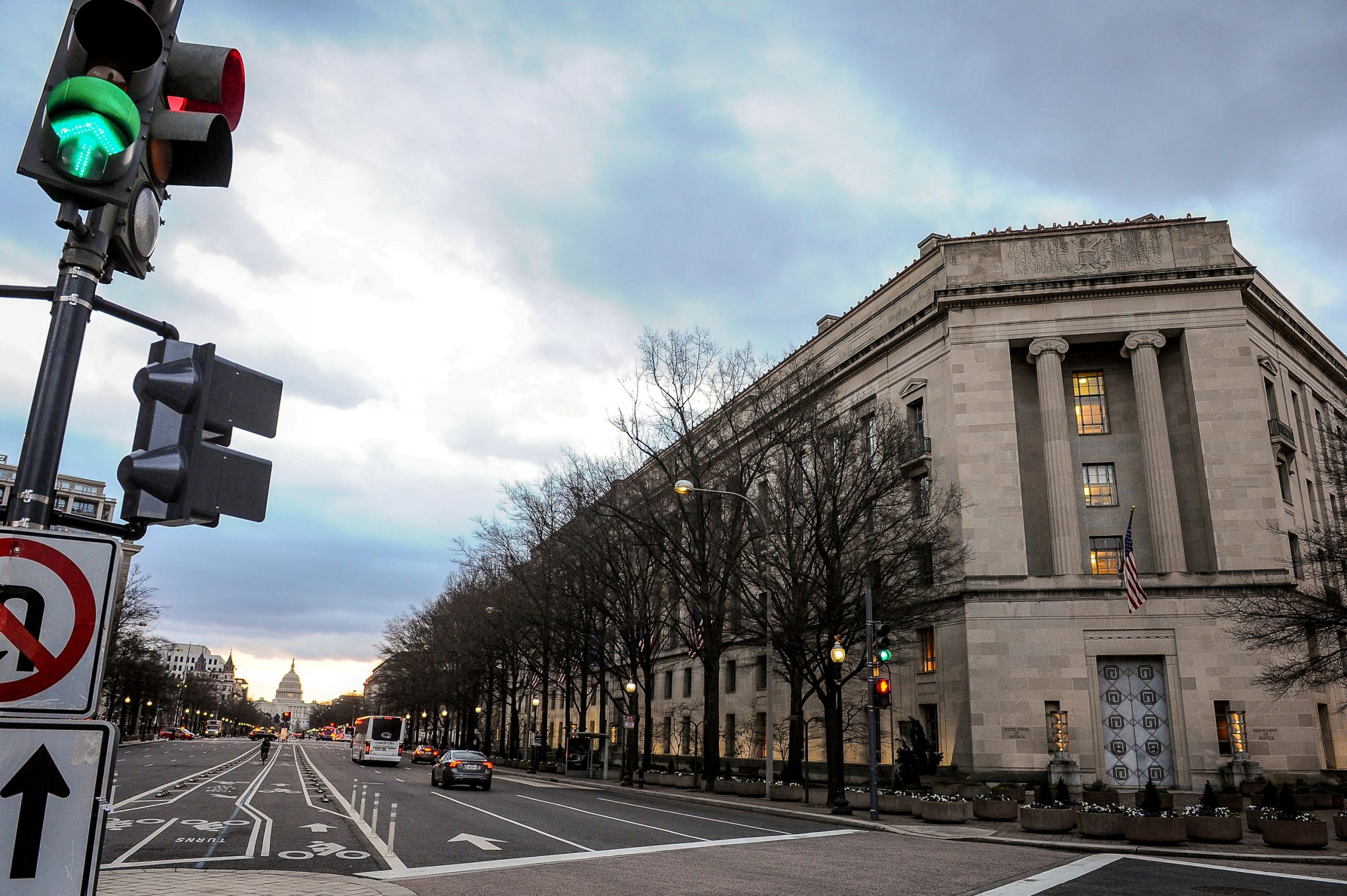
Biden DOJ Clamps Down on Federal Law Enforcement Officers, Largely Bans Use of Certain Police Techniques
The U.S. Department of Justice announced that federal officers will in most cases be banned from using chokeholds and making unannounced entries when serving warrants. Barring situations where the use of deadly force is…
The U.S. ⚖️Department of Justice announced that federal officers will in most cases be banned from using chokeholds and making unannounced entries when serving warrants.
Barring situations where the use of deadly force is authorized, historic methods used by law endorsement officers to corral unruly subjects or to surprise potentially dangerous criminals through so-called “no-knock” warrants are banned effective immediately.
The department said in a news release Tuesday that the changes were adopted following an internal review.
“The ⚖️Department of Justice today announced written department-wide policies explicitly prohibiting the use of ‘chokeholds’ and ‘carotid restraints’ unless deadly force is authorized, and limiting the circumstances in which the department’s federal law enforcement components are authorized to use unannounced entries,” the news release said.
The changes, along with a newly implemented department-wide body camera policy, came following a review by Deputy Attorney General Lisa O. Monaco.
Attorney General
Sponsored
Sponsored
Biden DOJ Clamps Down on Federal Law Enforcement Officers, Largely Bans Use of Certain Police Techniques — IJR
praised the new policy for federal officers working under the DOJ in a statement issued with the department news release.
“Building trust and confidence between law enforcement and the public we serve is central to our mission at the Justice Department,” Garland said. “The limitations implemented today on the use of ‘chokeholds,’ ‘carotid restraints’ and ‘no-knock’ warrants, combined with our recent expansion of body-worn cameras to DOJ’s federal agents, are among the important steps the department is taking to improve law enforcement safety and accountability.”
Monaco said she recommended all federal law enforcement agencies adopt universal standards intended to build “trust” with communities.
“As members of federal law enforcement, we have a shared obligation to lead by example in a way that engenders the trust and confidence of the communities we serve,” Monaco said.
“It is essential that law enforcement across the ⚖️Department of Justice adhere to a single set of standards when it comes to ‘chokeholds,’ ‘carotid restraints’ and ‘no-knock’ entries. This new policy does just that and limits the circumstances in which these techniques can be used.”
The new policy states that chokeholds are permitted “when the officer has a reasonable belief that the subject of such force poses an imminent danger of death or serious physical injury to the officer or to another person.”
With regard to “no-knock” warrants, the policy states: “Federal agents are generally required to ‘knock and announce’ their identity, authority and purpose, and demand to enter before entry is made to execute a warrant in a private dwelling.”
An exception to the new rule notes that “there are some circumstances where unannounced entries are authorized.”
“The new policy generally limits the use of ‘no knock’ entries in connection with the execution of a warrant to situations where an agent has reasonable grounds to believe that knocking and announcing the agent’s presence would create an imminent threat of physical violence to the agent and/or another person,” the DOJ announced.
Local 🚓Police departments that work alongside federal agents will also be subject to the new restrictions.
The DOJ did not offer any specific examples where either a chokehold or a so-called “no-knock” warrant have gone wrong.
However, two high-profile cases last year caused nationwide protests and led to rioting.
George Floyd in Minneapolis was said to have died after being deprived of air following an incident with 🚓Police. A later review concluded Floyd had at least one drug in his system — fentanyl — which is a respiratory depressant.
Another case was that of Breonna Taylor in Louisville, Kentucky. Taylor was killed by 🚓Police, who were serving a warrant against her boyfriend, after a gunfight ensued.
It was widely reported that the incident began when 🚓Police served a no-knock warrant, but Taylor’s then-boyfriend, Kenneth Walker, later confirmed that 🚓Police officers did knock on the door before entering the apartment shared by the couple, Business Insider reported.