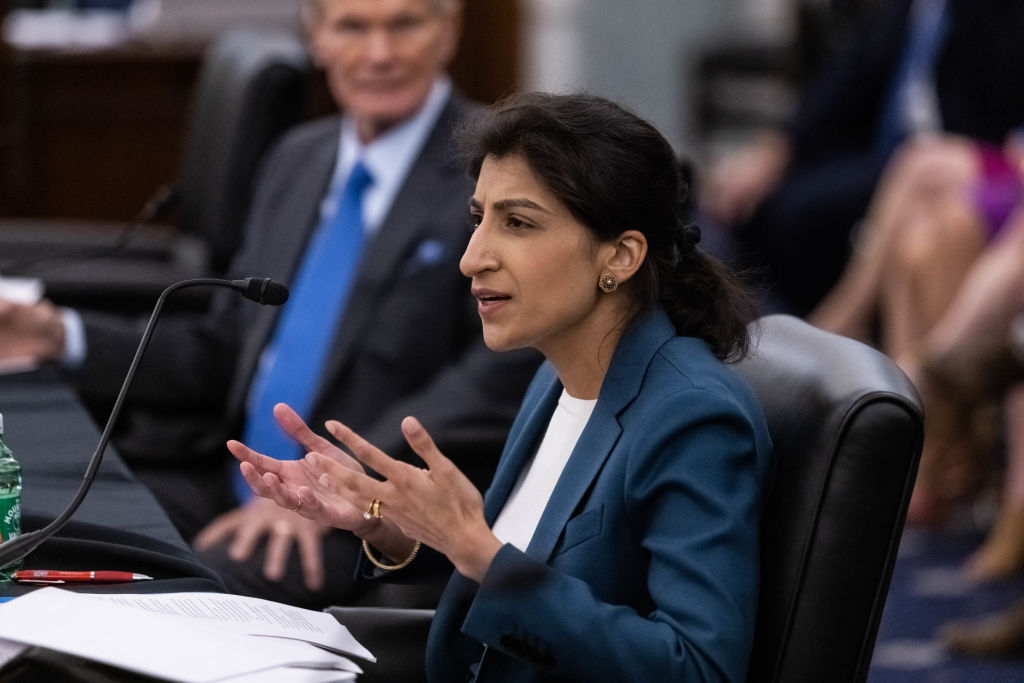



Federal Trade Commission (FTC) Chair Lina Khan has suffered several setbacks this year in her efforts to block acquisitions by Big Tech firms, The Wall Street Journal reported Wednesday.
A federal judge on Tuesday ruled against the FTC to permit Microsoftās record-breaking $69 billion acquisition of video gaming titan Activision Blizzard, just months after a judge similarly struck down an FTC effort to block Facebook-parent Metaās acquisition of a virtual reality startup, the WSJ reported.Ā Khan publicly criticized Big Tech firms and advocated for stricter antitrust enforcement against them prior to her ascension to FTC chair under President Joe Biden, and she has faced years of GOP allegations of partisan bias.
Khan has indicated a willingness to bring difficult, losable cases to court in order to force them to clearly delineate their stance on what counts as anticompetitive, the WSJ reported.
āIām certainly not somebody who thinks that success is marked by a 100% court record,ā Khan said at a May 2022 eventat the University of Chicago. āIf you just never bring those hard cases, I think there is severe cost to that that can lead to stagnation and stasis.ā
U.S. District Judge Jaqueline Scott Corely, who wrote the recent court ruling blessing the merger between Microsoft and Activision, questioned the vigor with which Khanās FTC has pursued the case, according to the WSJ.
āThis is for a shooter videogame,ā the judge said, referencing Activisionās blockbuster Call of Duty franchise and noting that Microsoft had already made a commitment to sell the franchise to competitors, according to the WSJ.
The Microsoft-Activision merger is considered by many antitrust attorneys to be an example of a vertical merger ā which involves companies in different stages of a supply chain for a product ā something courts typically consider to be beneficial for consumers, the WSJ reported.
Khan and her counterpart at the Department of Justice (DOJ) have used novel legal arguments to challenge these sorts of mergers, and their poor track record could lead companies to start ignoring the threat of an antitrust challenge, the WSJ reported. The FTC used one such argument in its unsuccessful bid this past winter to block Metaās acquisition of a VR startup, in which it challenged the deal on the grounds that it may harm future competition.
āItās a very difficult and slow process to get judges to look at some of these novel theories,ā Jennifer Rie, a senior litigation analyst at Bloomberg Intelligence, told the WSJ. Khanās FTC āneeds to pick better battles, battles where they have better evidence backing up their allegations.ā
The FTC and DOJ challenged 10 mergers last year, an increase from six the year prior and eight in 2020, the WSJ reported. The agencies have challenged four such deals to date this year.
The FTC did not immediately respond to a Daily Caller News Foundationās request for comment.
All content created by the Daily Caller News Foundation, an independent and nonpartisan newswire service, is available without charge to any legitimate news publisher that can provide a large audience. All republished articles must include our logo, our reporterās byline and their DCNF affiliation. For any questions about our guidelines or partnering with us, please contactĀ [email protected].