Commentary: Biden Steals McCain’s Quote About Following bin Laden To Gates of Hell
For everyone who vaguely remembers the 1988 presidential election but not enough to recall why a candidate as poxed and unelectable as then-Massachusetts Gov. Michael Dukakis got the Democratic Party’s nomination, you…
For everyone who vaguely remembers the 1988 presidential election but not enough to recall why a candidate as poxed and unelectable as then-Massachusetts Gov. Michael Dukakis got the Democratic Party’s nomination, you can thank Neil Kinnock, at least in part.
Kinnock was another thoroughly unelectable politician who could never hope to lead his country, only over in the United Kingdom. The spectacularly uninspiring leader of the Labour Party from 1983 to 1992, Kinnock is best remembered in the U.K. for two consecutive general election losses, including a shocking defeat in 1992 to John Major’s Tories.
On this side of the pond, he’s best remembered for a rousing speech he gave in May 1987 — although not for the reasons he might like.
“Why am I the first Kinnock in a thousand generations to be able to get to university?” he said, according to Sky News. “Why is Glenys the first woman in her family in a thousand generations to be able to get to university? Was it because all our predecessors were thick?”
Later in 1987, a young 44-year-old senator from Delaware who was seen as the potential breakout star of the 1988 presidential campaign told an Iowa crowd, “Why is it that 👤Joe Biden is the first in his family ever to go to a university? Why is it that my wife who is sitting out there in the audience is the first in her family to ever go to college? Is it because our fathers and mothers were not bright?”
Sponsored
Commentary: Biden Steals McCain’s Quote About Following bin Laden To Gates of Hell — IJR
I don’t know about them, but they probably knew it was important to cite a speech if they were lifting it word for word. The comments effectively ended Biden’s run as the media began focusing on his habit of plagiarizing bits and pieces of speeches from John F. and Robert F. Kennedy as well as the fact he failed a class at Syracuse Law School for plagiarism.
Couple that with a race where the other front-runners would implode (Gary Hart allegedly had an affair, Dick Gephardt allegedly took contributions from questionable sources and the Rev. Jesse Jackson was allegedly responsible for the insane stuff that came out of his mouth) and you get a candidate like Michael Dukakis: a man for no seasons, but at least he didn’t plagiarize anyone or get caught with a floozy.
Biden’s plagiarism issues during the 1988 cycle were a young man’s mistakes, though. At 78, he has a career of lumps behind him and four years ahead of him in the Oval Office. He’s learned his —
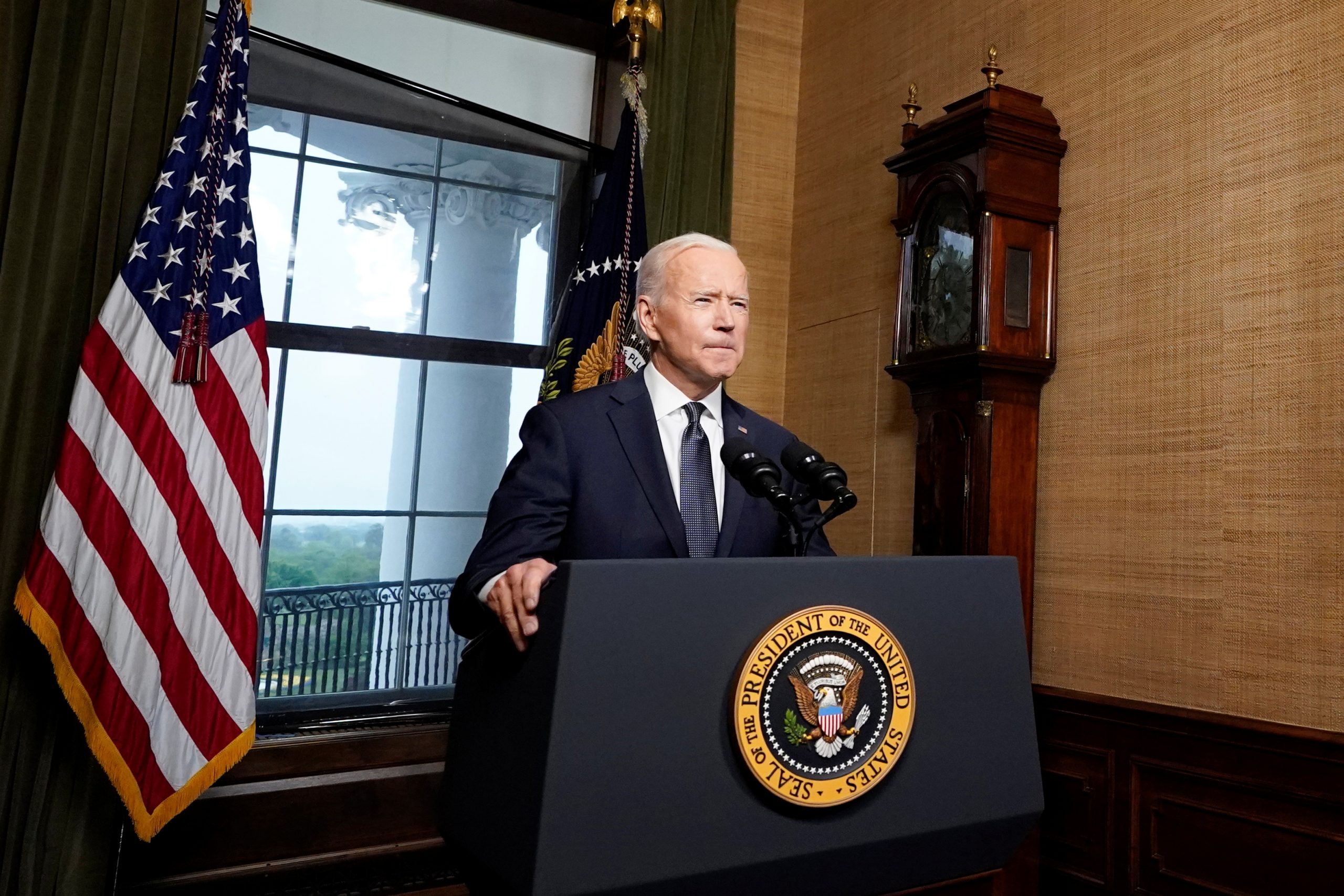
Biden made these remarks — which were factually inaccurate on a whole variety of levels, it’s worth noting — during the speech Wednesday in which he announced he was setting a hard date of Sept. 11 to withdraw all of our troops from Afghanistan.
“I believed that our presence in Afghanistan should be focused on the reason we went in the first place: To ensure Afghanistan would not be used as a base from which to attack our homeland again,” Biden said. “We did that. We accomplished that objective.
“I said, among with others, we’d follow Osama bin Laden to the gates of hell if need be. That’s exactly what we did, and we got him. It took us close to 10 years to put President Obama’s commitment into form. And that’s exactly what happened. Osama bin Laden was gone.
“That was 10 years ago. Think about that. We delivered justice to bin Laden a decade ago, and we’ve stayed in Afghanistan for a decade since.”
There’s a lot of historical rewriting going on here. There was the gaffe-tastic (“It took us close to 10 years to put President Obama’s commitment into form” — glad to know Obama was the president in 2001), the revisionist history (while I have no doubt Biden wanted bin Laden captured or dead, as with every American, he was nowhere near this gung-ho by any account except his own) and the fact that yet again, those weren’t his words.
Yes, Biden said he was one “among others” who had used the phrase. However, as Stephen L. Miller pointed out in a tweet, these were words most famously uttered by former Arizona Sen. John McCain during the 2008 Republican primaries.
“I want to look you in the eye today my friends and say that if I have to follow him to the gates of hell I will get Osama bin Laden, I will bring him to justice,” McCain said during an appearance in South Carolina in advance of the primary there, according to WTOC-TV. “I promise you that.”
By the way, if Biden was saying these kinds of things at the time, it didn’t register in the media, which didn’t think too much about McCain’s wording. Here’s one contemporaneous HuffPost headline: “McCain’s ‘Gates Of Hell’ Rhetoric ‘Equal Parts Incoherent And False.'” I don’t particularly remember 👤Joe Biden telling the media to cut the malarkey because he and McCain were gates-of-hell ride-or-dies.
However, it’s worth noting that when following terrorists to the gates of hell lost the whiff of McCain about it, he was more than happy to appropriate the line — just not about Osama bin Laden.
According to the Christian Science Monitor, back in 2014, he used almost the exact same rhetorical construct when talking about Islamic State group members after the terrorist organization released videos of its members beheading two American journalists.
“We take care of those who are grieving and when that’s finished they should know we will follow them to the gates of hell until they are brought to justice. Because hell is where they’ll reside,” Biden said.
So, yes, he’s used the phrase before. He can’t quite say he used it for the killing of Osama bin Laden, since, as the Washington Examiner’s Jerry Dunleavy pointed out, every account but Biden’s has him opposing the raid that took out the al-Qaida leader.
In a 2019 article, Dunleavy wrote that Biden’s official line, that he privately told the then-president to go ahead with the raid, “contradicts the public accounts of former Secretary of State Hillary Clinton, former Secretary of Defense Bob Gates, former CIA Director Leon Panetta, and Obama himself.”
Here was former Obama’s recollection in his 2020 memoir, “A Promised Land”:
“Joe also weighed in against the raid, arguing that given the enormous consequences of failure, I should defer any decision until the intelligence community was more certain that bin Laden was in the compound. As had been true in every major decision I’d made as president, I appreciated Joe’s willingness to buck the prevailing mood and ask tough questions, often in the interest of giving me the space I needed for my own internal deliberations.”
So, what did Biden have to say about the matter? Here’s him, um, clarifying things a bit:
“The reporting was accurate when I said, ‘I didn’t say go.’ And I didn’t. What I said was, ‘Mr. President, try one more thing,’” Biden said.
“And the reason for that was, imagine if I had said, ‘Mr. President, go’ and he didn’t go? And then bin Laden did something else bad? They would’ve said, ‘Well, everybody said, even his vice president said to go, and he said, and he said no,’” he continued.
“And had I said, ‘By the way, when I went up privately I told him to go,’ it would’ve made it look like I was self-aggrandizing,” Biden said.
I have no idea what that means, but it doesn’t sound like anything remotely close to “I said, among with others, we’d follow Osama bin Laden to the gates of hell.” That’s because 👤John McCain is the only notable person who said it. A half-century of plagiarism and Biden’s still got it, though.
In September of last year, Kinnock gave an interview to The Guardian in which he defended Biden. Even though the man who’d become president had been beset (again) with several plagiarism scandals on the campaign trail, including lifting whole swaths of his climate plan directly from nonprofit organizations without attribution, Kinnock still thought Biden’s 1987 plagiarism was just an unfortunate mistake.
“Joe’s an honest guy,” said the 78-year-old former Labour leader. “If Trump had done it, I would know that he was lying.”
Even at this late hour, Neil Kinnock — the man who played an inadvertent hand in bringing you presidential nominee Michael Dukakis — is just as good at ferreting out serial plagiarists as he is at becoming prime minister.