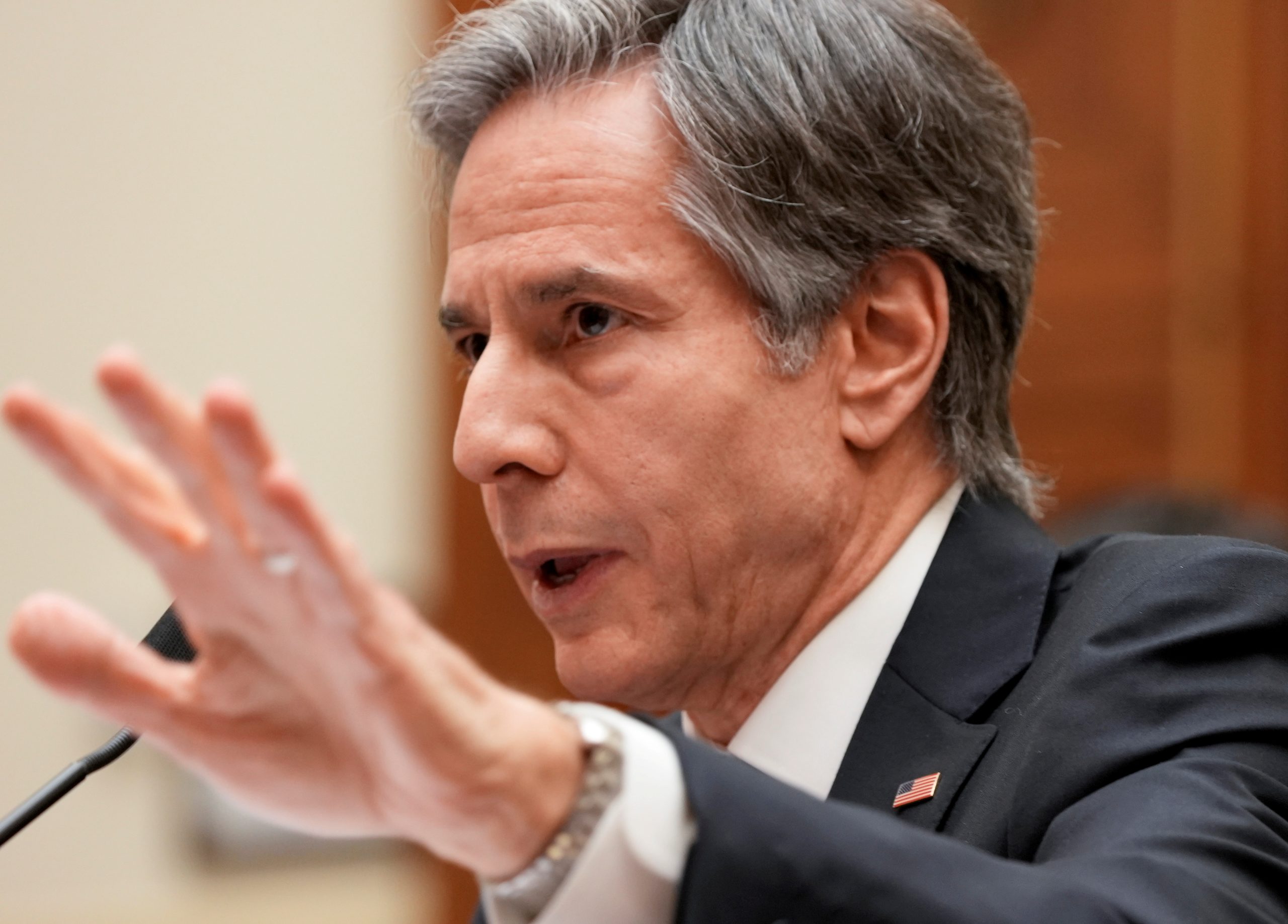
Secretary of State Blinken Rejects Looming ‘Cold War’ With China As Biden Pushes for Multilateralism
Secretary of State Antony Blinken refused to characterize the increasingly sour geopolitical relationship between Washington and Beijing as a “new Cold War” last week amid the United States’ intensified diplomatic…
Secretary of State 👤Antony Blinken refused to characterize the increasingly sour geopolitical relationship between Washington and Beijing as a “new Cold War” last week amid the United States’ intensified diplomatic dispute with the 🇨🇳People’s Republic of China.
“I resist putting labels on most relationships, including this one, because it’s complex,” Blinken said in an interview with the Financial Times. “If you look at it, we’ve seen unfortunately in recent years the government in Beijing acting more repressively at home and aggressively abroad.”
The secretary elaborated on the Biden administration’s triangular approach to challenging leadership in Beijing.
“And when I look at the relationship, I see adversarial aspects. I see competitive aspects. I see cooperative aspects — all three.”
Blinken also indicated that a key facet of President 👤Joe Biden’s “secret sauce” diplomacy will be for the U.S. to “engage China from a position of strength” — an offhanded response to Chinese diplomat Yang Jiechi
Sponsored
Sponsored
Secretary of State Blinken Rejects Looming ‘Cold War’ With China As Biden Pushes for Multilateralism — IJR
, who told American officials in March that the U.S. has no authority to speak to China from a position of strength.
For the United States to engage with China from a position of strength, American foreign policy must rely on “working with allies and partners, not disparaging them,” the secretary said, an apparent criticism of the Trump administration.
“It means leaning in and engaging in the vast array of multilateral and international organizations because that’s where so many of the rules are made. … And it means critically — and maybe most critically — actually investing in ourselves, investing in our own people, in our workers, in our technology, in our infrastructure.”
Contrary to its rhetoric, however, the new administration’s sentiment toward China has not drastically changed since President Donald Trump’s term in office.
According to The Wall Street Journal, U.S. Trade Representative Katherine Tai indicated that eliminating tariffs instituted by former President Donald Trump would undermine economic safeguards that provide protections for American companies, which encounter stiff, subsidized foreign competition from Chinese industries.
In addition, Trump’s de facto ban on products made by Chinese-based telecommunications and phone manufacturer Huawei has yet to be revoked by the current administration. A chorus of Trump-era sanctions and condemnations against the Chinese Communist Party have also swelled under Biden’s executive leadership.
Building on that foundation, Biden has attempted to forge an increasingly aggressive multilateral approach to challenge the leadership in Beijing. And now, months before this year’s Group of Seven summit in London, the West is preparing to showcase its collective strength.
Last week, in a precursor event, the foreign ministers of the G7 — Canada, France, Germany, Italy, Japan, the United Kingdom and the United States — gathered in London to reinforce and affirm their commitment to the international rules-based order.
A joint statement released by the foreign ministers continued to expand upon the West’s wide range of protestations against the Beijing regime, condemning the one-party state for its systematic crackdown on the values and convictions to which liberal democracies subscribe.
The leaders further elaborated on their concerns about the human rights violations in Xinjiang and Tibet, along with “China’s decision… to erode democratic elements of the electoral system in Hong Kong.”
In accordance with the West’s frustration over the Chinese economy, the foreign ministers urged Beijing to stop conducting “arbitrary, coercive economic policies and practices” and “assume and fulfill obligations and responsibilities commensurate with its global economic role.”
At this point, these statements come as no surprise, as they have become recurring features of the West’s grievances. But the foreign ministers expanded upon their standard platform by informally recognizing the People’s Republic of China and its “meaningful participation in the World Health Organisation.”
The move showcases a new dimension to the West’s multilateral objectives, which gives heightened significance to Taiwan, in addition to Australia and India — countries engaged in regional disputes with China.
With the goal of strengthening regional ties to countries that share similar values and economic objectives, the West has attempted to maintain pressure on Beijing by surrounding the region with countries sympathetic to the current liberal international order.
At the behest of the United Kingdom, leaders from Australia, India and South Korea will attend the G7 summit as guest countries in June.
This soft-power diplomatic move is sure to continue driving a wedge in between Washington and Beijing.
Blinken, nonetheless, told the Financial Times that the administration’s China policy is “not about initiating a Cold War.”
“This is all about doing our part to make sure that democracy is strong, resilient, and meeting the needs of its people,” he said.
The G7 meeting is scheduled for June 11-13. The leaders are expected to further articulate their shared platform and vision, addressing the wide array of issues arising from Beijing’s regional and international ambitions.