



‘Blood Moon’ Will Rise Over America on Election Day
Is it an Election Day red wave that reaches all the way into space? Not quite, but as the polls in Eastern states such as New York state open Tuesday, the moon will be glowing red in the sky as a rare “blood moon”…
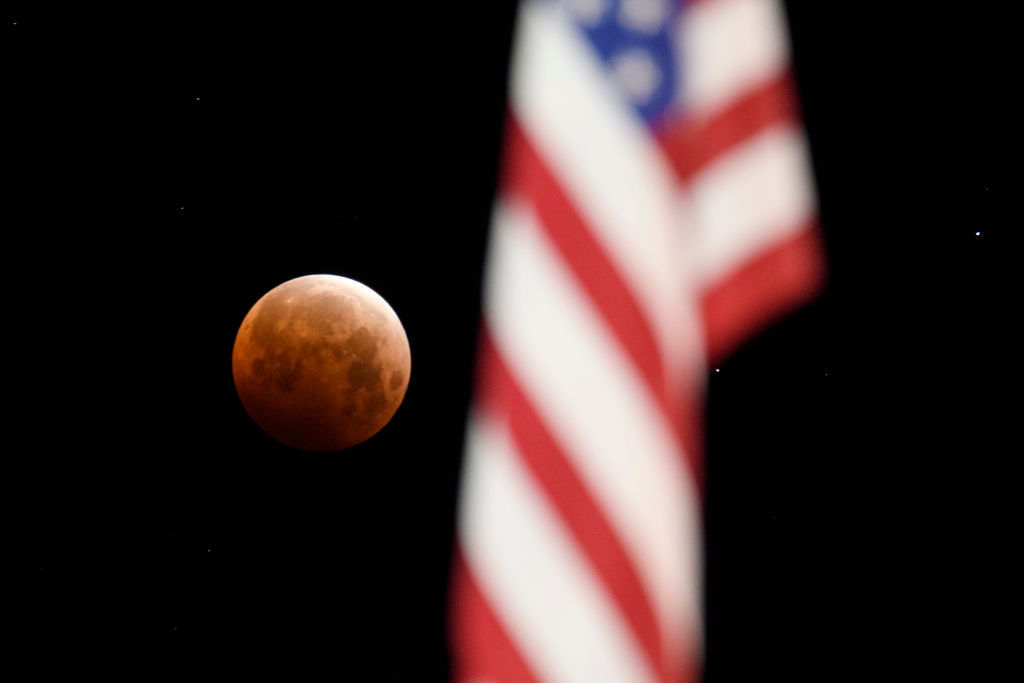
Is it an Election Day red wave that reaches all the way into Space?
Not quite, but as the polls in Eastern states such as New York state open Tuesday, the moon will be glowing red in the sky as a rare “blood moon” occurs.
To be clear, the phenomenon has nothing to do about the circumstances of any political party’s message being in alignment with the mood of the voters.
As noted by CBS, a “blood moon” takes place as part of the final phase of a total lunar eclipse, which is when the sun, Earth and moon all line up just right so that the Earth passes between the sun and moon, putting the moon in Earth’s shadow.
The eclipse will begin at 3:02 a.m. Eastern Time (that’s Standard Time because clocks go back Sunday).
The “blood moon” phase when the moon appears to be blood red will take place between 5:17 a.m. to 6:42 a.m. Eastern time, according to NASA. Pacific Time skygazers might see some reddish color as late as 4:49 a.m.
NASA said that depending on the cloud cover, the sky show can be seen from North and Central America, Colombia, and western portions of Venezuela and Peru. Folks who stay up overnight in Alaska and Hawaii to see the show can watch all the stages, NASA said.