CARSON HOLLOWAY: Here’s One Trump Legal Battle Flying Under The Radar That Has Massive Stakes
A potentially important legal development was largely overlooked amid the historic events of the past weekend. While the political pundits were understandably fixated on the sad fate of President Joe Biden’s…
A potentially important legal development was largely overlooked amid the historic events of the past weekend.
While the political pundits were understandably fixated on the sad fate of President Joe Biden’s presidential campaign, little attention was paid to the ruling of a Florida judge that former President Donald Trump’s defamation lawsuit against the Pulitzer Prize board may proceed.
This case merits more commentary than it has so far received.
Trump is suing the Pulitzer board for a 2022 statement reaffirming the board’s earlier decision to award the prize to the New York Times and the Washington Post for their reporting on the story of the 2016 Trump campaign’s alleged ties to Russian interference in that year’s presidential election. Trump claims that the statement is legally defamatory because it implies the accuracy of the Times’s and the Post’s reporting, even though Special Counsel Robert Mueller reported that his “investigation did not establish that members of the Trump Campaign conspired or coordinated with the Russian government in its election interference activities.”
Team Pulitzer sought to dismiss the case on the grounds that its statement in defense of the award amounted to pure opinion, which cannot be actionable as defamatory.
The judge, however, disagreed, holding that the Pulitzer statement was not pure but “mixed” opinion — that is, an opinion linked to facts to which the Pulitzer statement alluded but did not provide. Such mixed opinion can be actionable in American defamation law.
Sponsored
Sponsored
CARSON HOLLOWAY: Here’s One Trump Legal Battle Flying Under The Radar That Has Massive Stakes — IJR
It is one thing to offer the mere opinion that someone is corrupt. It is another to offer such an opinion and then say, in effect, “and if you knew what I knew you would agree.” That is essentially what the Pulitzer board did by publishing their statement in defense of the award and claiming that the reporting had been reviewed by experts they had retained, but without providing any more information.
This case is significant for two reasons. First, it is one that Trump might win.
Under prevailing constitutional standards, it is notoriously difficult — and well-nigh impossible — for a “public figure” such as Trump to prevail in a libel action. The modern Supreme Court, in New York Times v. Sullivan and subsequent rulings, has held that to win a libel suit a public figure must show “actual malice”— show, in other words, that the defendant knew the defamatory statement was false or at least acted with reckless disregard for the truth.
This is very difficult to prove of a news organization, since it can always claim that it was operating on a tight deadline and thought the material was true at the time. In the present case, however, the Pulitzer board stood by the original award, and the reporting on which it had been bestowed, even after a thorough Department of Justice investigation did not establish that the Trump campaign colluded with Russia.
Perhaps a court would find here the knowledge of falsity or reckless disregard for truth necessary for Trump to win even under the “actual malice” standard.
Second, and more important, if the case proceeds it might give the courts, and ultimately the Supreme Court, an opportunity to reconsider New York Times v. Sullivan. Trump hinted at this possibility in his TruthSocial post about the ruling. The judge, Trump said, had not allowed “Pulitzer to hide behind the deeply outdated Times v. Sullivan case, which is from a bygone Era, before the Media went Radical and Woke, as they suffer from a terminal case of Trump Derangement Syndrome.”
Trump has a point. The news media today is much more nakedly partisan and unscrupulous than it was in the 1960s, when New York Times v. Sullivan was decided. Hence the hysterical and routine reporting of the Trump era, often based on anonymous sources, seeking to discredit him with the public.
The Sullivan court thought it was protecting democracy with the actual malice standard, by sheltering the vigorous public discourse that is required for the voters to choose by whom they will be governed. In practice today, however, the standard has become an impediment to rational self-government. It permits the media to get away with publication of defamatory falsehoods about public officials and candidates for public office, thus empowering them to shape electoral outcomes by making their disfavored candidates odious to the public.
This, indeed, was the whole purpose of the “Russia collusion” storyline of the 2016 election. It is not helpful to “democracy” — that is, to the public’s right to genuinely informed consent — to allow partisans and the media to dupe voters into voting against a candidate based on defamatory misinformation.
There is another problem with New York Times v. Sullivan, one to which former President Trump did not allude in his comments. By imposing the “actual malice” standard, the Sullivan Court claimed to be implementing the requirements of the First Amendment’s clause protecting the “freedom of the press.”
In fact, however, the “actual malice” test has no basis in the original understanding of the First Amendment or in the dominant American legal tradition that prevailed up until the middle of the 20th century. The Founders’ understanding was simpler and more reasonable. It held that libel, or false and defamatory claims, were not protected at all by the “freedom of speech.” (See, for example, Justice Joseph Story’s opinion in Dexter v. Spear.) It was instead a noxious abuse of that freedom, an intrusion on the rights of others, and therefore properly actionable, whether or not the victim of the libel was a public figure.
In short, New York Times v. Sullivan was another instance of the unwarranted judicial activism for which the 1960s Warren Court was infamous. Trump’s suit against the Pulitzer board, then, has implications beyond his understandable interest in his own reputation.
It may create another opportunity for the contemporary Supreme Court to clean up the legacy of the Warren Court and return the Constitution to its original meaning, and at the same time restore libel standards that support a truthful, civil and rational public discourse.
Carson Holloway is a Washington Fellow in the Claremont Institute’s Center for the American Way of Life.
The views and opinions expressed in this commentary are those of the author and do not reflect the official position of the 🏢Daily Caller News Foundation.
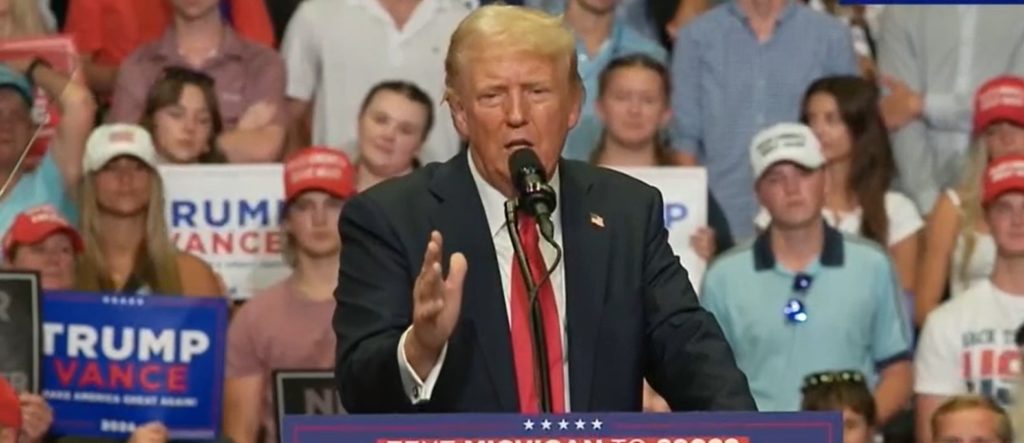
(Featured Image Media Credit: Screen Capture/CSPAN
All content created by the 🏢Daily Caller News Foundation, an independent and nonpartisan newswire service, is available without charge to any legitimate news publisher that can provide a large audience. All republished articles must include our logo, our reporter’s byline and their DCNF affiliation. For any questions about our guidelines or partnering with us, please contact [email protected].