
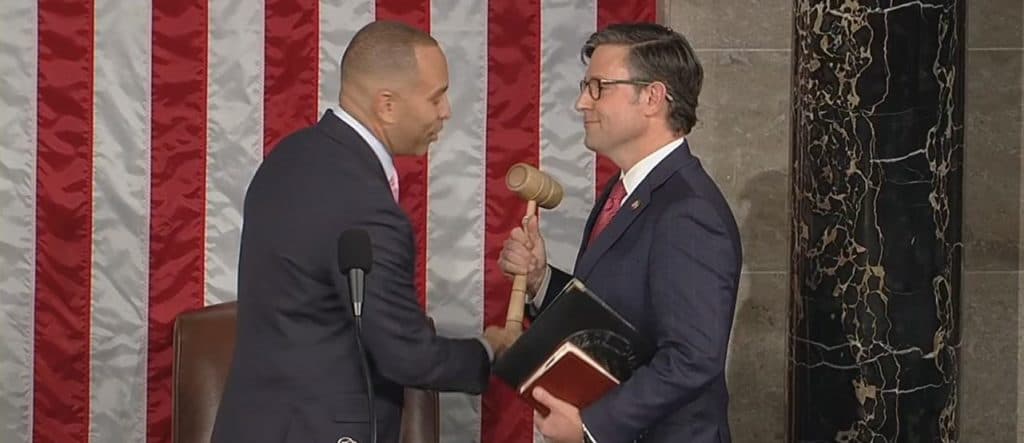

The House of Representatives has a short window of time in September to pass its legislative agenda as the midterm elections inch closer.
The House will return from August recess on Monday and attempt to pass several pieces of legislation since they will be out of session to campaign ahead of the Nov. 3 midterm elections. Lawmakers will try to pass a continuing resolution (CR) to keep the government open, pressure senators behind the scenes to pass the third reconciliation package and other legislative agenda items.
The chamber will take up the CR under suspension of the rules to fund the government through Dec. 11. The Senate passed the CR in a 90 to 6 vote without addressing the national debt, which exceeded $40 trillion on Aug. 20.
Before the recess, the House passed a stopgap funding bill that would fund the government through Dec. 4. The Senate version was negotiated with Democrats, prompting House leaders to quickly take up the upper chamber’s version.
The House was already on recess when the Senate passed the CR, causing a delay in it reaching President Donald Trump’s desk by the Sept. 30 deadline.
The second biggest priority is the $95 billion reconciliation package, which House Republicans want the Senate to pass before October. Senators threatened to delay passing the reconciliation package until a stopgap funding bill was passed, and some Senate Republicans expressed skepticism over the House’s version of the reconciliation bill.
House leaders were expected to pressure the Senate to pass the package. The Senate is not set to return from August recess until Sept. 14, giving them an even shorter window to pass the budget resolution.
Some senators were concerned the package spends too much, while some farm-state senators worry it spends too little. Senate Majority Leader John Thune was skeptical that the chamber had the votes to pass the package.
The package includes $10 billion for the House Administration Committee to hand out grants to implement the Safeguard American Voter Eligibility (SAVE) America Act, $73 billion for the House Armed Services Committee and House Permanent Select Committee on Intelligence to address the Iran war and $12 billion to aid struggling farmers. It includes no spending offsets and would not address the $1.4 trillion deficit.
Trump repeatedly pressured both chambers to advance and get the budget resolution to his desk, prompting more pressure on Republicans.
A highway bill will also expire on Sept. 30 if the House does not act. With the Infrastructure Investment and Jobs Act of 2021 set to expire, the House will need to vote on an extension to prevent a funding lapse for current highway funding programs.
The Senate included a temporary extension for highway funding to its version of the CR. The House will need to vote to extend highway funding or approve the Senate’s CR upon their return.
Congress is running out of time to pass the Farm, Food and National Security Act of 2026, a new five-year authorization of the 2018 farm bill. The current extension of the 2018 bill will expire Sept. 30, meaning the House and Senate will need a new farm bill or another extension passed before the October recess.
The House passed the bill on April 30 in a 224 to 200 vote, though it has since stalled. The Senate Agriculture Committee failed to advance its own version of the bill on Aug. 6 after Democrats on the committee voted against a Republican-led provision to require states to pay a portion of the Supplemental Nutrition Assistance Program (SNAP) benefit costs.
SNAP allowed people on food stamps to buy junk foods and sugary drinks on the taxpayers’ dime.
The House would likely take up The Lindsey O. Graham Sanctioning Russia and Iran Act of 2026, which would require Trump to impose tariffs of up to 100% on goods from the top five importers of Russian oil and gas and up to 500% on goods imported from Russia. The Senate passed the legislation on Aug. 7 in an 86 to 11 vote.
Graham first introduced the bill on April 1, 2025, although it stalled for over a year as the Trump White House wanted more waiver authority over the sanctions and tariffs. Following Graham’s sudden death, the bill was subsequently introduced by Graham’s sister, Republican South Carolina Sen. Darline Graham, on July 16.
All content created by the Daily Caller News Foundation, an independent and nonpartisan newswire service, is available without charge to any legitimate news publisher that can provide a large audience. All republished articles must include our logo, our reporter’s byline and their DCNF affiliation. For any questions about our guidelines or partnering with us, please contact [email protected].