



CDC Director Says Decision to Shorten Isolation Period for COVID Had to Do With What People Can ‘Tolerate’
Centers for Disease Control and Prevention (CDC) Director Rochelle Walensky says officials decided to shorten the isolation period for people with COVID-19 if they are asymptomatic in part due to concerns that they…
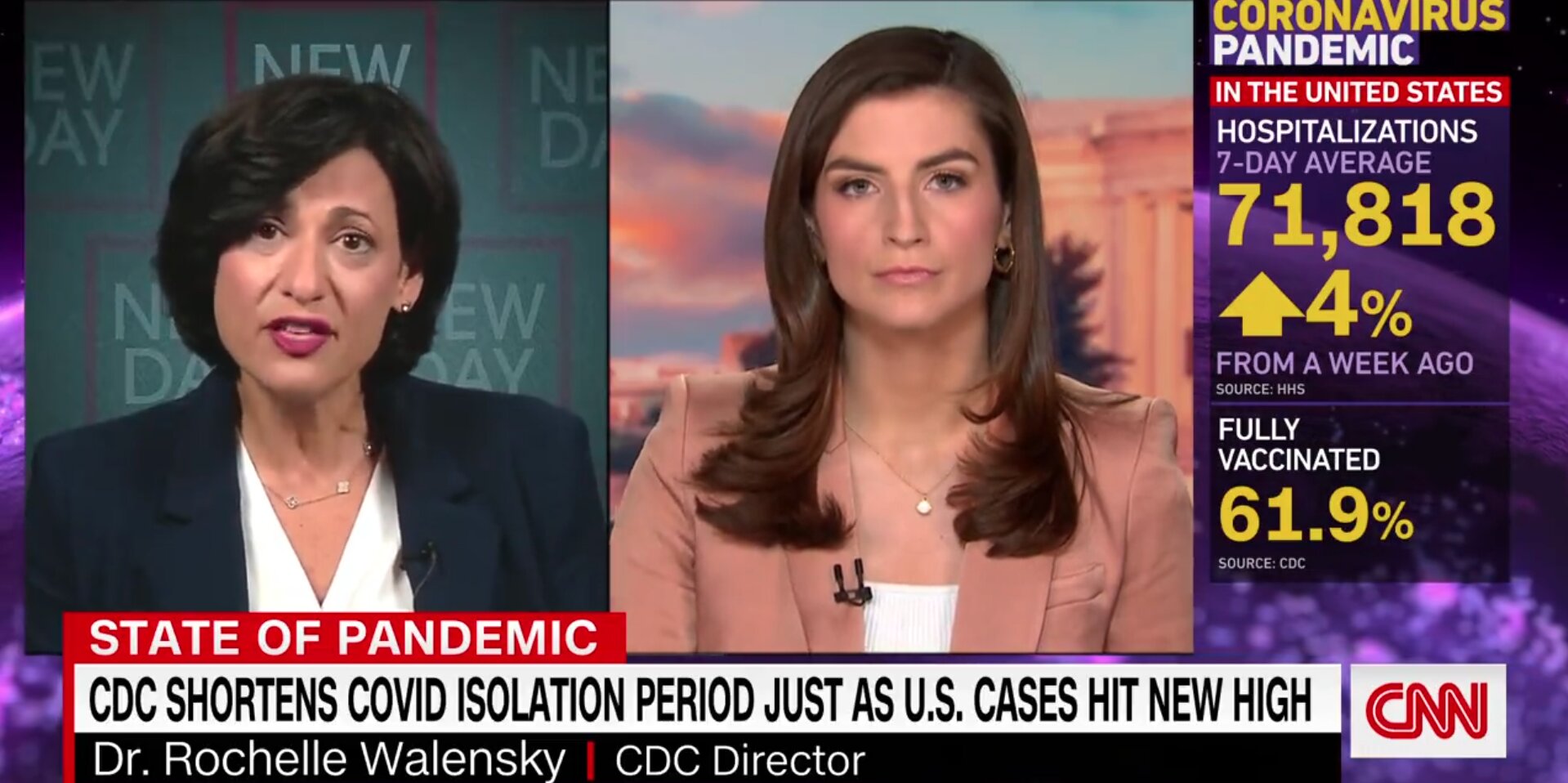
Centers for Disease Control and Prevention (CDC) Director Rochelle Walensky says officials decided to shorten the isolation period for people with COVID-19 if they are asymptomatic in part due to concerns that they would not comply with the previous isolation guidelines.
During an interview on CNN on Wednesday, Walensky was asked by the network’s Kaitlan Collins, “How did the CDC settle on five days for everyone?”
Walensky responded by saying the data has shown that most of the transmission of the virus occurs during the first two days before an individual develops symptoms and then during the following two to three days.
“If you map that out, those five days account for somewhere between 85 to 90 percent of all transmission that occurs,” she said. “So we really wanted to make sure that during those first five days you were spending in isolation, that’s when most of it occurs.”
She added that officials ask individuals to wear masks after the five-day period.
Additionally, Walensky said that the CDC examined “behavioral science” and “what will people actually do” when they want to return to work after being infected.
Watch the video below:
Collins interjected, “So from what you’re saying, it sounds like this decision had just as much to do with business as it did with the science.”
“It really had a lot to do with what we thought people would be able to tolerate. We have seen relatively low rates of isolation for all this pandemic,” Walensky responded.
She continued, “Some science has demonstrated less than a third of people are isolating when they need to. We really want to make sure we have guidance in this moment where we were going to have a lot of disease that could be adhered to, that people were willing to adhere to, and that spoke to specifically when people were maximally infectious. So it really spoke to both behaviors as well as what people were able to do.”