CHUCK DEVORE: Newsom: Green For Some, Not For All
California Gov. Gavin Newsom has a lot to say about the environment and also about government-funded high-speed rail in his state. As usual, he leaves out a lot of important context. In the third and final part of our…
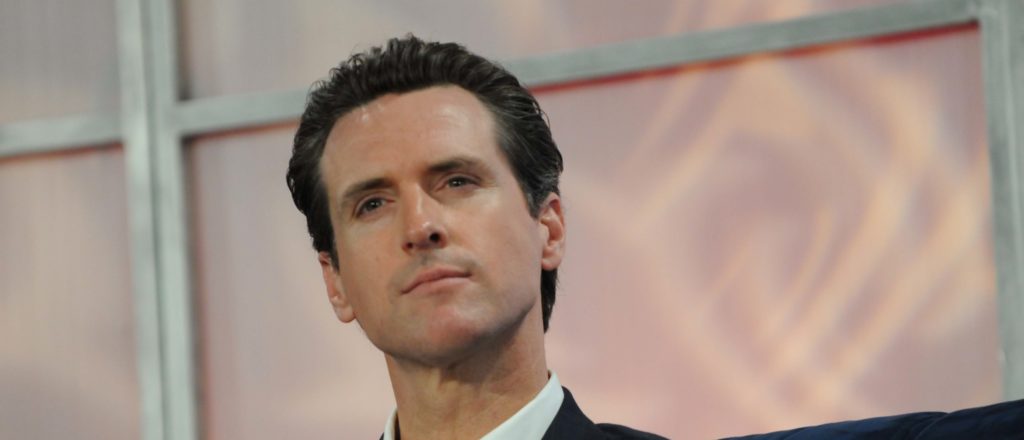

California Gov. Gavin Newsom has a lot to say about the environment and also about government-funded high-speed rail in his state. As usual, he leaves out a lot of important context. In the third and final part of our look at Shawn Ryan’s marathon mid-July podcast with Newsom, we share what Newsom won’t.
In the third and last installment breaking apart Shawn Ryan’s four hour mid-July podcast interview of California Gov. Gavin Newsom, we’ll look at Newsom’s green policies as it relates to electricity and high-speed rail.
On Ryan’s podcast, Newsom blasts Trump and congressional Republicans’ Big Beautiful Bill for modestly cutting back on green energy subsidies, claiming, “We’re raising the prices for average utilities by eliminating all these damn green energy tax cuts… we’re doubling down on the past on subsidizing coal and more oil and gas and eliminating investments in the future which is cheaper greener more abundant energy.”
On a per unit of energy basis, wind receives about 48 times the subsidies of oil and gas while solar nicks taxpayers for 168 times oil and gas.
As for “raising the prices” of electricity, what has California been doing for the past 20 years?
During my first full year in the California State Assembly in 2005, California had the eighth-highest electricity prices in the nation. Today, California has the second-highest electricity prices, only behind Hawaii—which meets its electricity needs with diesel generators and a bit of solar power—so much for that cheap green electricity.
Even so, Newsom was boasting about California’s green electrons, crowing, “We’re running the fourth largest economy at 100 percent green energy for the majority of this year.” Of course, the grid must be up 24/7/365—being “100 percent green” for six months and a day means little if the remainder of the time is very expensive or has rolling blackouts. For reference, California’s average retail electricity prices are almost 1-1/2 times higher than Texas’s.
But just before that, Newsom hinted at issues, admitting, “You got this next generation, this tech generation, that sees AI data centers and sees energy consumption going through the roof—sees a transition or the duck curve and issues around battery storage maybe not getting to the scale it needs to be with solar and wind, uh, and needing to accelerate that transition.” What Newsom is admitting here, in technical language, is that the scale and cost of battery storage to bridge gaps in renewable generation is substantial—and likely beyond the reach of global mining to supply the 30-fold increase in minerals needed to power the so-called energy transition.
California voters narrowly approved the state’s High-Speed Rail project in 2008. I voted against the measure in the Legislature and I authored the official ballot argument against the project. I thought then and I do today, that a passenger rail link between San Francisco is a waste of billions in an era of low-cost commuter air travel and freeways. Further, it’s a pork fest, benefiting contractors and environmentalists, not average Californians.
Gov. Newsom thought the same when he delivered his first state-of-the-state address in February 2019, telling the Legislature that the program was poorly managed, cost too much, and needed to be scaled back. He tried to chart the middle ground, saying, “Abandoning high-speed rail entirely means we will have wasted billions of dollars with nothing but broken promises and lawsuits to show for it.” He then proposed a short route through the thinly populated Central Valley, America’s vegetable and fruit basket.
The first Trump administration quickly canceled federal participation in the project, rightly citing that California was in breach of contract as the state had received federal monies predicated on the promise of building a rail line over 400 miles from the Bay Area to L.A.—not a modest line running from Merced to Bakersfield.
Rather than cut his losses, Newsom indulged his ego to keep this boondoggle alive, wasting tens of billions of additional state and federal taxpayer dollars.
In the podcast, Newsom highlighted the rail effort, claiming “We’re finally laying track, we built 50 structures already,” he then contrasted it with Texas’s failed high-speed rail project, which “didn’t lay one inch of track.”
What Newsom didn’t reveal was that the Texas Dallas to Houston project was a private initiative, opposed by the Texas Legislature which passed a law in 2017 prohibiting state funding for high-speed rail projects operated by private entities. The project did receive up to $500,000 in December 2023 from the Biden administration $8.2 billion allocation for high-speed rail projects nationwide, while in September 2024, Amtrak was awarded a $63.9 million grant to continue planning the Dallas-Houston route. The new Trump administration rescinded this $63.9 million grant in April, citing ballooning costs.
When the High-Speed Rail project was first sold to voters it was to cost $33 billion, be completed by 2020, and feature trains whisking along at 220 mph on dedicated tracks. Today, the cost estimate is $130 billion, with no final completion date. In fact, the 171-mile train to nowhere will cost up to $38.5 billion—more than the cost of the entire project as promised to voters in 2008. And, of course, the slim ridership of a Merced (population 93,692) to Bakersfield (pop. 413,381) line will mean the train will run at a steep loss, assuming it ever starts in the first place.
In fact, the funding gap for this short line is up to $10.2 billion after Trump pulled $4 billion in federal funding and some $100 billion short for the full length fantasy ride. Of note, voters were told in 2008 that the project would be built “WITHOUT RAISING TAXES” and that “Matching private and federal funding to be identified BEFORE state bond funds are spent.” Both these claims were false—there’s been no private funding, much less private funding identified, and the project has been kept alive with $6.4 billion from the state’s carbon cap-and-trade tax.
California’s high-speed rail project, as with most of the state’s other government created ills, would have been better served if lawmakers—especially Gavin Newsom—were driven less by their progressively inflated egos and more by a modest sense of the possible.
Chuck DeVore is Chief National Initiatives officer at the Texas Public Policy Foundation. He served in the California State Assembly and is a lieutenant colonel in the U.S. Army Reserve. He’s the author of “Crisis of the House Never United.”
The views and opinions expressed in this commentary are those of the author and do not reflect the official position of the Daily Caller News Foundation.
(Featured Image Media Credit: JD Lasica/Creative Commons/Flickr)
All content created by the Daily Caller News Foundation, an independent and nonpartisan newswire service, is available without charge to any legitimate news publisher that can provide a large audience. All republished articles must include our logo, our reporter’s byline and their DCNF affiliation. For any questions about our guidelines or partnering with us, please contact [email protected].