

CNN senior data reporter Harry Enten on Monday said former President Donald Trumpâs substantial gains with nonwhite voters could be countered by a slight decline among ânon-college white voters.â
Trump currently holds slim leads over Vice President Kamala Harris in all of the top seven battleground states, according to the RealClearPolling averages. Enten, on âCNN News Central,â suggested Trump risks losing the election in November if he doesnât maintain his support among ânon-college white voters,â a demographic that represents a significant share of American voters, particularly in certain critical battleground states.
WATCH:
đş Embedded media â coming soon
âItâs been a key demographic for him. Itâs been his base and this is whatâs so interesting, because weâve seen so many groups this year moving in Donald Trumpâs direction. So you would think his core group, his base of support would be doing the same. But in fact, itâs moving a little bit away from him. So this is Trumpâs margin with non-college white voters,â Enten told host John Berman. âUnlike most voting blocs, this group is not moving towards him, itâs actually moving slightly away. So you go back eight years ago, where he won âem by 33, You go back four years ago, he won âem by 31.â
âNow what we look is we see them, the latest average of polls, heâs only up by 27. Now that may not seem like a lot, but given that weâre seeing these double digit gains, say among black voters or among Hispanic voters in some of the polls, the fact that weâre seeing this core group of supporters actually moving away from him, not just off of the 2016 baseline, but the 2020 baseline as well,â he continued. âI think thatâs a rather interesting development.â
Trump has made inroads with key Democratic voting blocs, including black and Hispanic voters, according to a recent New York Times/Siena College poll.
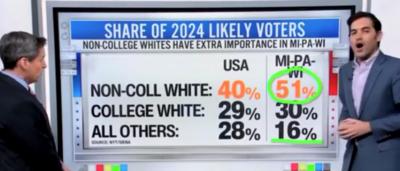
âWhy can a small difference with this group matter? Because look at what percentage of the electorate that they make up. So we can look nationally, right? Look at this, non-college white voters make up 40% of the electorate. Thatâs more than college whites at 29%. All other groups, voters of color at 28%,â Enten added. âSo this is something that weâve seen throughout the board, right? Which is that Donald Trump is making huge gains with groups that make up a smaller percentage of the electorate while heâs losing a little bit. But these groups that heâs losing a little bit of make up a much larger portion of the electorate.â
âBut more than that, you know, weâre talking about the U.S. of A where they make up 40%. Why donât you go to those key Great Lake battleground states, Michigan, Pennsylvania and Wisconsin? They have out-sized import in those Great Lake battleground states,â he said. âNon-college white voters, look at this. They make up the slim majority of voters at 51%, way more than college whites at 30%, way more than all other voters at 16%. So if youâre seeing movement in the Great Lake battleground states among non-college whites, that could be a very big development, John.â
The data reporter noted that Trump is shedding some support from this demographic in these crucial swing states. Trump is leading Harris 1.2% in Michigan, but only holds a .8% lead in Pennsylvania and a .2% advantage in Wisconsin, according to the RealClearPolling averages
âAnd when you have a shrinking margin for Donald Trump, among his core group that makes up the majority of voters, it can make up for big shifts amongst smaller groups of the electorate and this is why Kamala Harris has still in the ball game right now,â Enten said. âItâs because even though sheâs losing big league, sheâs losing big league among groups that make up a small portion electorate and sheâs making it up among groups that make up a big portion electorate, even if the movements are small. But itâs clear here.â
(Featured Image Media Credit:Â Screenshot/Rumble/CNN)
All content created by the Daily Caller News Foundation, an independent and nonpartisan newswire service, is available without charge to any legitimate news publisher that can provide a large audience. All republished articles must include our logo, our reporterâs byline and their DCNF affiliation. For any questions about our guidelines or partnering with us, please contact [email protected].