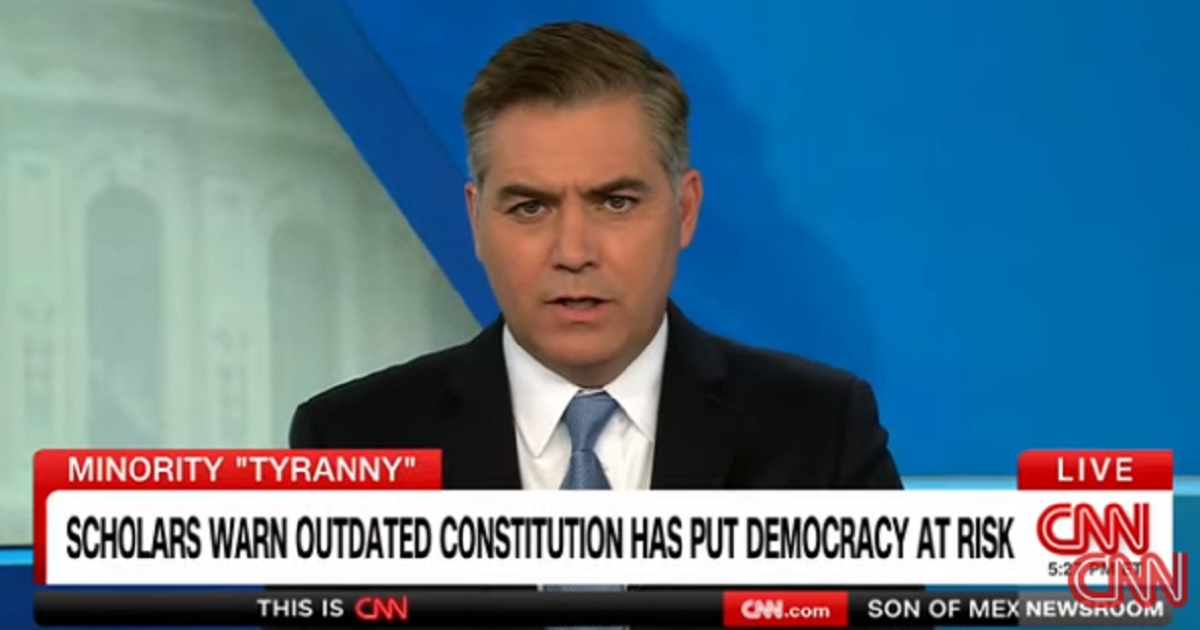
CNN Gets Roasted for Absurd Chyron Warning Constitution Is ‘Outdated, Puts Democracy at Risk’
The few remaining viewers of CNN got a remarkable dose of news on Saturday. Just in time for Constitution Day, CNN’s dwindling audience learned that the Constitution of the United States — the oldest written government…
The few remaining viewers of 📺CNN got a remarkable dose of news on Saturday.
Just in time for 📜Constitution Day, 📺CNN’s dwindling audience learned that the 📜Constitution of the United States — the oldest written government charter in the world and the document that gave birth to the nation that has spread democracy around the globe — has become so “outdated” that it’s actually a “threat to democracy.”
Of course, that’s democracy as 📺CNN’s scholars understand it. And you can’t spell ignorance without “C-N-N.”
The word came on “Newsroom,” anchored by former 📺CNN White House correspondent Jim Acosta. Acosta interviewed two Harvard professors of government who are of the opinion that the grand system of compromise, checks and balances devised by the Founders in Philadelphia in 1787 is as obsolete as the quill pens they used to write it down.
Sponsored
CNN Gets Roasted for Absurd Chyron Warning Constitution Is ‘Outdated, Puts Democracy at Risk’ — IJR
Accompanying the interview was a chyron at the bottom of the screen declaring (in all caps): “Scholars Warn Outdated 📜Constitution Has Put Democracy At Risk.”
📺CNN chyron’s are known for their quirks. The network’s now-legendary description of the 2020 Kenosha, Wisconsin, riots as”Fiery But Mostly Peaceful Protests” is a classic contribution to American journalism that deserves to be remembered for decades to come.
But in fairness to 📺CNN’s chyron writers (a job where respect for truth is clearly not a priority), there was at least a tiny bit of justification for it this time.
Acosta’s guests, Harvard’s Steven Levitsky and Daniel Ziblatt do indeed argue that the 📜Constitution is a “threat to democracy.” What they don’t acknowledge, though, is that that “threat” was deliberately designed into the document — a “feature,” not a “bug.”
Levitsky and Ziblatt both surely know that. They’re probably just as sure that a large segment of a largely ignorant American population does not.
They are authors of “Tyranny of the Minority,” a new book aimed at attacking the 📜Constitution, judging by their conversation with Acosta, by hitting the usual liberal targets — the Electoral College and the United States Senate.
Check it out here:
The Electoral College was the Founders’ method of ensuring that states with small populations would have an equal say in choosing the leader of the country.
It’s also how a president can get elected without winning the nationally popular vote — a concept that appears to outrage Messrs. Levitsky and Ziblatt but is a small price to pay for saving the country from being dominated by huge states like New York and California with little or nothing in common with, say, conservative Idaho or liberal Vermont.
It doesn’t take a scholar to understand that.
The Senate, meanwhile, is where bills go to die — and it was meant to be that way, to protect the country from the rush of popular passion. In any apocryphal story that’s almost too good to be true, George Washington is said to have told Thomas Jefferson that the Senate was a means of cooling off bills before they could become the law of the land, like tea needed to cool before it can be enjoyed.
The Senate and its filibuster have stood in the way of some very good ideas — the Civil Rights Act of 1964, for instance. They stood in the way of some very bad ones — like expanding the United States Supreme Court.
While the filibuster isn’t in the 📜Constitution, the Senate’s role as an upper chamber of Congress is, with its members’ terms are three times longer than in the House, and where only a third of the body turns over at mid-term elections.
Contrary to what liberals — and even sane Americans — often think, the United States is not a democracy, it’s a republic — a collection of largely sovereign states united into the greater body of the United States.
It’s the autonomy of the individual states that helps make the country the freest in the world. Not only do American voters have to power to change their own government, they have to power to move to another government if theirs is not to their liking, but they don’t have to leave the country. (Think of all those New Yorkers fleeing to Florida in recent years.)
So naturally, that’s what liberals hate. And since the Electoral College and the Senate’s position are what guarantees the freedom of smaller states (leave it to the genius of the Founders to protect liberty by limiting democracy), liberals hate them passionately.
And as happens periodically in history, the left is attacking the 📜Constitution itself. (Before the turn of the last century, Woodrew Wilson, before he became president, might have been the document’s best-known opponent.)
But patriotic Americans know better, and on social media, it showed.
What’s interesting is that Levitsky and Ziblatt seem to think that every change to the 📜Constitution has been good — ignoring the disaster of Prohibition, for instance (instituted by the 18th Amendment, repealed by the 21st) or the 17th Amendment that gave the country popular election of the Senate instead of senators being elected by state legislatures and has gotten worse ever since. (A truly conservative Republican Party would make repealing the 17th Amendment part of its platform.)
The professors note that the country came close to abolishing the Electoral College in 1970 and appear to be convinced — or trying to convince the shrinking band of Americans still tuning in to 📺CNN — that the fact that it hasn’t makes the 📜Constitution a weapon for tyranny instead of a shield for freedom.
As the country marked Constitution Day on Sunday, remembering the gift from God that was the signing of the 📜Constitution at Philadelphia’s Constitutional Convention, the lesson from 📺CNN a day earlier couldn’t have been more timely.
It’s not that the 📜Constitution needs to be amended immediately to satisfy leftists, though. It’s something much of much more immediate importance: