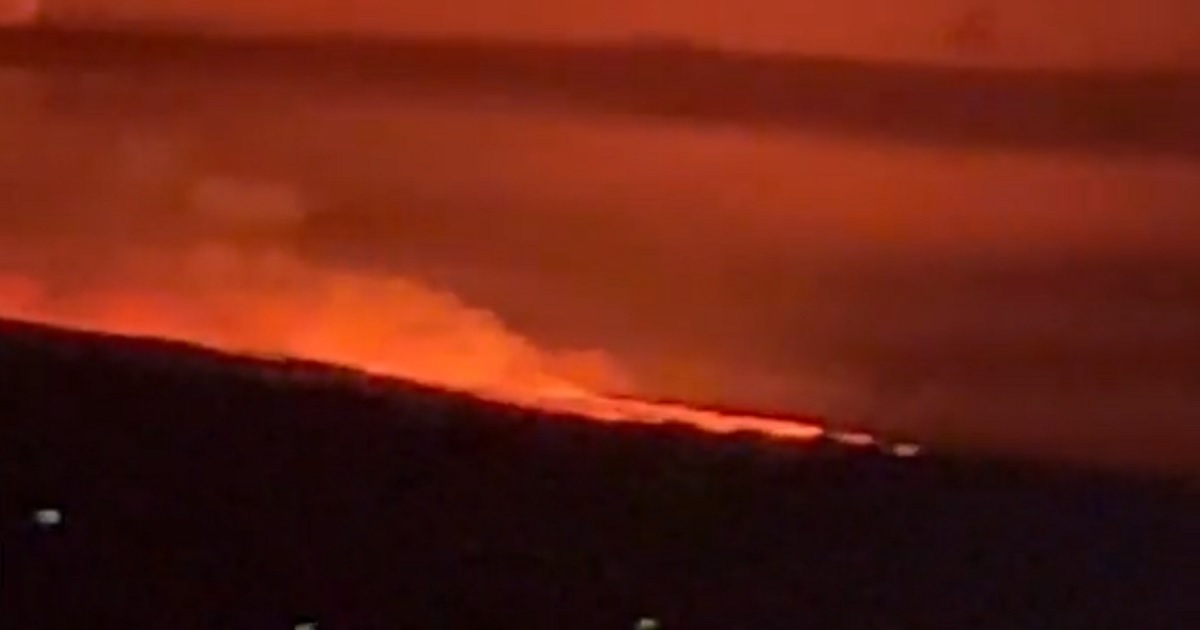
Code ‘Red’: The World’s Largest Active Volcano Has Erupted for the First Time in Decades
The world’s largest active volcano is erupting for the first time since 1984. According to NBC , Mauna Loa, located on the island of Hawaii, erupted at 11:30 p.m. local time Sunday, which equates to 4:30 a.m. Eastern…
The world’s largest active volcano is erupting for the first time since 1984.
According to NBC, Mauna Loa, located on the island of 🌺Hawaii, erupted at 11:30 p.m. local time Sunday, which equates to 4:30 a.m. Eastern Time on Monday.
The eruption began in Moku‘āweoweo, the summit caldera (or “crater”) of the volcano, which is located in 🌺Hawaii Volcanoes National Park.
“The eruption continues at the summit of Mauna Loa. All vents remain restricted to the summit area. However, lava flows in the summit region are visible from Kona. There is currently no indication of any migration of the eruption into a rift zone,” according to the U.S. Geological Survey.
“Based on past events, the early stages of a Mauna Loa eruption can be very dynamic and the location and advance of lava flows can change rapidly,” the USGS advised.
Evacuations have not yet been ordered, but shelters have already been opened for residents who are leaving their homes in anticipation of lava flows, according to KHNL-TV in Honolulu.
Amid what officials called “heightened unrest” in the volcano that began in September, officials held a planning meeting with residents last month to discuss what might happen when an eruption takes place, according to KHNL-TV.
Jandale Waltjen-Kuilipule, a resident of nearby Pahala, said at the meeting that she was “very concerned, yes, very concerned” about an eruption.
“Because we didn’t have one for a very long time with Mauna Loa,” she told KHNL.
Lynne Adams, a resident of Waiohinu, which is near the volcano, said that if a major eruption takes place, there will be “another mass exodus.”
“I mean, people are going to panic. That’s human nature,” she told KHNL.
Ken Hon, scientist in charge at the Hawaiian Volcano Observatory, said at the October meeting that the final determination of evacuation instructions will depend on what the volcano does.
“Do I turn to the right when I hit the highway? Do I turn left when I hit the highway? That’s what you really want to know. But we can’t do that until we react to what the volcano is doing,” he said.
“We would hope if Mauna Loa rocks that we would have … days so that folks can be evacuated and notified,” Andria Ellis, a geophysicist with USGS at the Hawaiian Volcano Observatory, said at the meeting.
However, she said, geology is not on the side of the residents.
“One of the challenges with Mauna Loa … is the way that it’s structured. It has flanks or sides that are really steep, and that depending on where lava emerges for at the surface, it could travel very quickly into places of residence and we might not have that day or more,” she said.