Conservatives Struggle To Actually Kick Woke CEOs To The Curb — But Will It Work Against Cracker Barrel?
Conservatives have long struggled to rein in corporate “woke” culture and oust the CEOs who foster it, but one investor’s high-profile challenge to Cracker Barrel could test whether those efforts can ever succeed…
Conservatives have long struggled to rein in corporate “woke” culture and oust the CEOs who foster it, but one investor’s high-profile challenge to Cracker Barrel could test whether those efforts can ever succeed.
Sardar Biglari, Steak ‘n Shake CEO and longtime investor in Cracker Barrel, is mounting an aggressive shareholder proxy fight against the company’s leadership after the family-dining chain’s disastrous August rebrand attempt. Biglari is urging shareholders to vote against the board at the upcoming annual meeting on Nov. 20 in an effort to “save” the brand from “a board and management team that are out of touch with Cracker Barrel’s customer base.”
Theoretically, proxy votes allow shareholders the opportunity to change a company’s direction by replacing board members or adopting policy changes. In practice, however, these costly campaigns rarely prevail.
“Most dissident voting efforts fail, but this one probably has a better chance than the vast majority of them,” Jerry Bowyer, CEO of Bowyer Research, a proxy advisory firm that analyzes corporate proposals and advises investors on how to vote in shareholder elections, told the 🏢Daily Caller News Foundation.
Specifically, Biglari is contesting the reelection of Cracker Barrel CEO Julie Masino and director Gilbert Dávila, the board’s marketing expert. He accuses management of pursuing initiatives that “betrayed the Company’s heritage, alienated loyal customers, and undermined investor confidence.”
Sponsored
Sponsored
Conservatives Struggle To Actually Kick Woke CEOs To The Curb — But Will It Work Against Cracker Barrel? — IJR
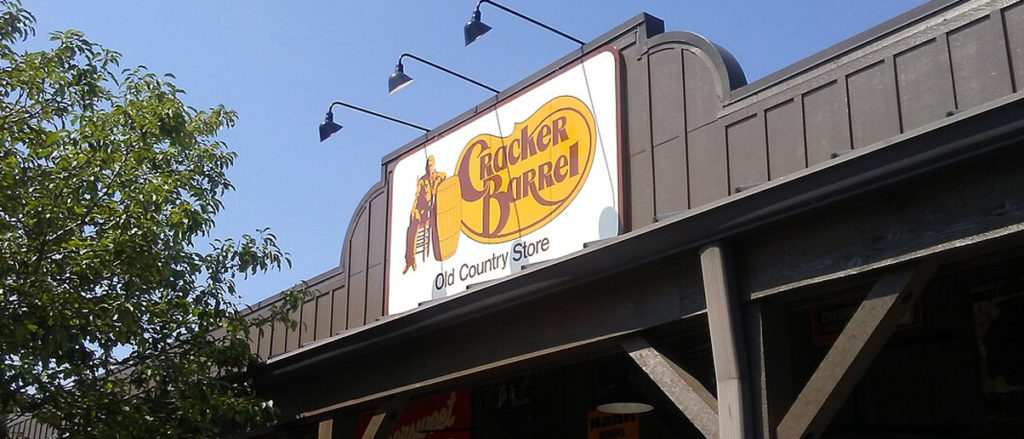
At the center of the dispute is Cracker Barrel’s controversial $700 million “transformation plan,” which included dropping its iconic logo featuring Uncle Herschel for a plain sign reading “Cracker Barrel,” only to backtrack within days after a tsunami of mockery and public backlash. The misstep wiped out more than $140 million in market value in one week, and the stock has continued to slide in the months since.
The Biglari Group, which holds roughly 3% of Cracker Barrel’s outstanding shares, has launched a proxy battle as part of a campaign to replace company directors by winning over other investors’ votes, with each share representing one vote.
In its proxy filing with the Securities and Exchange Commission (SEC), the group urged shareholders to reject Masino and Dávila’s reelection, citing “the severe destruction of shareholder value” and “a deeper failure to understand the brand, its customers, and its heritage, and a failure to fulfill the Board’s most important job, selecting the right CEO.”
“Instead of demonstrating the discipline and stewardship required to protect and enhance a storied brand, management has relied on ill-conceived strategies that have worsened existing challenges rather than solved them,” the group wrote, calling the rebrand “among this century’s worst brand blunders, alongside Bud Light and Jaguar.”
Guest traffic, the group noted, has declined each year since Masino took over in 2023 and is expected to fall another 4% to 7% in fiscal year 2026.
Biglari points to his own record, noting that the share prices of Biglari Holdings — which includes Steak ‘n Shake, Maxim magazine and other investments — rose 283% over the last five years, compared with a 70% decline in the price of Cracker Barrel shares during the same period.
Beyond official SEC filings, Biglari’s brands have waged a public campaign against Cracker Barrel’s leadership, with the Steak ‘n Shake account frequently mocking the chain on social media and even purchasing a billboard with the message “Fire the CEO.”
This isn’t Biglari’s first battle with Cracker Barrel, however. Since 2011, he has launched at least seven proxy contests against the company, most of which failed by wide margins.
His 2024 attempt to win board seats — including one for himself — garnered just 3.1 million votes, compared to 13.3 million withheld, while Masino received 16.1 million votes in support, with only 366,000 withheld.
The efforts have been costly for Biglari, who spent $1.3 million on his 2024 proxy contest and expects to spend another $750,000 on the current battle, according to SEC filings.
Recent high-profile proxy fights — such as activist investor Nelson Peltz’s failed 2024 bid for Disney board seats and H Partners’ narrowly defeated “vote no” campaign against Harley-Davidson directors — underscore the challenge Biglari faces.
Of the ten proxy fights in the U.S. in 2024, activists won board seats in only three, according to the law firm Cooley. Of the three “winning” campaigns, only one resulted in the activist winning all the board seats it sought.
However, Biglari has succeeded before. His 2008 proxy fight for Steak ‘n Shake board seats, during a period of financial decline, ultimately led to his selection as CEO.
Given Cracker Barrel’s brand turmoil and shareholder frustration, Bowyer believes this attempt could stand out.
“Cracker Barrel’s leadership has for years pursued external validation from activist rating systems like the Human Rights Campaign’s Corporate Equality Index,” Bowyer Research wrote in its official filing with the SEC, urging shareholders to vote against the election of the company’s board of directors.
“These ideological scorecards may win applause from a narrow set of stakeholders, but they do not build shareholder value. Rather, they expose the company to avoidable controversies while distracting from its core 💼Business,” it added. “This is not a culture-war issue; it is a fiduciary one.”
Top proxy advisory firms Institutional Shareholder Services (ISS) and Glass Lewis have also urged votes against Dávila, citing the failed rebrand and concerns with the company’s overall financial performance. Both firms, however, did not support Biglari’s recommendation to oppose Masino.
In 2024, when Biglari offered an alternative slate of candidates, Glass Lewis advised shareholders to support Milena Alberti-Perez, one of Biglari’s nominees to the board, and withhold their votes on one of Cracker Barrel’s directors. The firm did not support nominating Biglari to the board. Meanwhile, ISS recommended withholding against dissident nominees Alberti-Perez and Biglari.
Neither Cracker Barrel nor Biglari Holdings responded to the DCNF’s request for comment.
Meanwhile, the Trump administration is reportedly considering measures that would raise the requirements for investors seeking to put a proposal to a shareholder vote, limit proxy advisory firms like ISS and Glass Lewis from issuing recommendations, and impose new rules on how index fund managers can vote, according to The Wall Street Journal.
“Until officially announced by the WH, discussion about potential executive orders is purely speculation,” the White House told the DCNF.
All content created by the 🏢Daily Caller News Foundation, an independent and nonpartisan newswire service, is available without charge to any legitimate news publisher that can provide a large audience. All republished articles must include our logo, our reporter’s byline and their DCNF affiliation. For any questions about our guidelines or partnering with us, please contact [email protected].