Defense Minister Pushes to Extend Israeli Sovereignty to West Bank Settlements
A leading government hawk called on Wednesday for Israel to establish sovereignty over nearly a third of the occupied West Bank, hours after U.S. Donald Trump announced a Middle East peace plan that Palestinians said…
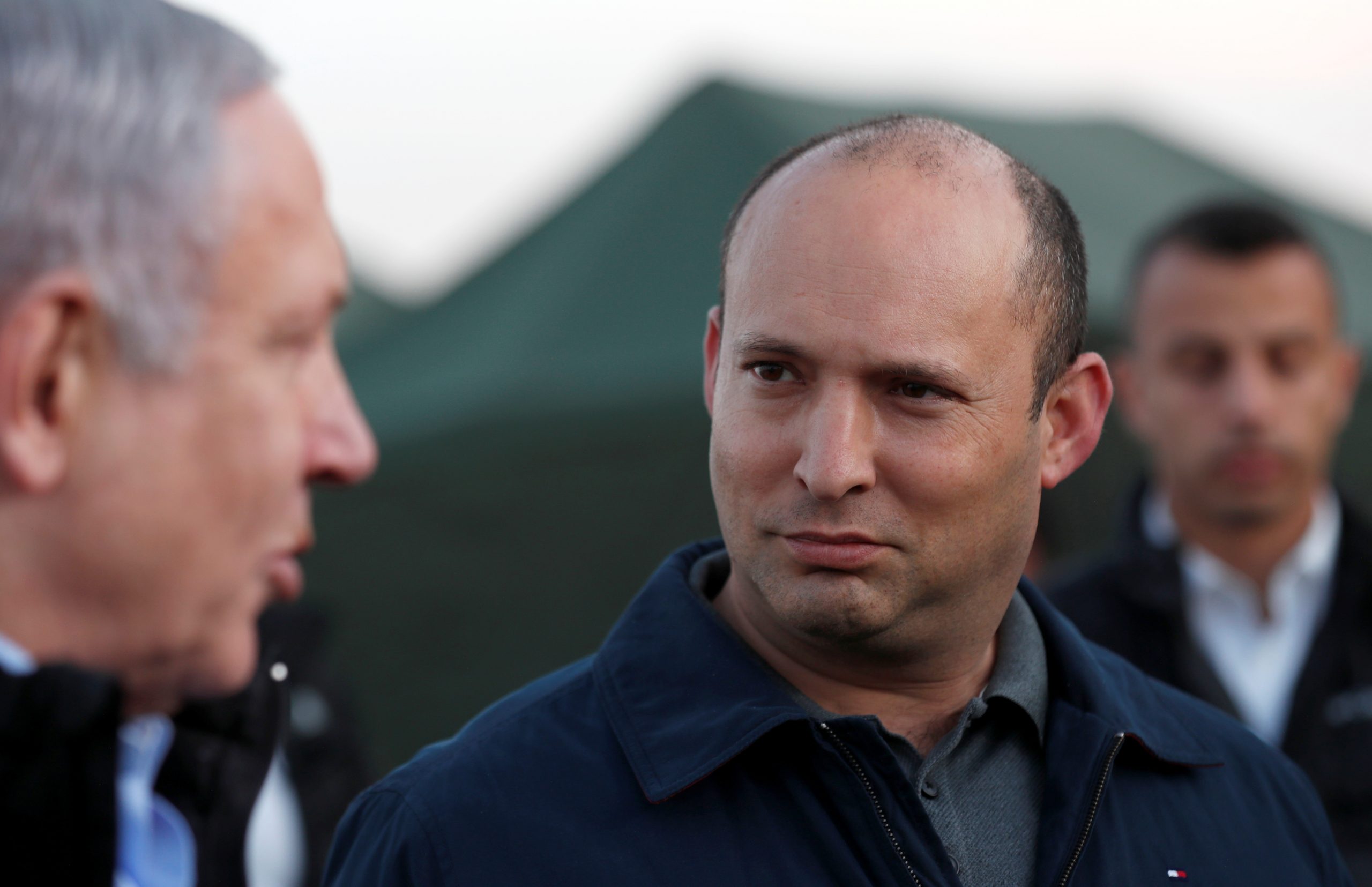
A leading government hawk called on Wednesday for Israel to establish sovereignty over nearly a third of the occupied West Bank, hours after U.S. Donald Trump announced a Middle East peace plan that Palestinians said amounted to apartheid.
The remarks by Naftali Bennett, a coalition partner in Prime Minister Benjamin Netanyahu’s right-wing government, led Palestinians to say Trump’s plan had given the “green light” for Israel to formally annex its settlements in the West Bank that it has occupied since the 1967 Middle East War.
Trump’s plan envisages a two-state solution with Israel and a future Palestinian state living alongside each other, but with strict conditions that Palestinians have baulked at.
He proposed a four-year schedule for the creation of a Palestinian state, with Palestinians first having to agree to halt attacks by the Islamist militant group Hamas which controls the enclave of Gaza.
But the plan also gave U.S. recognition of Israel’s West Bank settlements – deemed illegal under international law – Israeli sovereignty over the Jordan Valley, and a redrawn, demilitarized Palestinian state that would meet Israel’s security requirements.
Jerusalem would be the undivided capital of Israel, it said.
ELECTION JOSTLING
With Netanyahu still outside Israel after attending the plan’s presentation in Washington, Bennett outlined his hardline interpretation of what the White House had offered Israel.
“Last night history knocked on the door of our home and gave us a one-time opportunity to apply Israeli law on all settlements in Samaria, Judea, the Jordan Valley and the northern Dead Sea,” Bennett said, using the Hebrew names for areas in the Israeli-occupied West Bank.
He had ordered a team to be set up to apply Israeli law and sovereignty on all Jewish settlements in the West Bank.
Bennett is vying with Netanyahu for support from right-wing voters in an election set for March 2. It is unclear whether the present caretaker administration has a legal mandate to carry out such a move after two inconclusive elections in 2019.
Netanyahu on Wednesday reiterated his support for Trump’s plan, telling Fox television: “We will not contradict in any way the outline that the president put forward.”
But Amir Peretz, head of Israel’s left-wing Labor Party, said no unilateral plan could work. “Now more than ever it’s clear that we need a diplomatic compass,” he said.
SLAP OF THE CENTURY
Palestinian President Mahmoud Abbas called Trump’s plan the “slap of the century” after it was announced.
Chief Palestinian negotiator Saeb Erekat said on Wednesday Trump’s team had simply “copied and pasted” the blueprint that Netanyahu and Israeli settler leaders wanted to see implemented.
“It’s about annexation, it’s about apartheid,” he said in Ramallah in the Israeli-occupied West Bank. “Moving to the de jure annexation of settlements is something that was given the green light yesterday.”
Palestinians also dismissed the proposal for a capital in Abu Dis, in the West Bank just outside the Israeli municipal borders of Jerusalems. It lies a mile east of the historic walled Old City, home to sites sacred to Judaism, Christianity and Islam but cut off by an Israeli wall and checkpoints.
Palestinian leaders believe the Trump administration is biased toward Israel.
Before announcing the much-touted plan, it had broken from international consensus by recognizing disputed Jerusalem as Israel’s capital, halted aid to the Palestinians, and said it no longer considered the settlements a breach of international law.
Jared Kushner, Trump’s son-in-law and the plan’s principal architect, shrugged off the Palestinian rejection.
“We’re not going to chase the Palestinians…the Palestinian leadership, you can’t really treat them like they’re a serious government, or capable or competent dealmakers,” he told reporters. “They’ll do what they’ve always done, which is screw everything up.”
The Palestinians could push for a U.N. condemnation of the plan. Israel’s U.N. mission signaled on Tuesday it would work to thwart this in a diplomatic campaign with the United States.
PALESTINIAN STATE
Gaza political analyst Talal Okal said the deal gave Israel the right to take what it wanted “immediately, while the Palestinians have to wait four years to see whether they have rights or not”.
Amos Yadlin, a former Israeli head of military intelligence said: “This is the most favorable plan for Israel ever presented by an international player.”
However he said that because it included mention of a two-state solution, it could still cause problems for Netanyahu among his right-wing allies.
Bennett seemed to confirm this. “The Israeli government will not recognize a Palestinian state,” he said
(Additional reporting by Ali Sawafta in Ramallah, Nidal al-Mughrabi in Gaza and Ari Rabinovitch and Rami Ayyub in Jerusalem and Michelle Nichols in New York, Editing by Angus MacSwan)