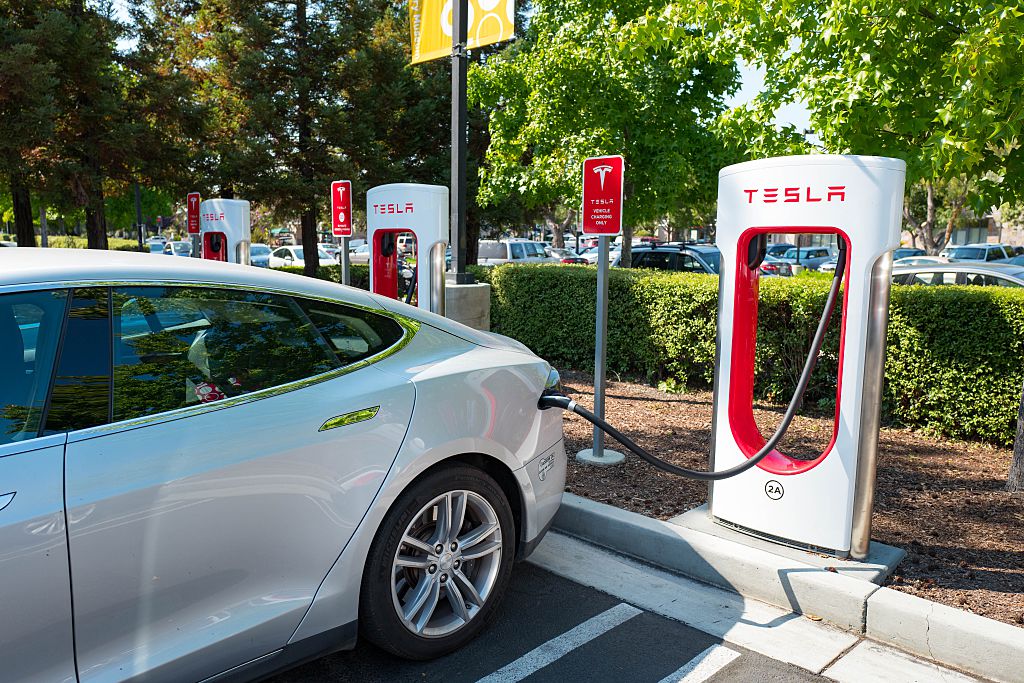
Electric Vehicle-Owning Journalist Dismayed to Find Huge Number of Chargers Unusable
Imagine if 40 percent of the gas stations you went to had pumps that were dry or out of order. You’d think you’d taken a time-warp back to the gas crisis under President Carter. Well, welcome to what it’s like owning an…
Imagine if 40 percent of the gas stations you went to had pumps that were dry or out of order. You’d think you’d taken a time-warp back to the gas crisis under President Carter.
Well, welcome to what it’s like owning an electric vehicle. And not somewhere in back-country Montana — but in super-green, super-techy 🌴Los Angeles.
According to a Wall Street Journal article published Wednesday, a test of 30 non-Tesla fast-charging stations in the EV capital of America — stations that had a combined total of more than 120 stalls — revealed at least 40 percent of them had some sort of issue.
“L.A. County has more public DC fast chargers than any other in the country, according to the Atlas Public Policy research group,” wrote columnist Joanna Stern, herself the owner of a Ford Mustang Mach-E EV.
“From the beach in Santa Monica to parking garages under Rodeo Drive, my video producer Adam Falk and I visited 30 different non-Tesla DC fast-charger stations in a Rivian R1T pickup. I ran into problems at 13 of them — that’s over 40%. Oof is right.”
Stern said that “uring my testing expedition, I encountered three problem categories. I pressed the companies on why they happen, and what can be done to fix them. And while it’s good that Tesla will start accepting non-Teslas in 2024, that might not put an end to the issues I’ve encountered.”
Sponsored
Sponsored
Electric Vehicle-Owning Journalist Dismayed to Find Huge Number of Chargers Unusable — IJR
(For the record, the experiment was deliberately limited to Level 3 chargers, a cut above the Level 2 chargers that are the norm at most public charging stations. “I ignored the more common chargers known as Level 2 because they’re just too slow for quick fill-ups,” Stern wrote.)
The first problem was simple: The charging station was broken, with “a sign, a dead screen or an error reading ‘Charger unavailable’ or ‘Out of service,'” Stern wrote.”
She found that fully 27 percent of the 126 individual Level 3 fast chargers at the EVgo, Electrify America and EVCS stations surveyed weren’t working for one reason or another.
The problem in some cases could be solved simply by a company technician turning a troublesome unit off and on again, Stern wrote, though that’s not much of a help to a motorist who needs the charge immediately.
Electrify America’s vice president of operations, Anthony Lambkin, also said that issues with power generally could force the units out of service.
But the unit could also have a broken part or defective connector, Stern wrote, which requires replacement parts.
Stern wrote that part of the solution is replacing gear that is as new as five years old because EV charging tech is advancing.
Scrapping such new equipment seems like it adds to exactly the kind of waste environmentalists will tell you they’re trying to avoid — but nothing says that you care like owning an EV, no matter what the actual impact is!
The second issue had to do with payment — namely, it being rejected.
“My favorite stop? No. 18, an EVgo in Culver City,” Stern wrote.
“After I repeatedly tried the credit-card reader with several different cards, the system demanded: ‘CASH ONLY,’” she wrote. “As if this was some hot-dog stand in the park — except there’s no money slot!”
This affected nearly 10 percent of the stalls that were otherwise working. Both swipe read and chip read errors were reported.
“Why do these machines hate credit cards? Again, a few reasons. Karim Farhat, the chief commercial officer at EVCS, said the makers of the charging hardware and the credit-card reader machines are often different, so there can be integration problems,” Stern wrote.
Sara Rafalson, a senior vice president at EVgo, told Stern the problem could be chip readers mandated by the state.
“The newest standards require more dependable contactless card readers,” Stern wrote.
So, the solution? According to Stern, motorists should go contactless and use online payment systems like Apple Pay — although it’s worth noting that certain EV models can be registered with apps operated by EVgo and Electrify America and payment is handled automatically as soon as you plug in.
Surprise surprise, that’s exactly what the operators posited was the solution to this all.
The third issue? Handshakes.
No, we’re not talking about a sign of friendliness exchanged between two individuals, but rather a software error between the charger and the car.
“The charger and the car are both computers, and they use industry standards to communicate about how much power to transfer,” Stern wrote.
“The Combined Charging System (aka CCS) — the technology integrated in most fast-charging non-Tesla EVs including the Rivian — requires a quick handshake. If there’s a timeout before things align, you have to unplug and start over.”
Stern continued: “These stations from EVgo, Electrify America and EVCS tend to support CCS along with the Tesla charger, known as the North American Charging Standard (NACS), and occasional older standards as well. Meaning, unlike with Tesla’s own stations, there could be a dizzying number of combinations of car and charger.”
And, to make things worse, according to EVCS chief commercial officer Karim Farhat, a software update could be enough to throw the handshake balance off and make the car unchargable.
The solution to this? Getting the industry to agree on a standard. This might be problematic, considering that Tesla’s system seems to be viewed most positively by those who own the vehicles. At present, however, those systems only work with Teslas. When Tesla starts allowing models from Ford, GM and Rivian to start using its stations, some will be able to handle the vehicles’ charging system — but in other locations will require motorists to use an adapter between CCS and Tesla’s North American Charging Standard. That could cause a whole new set of headaches, as well.
🌴Los Angeles isn’t the only place in 🌴California experiencing these kinds of problems with EV charging stations. A 2022 study by the University of 🌴California, Berkeley found that 22.7 of plugs studied in the Bay Area weren’t working properly and 4.9 percent had cords too short to reach their vehicles. (Tesla stations weren’t included here, either.)
And it’s bad enough elsewhere in the country that even on a tour to promote electric vehicles, the entourage of Energy Secretary Jennifer Granholm couldn’t find places to charge at times.
It’s little wonder, then, that while EV adoption was a hot thing for the last few years, the trend has cooled. The Journal had previously reported that EV prices are being slashed as electric cars go unsold on lots they would have flown off of just a year or two ago.
🌴California, meanwhile, wants to ban the sale of internal-combustion cars by 2035 — and, in its biggest city, 40 percent of the chargers aren’t working now.
I can see the new license plate slogan now. “🌴California: Drive Like It’s the Future, Fill Up Like It’s 1979.” Not exactly the thing to make voters — even Golden State voters — go wild, is it? Well, unless lawmakers in Sacramento change course in a hurry, that could be exactly what drivers will face from San Diego to the Bay Area and beyond.
And don’t think the rest of America isn’t far behind — not if the Democrats have their way, anyhow.