EXCLUSIVE: Ted Cruz Fears Attempt To Scrap Provision In Trump’s Megabill Would Hand ‘Gift’ To China
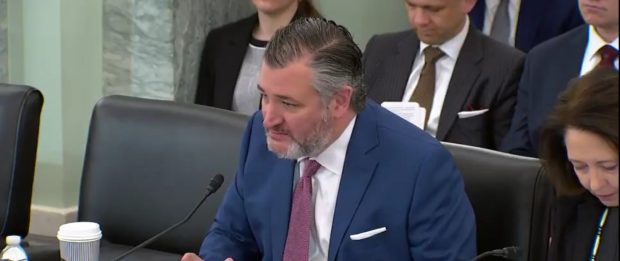
Republican Texas Sen. Ted Cruz on Saturday defended a ten-year freeze on state-level artificial intelligence rules, telling the Daily Caller News Foundation the moratorium is all that stands between U.S. innovators and…
Republican Texas Sen. Ted Cruz on Saturday defended a ten-year freeze on state-level artificial intelligence rules, telling the 🏢Daily Caller News Foundation the moratorium is all that stands between U.S. innovators and a Chinese takeover of the AI economy.
Cruz’s provision, tucked in the Senate’s version of the One Big Beautiful Bill, would bar states and cities from enacting provisions aimed solely at AI systems. Republican Tennessee Sen. Marsha Blackburn is leading an effort to scrap the freeze, arguing it tramples states’ rights and undermines efforts such as Tennessee’s ELVIS Act and a new child safety law in Texas.
“If we lose that race, the Chinese communists will have the dominant economic position for the next generation,” Cruz told the DCNF.
“Protecting kids, citizens, innovators, and creators in the virtual space is imperative. We have worked in good faith to negotiate a solution with Chairman Cruz that shields Americans from the unintended consequences of AI and upholds their constitutional rights. Until Congress passes legislation to stop Big Tech from exploiting vulnerable individuals, we cannot decimate the progress states like Tennessee have made in standing up for their citizens,” Blackburn told the DCNF.
The senator likened today’s AI moment to the dawn of the internet, noting that a federally-led approach championed by former President Bill Clinton in the 1990s helped U.S. tech firms eclipse their European rivals.
Sponsored
Sponsored
EXCLUSIVE: Ted Cruz Fears Attempt To Scrap Provision In Trump’s Megabill Would Hand ‘Gift’ To China — IJR
“That decision in the United States to employ a light-touch regulatory approach, in Europe to employ a heavy-handed regulatory approach, was critical and benefited America massively,” he said.
Cruz argued Democrats are prepared to repeat Europe’s mistakes. He pointed to what he called “wild left-wing lawfare,” claiming Democratic attorneys general are already “suing every day” and would target AI startups just as aggressively if allowed to write their own rules.
He further blasted former President Joe Biden’s now-rescinded AI executive order as “the longest executive order in American history that would have crippled AI in America,” crediting President Donald Trump for revoking it upon being reelected and restoring a light-regulation framework.
Left-leaning legislatures, he said, are rushing to fill the vacuum with “tremendously harmful” statutes.
“California … passed AI legislation that would have had a crippling effect on American AI. Thankfully, Gavin Newsom vetoed it because it was so left wing that even he wasn’t willing to sign it,” Cruz said. “I guess that was the week he pretended to be a moderate.”
He added that Colorado’s new law “turns AI into the left’s DEI police.”
Critics like Blackburn say the moratorium would also block conservative states from cracking down on AI-enabled abuses, but Cruz insisted otherwise.
“The ELVIS Act is explicitly and unambiguously excluded from the bill because we made clear that any law of general applicability is not covered,” he said, calling Texas’s child-pornography measure similarly safe.
Tennessee Attorney General Jonathan Skremetti responded to the debate surrounding the AI provision and the ELVIS Act on Thursday. “Unfortunately, the moratorium’s broad definitions and broad preemption continue to create too much risk for existing Tennessee laws like the ELVIS Act and the Tennessee Information Protection Act, as well as our ability to confront as-yet unknown future challenges from AI,” Skremetti posted to his X account.
Blackburn has proposed a two-year pause instead. Cruz has dismissed this, warning colleagues that stripping his language would court political and economic disaster.
“We cannot prohibit states across the country from protecting Americans, including the vibrant creative community in Tennessee, from the harms of AI … Congress has proven incapable of passing legislation to govern the virtual space and protect vulnerable individuals from being exploited by Big Tech,” Blackburn told Time magazine.
“Any Republican who votes to strip this moratorium out of the bill is voting, number one, to give a massive gift to communist China, and essentially to surrender the race for AI to China,” Cruz said.
“But number two,” Cruz continued. “Anyone voting to strip this provision out — they better go out and buy a t-shirt that says ‘I’m all for the DEI speech police, color me a transgender witch,’ because every time you have a query, ‘How do I get to Safeway,’ you’re gonna get a direction on how to have your child have a sex transition surgery instead.”
Asked what he would do if Blackburn’s amendment prevails and the moratorium collapses, Cruz brushed off the scenario as unlikely.
“We’re going to get it done,” he said. “I don’t think there are a whole lot of Republicans eager to defy President Trump … the White House is involved as we speak.”
The moratorium has exposed a fault line in the GOP — House Speaker Mike Johnson approved of the decade-long pre-emption, while Republican Georgia Rep. Marjorie Taylor Greene blasted the plan as a frontal assault on states’ rights.
“We have to be careful not to have 50 different states hyper-regulating AI because it has national security implications,” Johnson told reporters in early June.
Meanwhile, Greene said she couldn’t “imagine destroying federalism, taking away state rights to regulate or make laws on AI for ten years.”
The Senate is expected to vote on Blackburn’s amendment as early as Sunday night or Monday morning. If the moratorium survives and the bill passes, it would sunset in 2036, forcing Congress to revisit state-level AI regulation only after a make-or-break decade that could lock in the winners of the global AI race.
Editor’s note: This story has been updated with a statement given to the DCNF from Blackburn as well as an X post from Tennessee Attorney General Jonathan Skremetti.
All content created by the 🏢Daily Caller News Foundation, an independent and nonpartisan newswire service, is available without charge to any legitimate news publisher that can provide a large audience. All republished articles must include our logo, our reporter’s byline and their DCNF affiliation. For any questions about our guidelines or partnering with us, please contact [email protected].