EXCLUSIVE: Red States Paint Grim Picture In Supreme Court Brief If Men Are Allowed To Compete In Girls’ Sports
Two dozen states painted a grim picture for the Supreme Court about the future of women’s sports should the high court fail to take up an appeal in a brief filed Thursday. The 24 states raised concerns regarding safety…
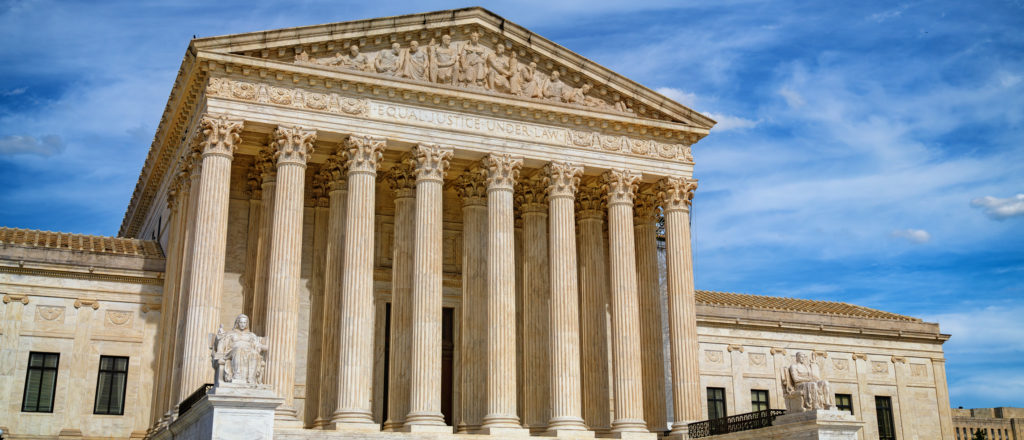
Two dozen states painted a grim picture for the Supreme Court about the future of women’s sports should the high court fail to take up an appeal in a brief filed Thursday.
The 24 states raised concerns regarding safety and fairness for female athletes in their brief which asks the Supreme Court to take up Warren Petersen v. Jane Doe, after the United States Court of Appeals for the Ninth Circuit upheld a lower court’s injunction against a 2022 Arizona law, the Save Women’s Sports Act, which prohibits males from competing in female sports. The law was first challenged in April 2023 transgender-identifying students — alongside their parents — who wished to participate on girls’ sports teams.
“States are regularly hauled into court and must bring with them an army of biologists, endocrinologists, and physicians just to defend policies that have long been viewed as commonsense ways to protect and promote flourishing for women and girls,” the brief says. “Female-only basketball and swimming teams. Female-only locker rooms and showers. Female-only bathrooms. But as this case demonstrates, courts across the country have splintered over how to apply the Equal Protection Clause to these policies when confronted with allegations that the policies discriminate based on gender identity.”
Sponsored
Sponsored
EXCLUSIVE: Red States Paint Grim Picture In Supreme Court Brief If Men Are Allowed To Compete In Girls’ Sports — IJR
“Schools are faced with an impossible task. They must create sport-specific policies that protect girls’ sports just enough from unfair or unsafe competition but that don’t exclude all biological males from the girls’ teams,” the brief adds. “Then they must attempt to administer those policies, which, if the judgment below is any indication, will require some sort of testosterone and/or Tanner-stage monitoring and other invasive medical testing to determine whether a student is eligible to play on the girls’ team for a specific sport. And if a school guesses wrong in striking just the right balance for any individual student (at least as judged by a federal court), it will face judgment for damages and attorney’s fees and have to start all over.”
Biological men competing on women’s sports teams prompted a flurry of legislation in multiple states, including Arizona, West Virginia and Tennessee. The legal action intensified after biological men began winning competitions in women’s categories by wide margins.
“The Constitution does not require States to redefine ‘sex’ to mean or include ‘gender identity.’ The difference between men and women in athletics ‘is a real one, and the principle of equal protection does not forbid” States from “address the problem at hand in a manner specific to each gender,’” the brief says. “Indeed, ‘o fail to acknowledge even our most basic biological differences … risks making the guarantee of equal protection superficial, and so disserving it.’ And ‘he distinction embodied in the statutory scheme here at issue is not marked by misconception and prejudice, nor does it show disrespect for either class.’ Instead, it seeks to accomplish just what the Act’s title suggests: to save women’s sports from unfair competition and provide meaningful athletic opportunities for girls and women.”
The discussion surrounding male transgender-identifying athletes competing in female sports garnered national attention after Lia Thomas, a male who identifies as a transgender-woman, won the 500-yard women’s final during the 2022 NCAA championships.
North Carolina high school volleyball player Payton McNabb, who suffered a career-ending concussion when a transgender player’s spike hit her in the face during a September 2022 volleyball match, described ongoing medical afflictions in legislative testimony given in April 2023, during which she urged the legislature to pass a bill similar to the one at issue in the case. Multiple college teams elected to forfeit matches against San Jose State University’s women’s volleyball team due to the presence of a biological male on the San Jose State roster, according to the Los Angeles Times.
The states that signed the brief are Alabama, Arkansas, Alaska, Florida, Georgia, Indiana, Iowa, Kansas, Kentucky, Louisiana, Mississippi, Missouri, Montana, Nebraska, New Hampshire, North Dakota, Oklahoma, South Carolina, South Dakota, Tennessee, Texas, Utah, Virginia and Wyoming.
All content created by the 🏢Daily Caller News Foundation, an independent and nonpartisan newswire service, is available without charge to any legitimate news publisher that can provide a large audience. All republished articles must include our logo, our reporter’s byline and their DCNF affiliation. For any questions about our guidelines or partnering with 🇺🇸US, please contact [email protected].