Federal Trial Over Trump’s Portland Guard Deployment Highlights Chaos, Con
The federal trial over President Donald Trump’s deployment of the National Guard to Portland, Oregon, began on Wednesday, with both sides giving their opening arguments and a witness a part of the Portland Police Bureau…
The federal trial over President Donald Trump’s deployment of the National Guard to Portland, Oregon, began on Wednesday, with both sides giving their opening arguments and a witness a part of the Portland Police Bureau testifying about the riots that led to the decision.
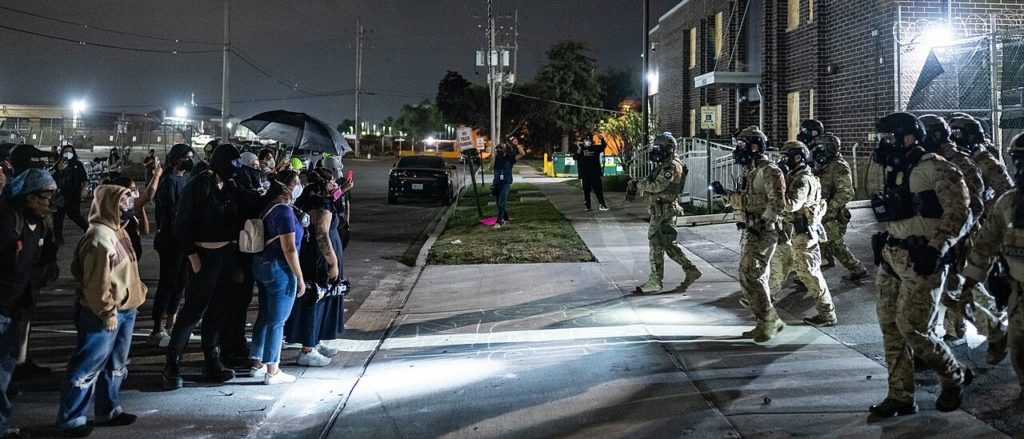
Trump deployed the Guard on Oct. 1 after months of unrest outside the United States Immigration and Customs Enforcement (ICE) facility. The case, presided over by Trump-appointed U.S. District Judge Karin Immergut, stems from a lawsuit filed by the city and state seeking to block the deployment.
During opening arguments, Portland’s attorney Caroline Turco claimed that evidence and witness testimony from local law enforcement showed the city was not facing threats nor was it “war ravaged.”
“Are the protests in Portland so violent that the deployment of the National Guard is justified?” Turco asked the court. “The plaintiffs would submit to you, no … Portland is not ‘war-ravaged.’ There is no rebellion, and the laws continue to be enforced every day.”
The deployment of the National Guard has found itself in a legal limbo. An order previously filed Oct. 4 sought to block the National Guard from entering the city, though it was blocked on Oct. 20 after a majority on the Ninth Circuit Court of Appeals ruled Trump “likely” acted within proper legal boundaries.
Federal Trial Over Trump’s Portland Guard Deployment Highlights Chaos, Con — IJR
on the Court of Appeals voted to rehear the case, leaving Immergut to make the final decision on if the Trump lawfully invoked Presidential authority to deploy the National Guard to protect Portland’s ICE facility.
Cmdr. Franz Schoening of the Portland Police Bureau, the first witness to testify, spoke for over an hour about his background and experiences observing the protests and riots. Schoening noted that Portland’s sanctuary laws have added a “layer of complexity” for local law enforcement when working with federal officers.
When asked about incidents outside the ICE facility since June, Schoening testified that the groups have generally been “fairly small” since Sept. 28 and said he did not recall any arrests of protesters for assaults on federal officers.
“I think the trend that we’ve noted and had to try to figure out how to deal with is the increased number of people showing up to engage in debate and argument and physical conflict around the ICE facility, not so much criminal conduct focused at the ICE facility or federal officers,” Schoening said.
“There’s been a lot of harassment cases, assault cases that we’ve had to, again, make arrests for the bulk of the conduct that we’ve seen focused on the ICE facility has been really civil disobedience, passive conduct, blocking the driveway, that sort of stuff,” Schoening added.
Schoening further explained during questioning from prosecutors how Oregon state laws passed after the 2020 George Floyd riots limited how local law enforcement could use crowd control munitions.
When asked if any events after Sept. 28 stood out regarding their use, he said federal officers deployed a significant amount of tear gas, despite noting protesters were seen trespassing. Schoening added that, in his opinion, local law enforcement wasn’t “seeing criminal conduct or violent behavior.”
During cross-examination by President Trump’s Department of Justice (DOJ) lawyers, Schoening was questioned about the lack of arrests made by Portland police during the June protests. Prosecutors read from an Incident Commander’s summary of the June 12 events, which described a “black bloc protester with a helmet and pepper spray” hanging donuts on the ICE facility’s entry control speaker as more protesters began to arrive.
The report also noted that Antifa handbooks were being distributed and that about 100 protesters wearing helmets, gas masks, and carrying pepper spray were visible. After the crowd grew to roughly 200 people, federal officials fired pepper balls, which “enraged the crowd” and led protesters to pull out makeshift shields and throw objects at agents who fired back.
“PPB DLO’s were directed not to engage in this hostile crowd for safety reasons, correct?” the DOJ lawyer asked.
“Yes,” Schoening said. “Our dialogue means an officer is not prepared to engage in violent unrest.”
The DOJ lawyer then asked, “PPB would typically arrest somebody who threw an object at an officer, right?” to which Schoening replied, “Yes.”
Pressing further on the lack of arrests, the DOJ lawyer pointed out that the crowd eventually swelled to about 400 people. The report described a woman in black spray-painting a window, others using slingshots to hurl rocks at a second-story window and a dumpster being pushed into the ICE facility’s driveway. The first arrest, according to the report, wasn’t made until a fire was spotted on law enforcement’s livestream.
During follow-up questioning, Schoening notably said he did not believe Antifa, which was seen during the protests, is not an organized group.
The trial is expected to last an additional two days.
All content created by the 🏢Daily Caller News Foundation, an independent and nonpartisan newswire service, is available without charge to any legitimate news publisher that can provide a large audience. All republished articles must include our logo, our reporter’s byline and their DCNF affiliation. For any questions about our guidelines or partnering with 🇺🇸US, please contact [email protected].