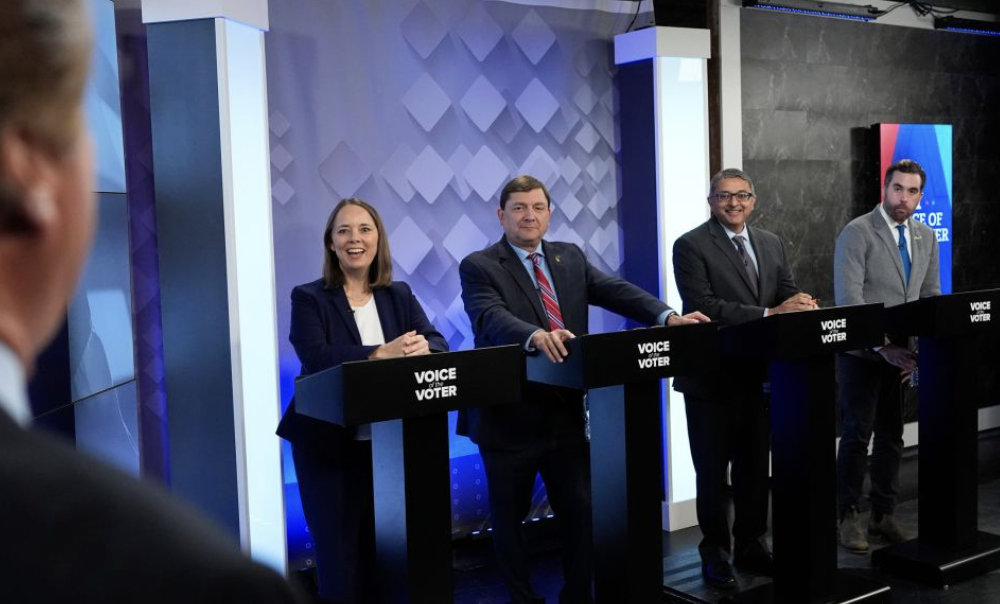



If you missed the first round of debates among the Maine Democrats hoping to replace the disgraced and now-withdrawn Graham Platner, congratulations. You apparently had something better to do with your evening, and I envy you.

The easiest way to summarize the event is this: The first hour was painful. The second was unintentionally hilarious.

Eight candidates are competing for the nomination, which Maine Democrats will decide at a July 25 party convention. The first debate featured four candidates who had already run in other Democratic primaries this year, lost, and still managed to receive at least 20 percent of the vote.

That group included Maine Secretary of State Shenna Bellows, former Maine Senate President Troy Jackson, epidemiologist and public health official Nirav Shah, and Jordan Wood, the former chief of staff to ex-Rep. Katie Porter. Wood finished third in the close Democratic primary for Maine’s 2nd Congressional District.

The second debate was what CNN politely described as “an undercard of sorts,” featuring four lesser-known candidates trying to gain attention in a race that has been thrown together on short notice.

The most serious figure in that group was probably Dan Kleban, founder of the Maine Beer Company. Kleban may have the best chance of tapping into some of the independent, anti-establishment energy that originally helped Platner. He had previously been squeezed out of the Senate race by Platner and the Democratic establishment’s preferred candidate, Gov. Janet Mills.

The undercard also featured Charles Webb, who at least managed to make the second hour more interesting. That was more than could be said for much of the opening debate.

Advertisement

The first four candidates largely agreed with one another on the usual progressive positions. The problem was not simply that their answers were predictable. It was that they delivered them with almost no energy, clarity, or political instinct.

CNN’s assessment was blunt. None of the candidates came close to reproducing the political talent that had allowed Platner to become a viral figure, push a two-term governor out of the race, and poll competitively against Republican Sen. Susan Collins before ending his campaign following a rape accusation, which he has denied.

Shah spoke in a flat, almost unchanging tone. Bellows frequently stumbled through her answers. Wood repeatedly looked down at his notes. Jackson cleared his throat, lost his train of thought, and changed direction in the middle of sentences.

Bellows is arguably the favorite, but even the moderators seemed frustrated by her tendency to answer questions without actually saying much.

Her economic message was essentially that she understands what it is like to struggle financially, so voters should trust her to secure the money and resources they need. It was the kind of broad promise politicians have made for decades, usually without explaining exactly how they intend to deliver.

She was more specific when discussing her attempt to remove Donald Trump from Maine’s 2024 presidential ballot over the events of Jan. 6, 2021. That may appeal to Democratic activists who are still looking for the emotional rush that surrounded Platner’s campaign. It is less obvious that it will help her with swing voters who might otherwise consider supporting Collins.

Jordan Wood also made the questionable decision to highlight his work for Katie Porter. Porter’s political career ended badly after a failed run for California governor and damaging allegations involving her treatment of staff and her former spouse. Drawing attention to that connection did not exactly strengthen Wood’s case.

Advertisement

Shah produced several memorable moments of his own. At one point, he argued that the arrest and removal of Venezuelan dictator Nicolás Maduro had made the United States less safe. He also embraced expensive federal programs without offering much of an explanation for how they would be funded.

Then came the second debate.

Kleban was clearly the candidate with the most potential, but he was joined by several people whose campaigns appeared to be driven more by personal enthusiasm than political viability.

Elizabeth Dickerson explained that she was running in part because she was “very interested in climate,” which sounded less like a Senate platform than the opening line of a community college discussion group.

Webb focused heavily on transgender issues, apparently viewing them as central to his candidacy.

David Costello, meanwhile, reminded everyone why the special nomination process was happening in the first place by mentioning that Platner had allegedly voted for him in a previous race.

Kleban showed flashes of competence and political ability. He was more comfortable than many of the others and seemed capable of making a coherent argument. Still, he also relied on vague answers when specifics would have helped him.

The most revealing moment of the night may have been the one area where all eight candidates agreed: Every one of them supported Medicare for All.

That unanimous answer said more about the field than any individual exchange.

For all the awkwardness of the first debate and the accidental comedy of the second, the candidates were remarkably unified on the substance. They supported single-payer health care. They opposed Immigration and Customs Enforcement while taking a permissive approach to illegal immigration. They were strongly critical of Israel and sympathetic to Gaza. They embraced most of the same positions that had defined Platner’s campaign while distancing themselves from the behavior that ended it.

That creates a serious political problem for Maine Democrats.

Platner, whatever else could be said about him, had charisma. He knew how to attract attention, build excitement, and present himself as something different from the usual party candidate. His conduct, rhetoric, and personal instability should have raised major concerns long before his campaign collapsed, but he still had a political presence that none of these candidates demonstrated during the debates.

The current field is a strange mixture of ambitious party officials, failed candidates, ideological activists, and political oddities. They appear eager to inherit Platner’s movement, but none of them has shown that they can inherit his appeal.

The Western Journal