Dozens of Towns Reject AI Cameras That Track Your Every Move
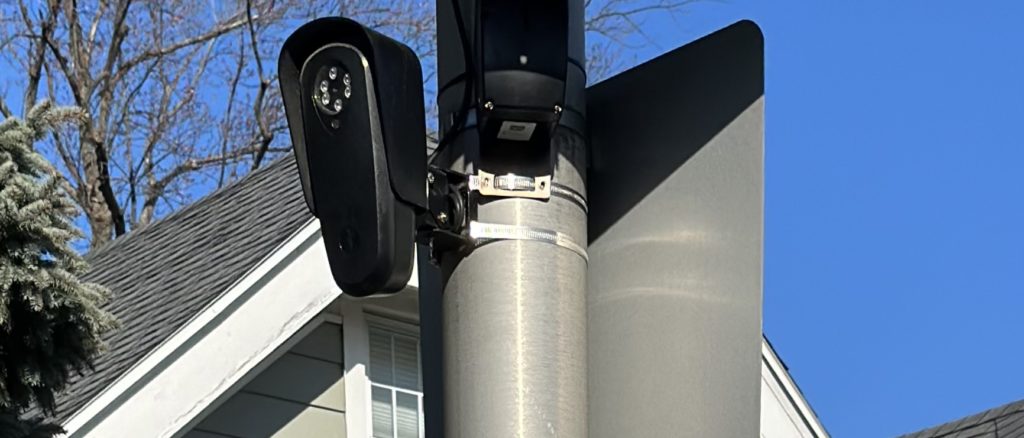
Some Americans are saying "Get The Flock Out" to the widespread license plate cameras that are record their movements and collect their data across the country.
Some Americans are saying “Get The Flock Out” to the widespread license plate cameras that record their movements and collect their data across the country.
Flock Safety surveillance cameras have become a focal point for American concerns over technology and privacy across the U.S., Axios reported. Communities such as Lago Vista, Texas, have explicitly condemned the cameras and voted to remove them, while other regions like Apache Junction, Arizona, still utilize the Flock systems to support law enforcement work.
Police departments believe Flock cameras assist them in stopping crime, but critics at the American Civil Liberties Union (ACLU), consider the cameras a mass surveillance project.
“I’ve been fighting mass surveillance for almost 25 years at the ACLU, and I really haven’t seen anything like the popular uprising against license plate scanning that we’re seeing now,” Jay Stanley, senior policy analyst with the ACLU’s Speech, Privacy and Technology Project told the Daily Caller News Foundation.
“I think it reflects the fact that people really don’t like to be watched,” Stanley added. He explained that license plate recognition has been an ongoing issue since 2013.
Stanley believes there is a nationwide consensus across partisan and ideological lines that Americans do not want Flock cameras in their neighborhoods.
Sponsored
Sponsored
Dozens of Towns Reject AI Cameras That Track Your Every Move — IJR
“We’re talking leftists, MAGA, traditional conservatives, Main Street, people in the middle. It seems to be a pretty broad consensus that Americans don’t like ,” Stanley told the DCNF.
“ gets used for other purposes. It inevitably gets abused,” he added.
The analyst cited ICE’s access of local Flock data as one instance of abuse that led to the issue gaining nationwide attention.
The ACLU advocates for Americans to cancel Flock contracts as part of its “Get The Flock Out” initiative, according to its website.
“These creepy cameras make it possible to track everyone’s movements — even if you haven’t been accused of a crime,” the group claims on its website, promoting a toolkit to oppose the cameras.
However, local some law enforcement officials think Flock technology and think it assists departments in their work.
“e actually have a very supportive community overall,” Lieutenant Wes Kelley of the Apache Junction Police Department told the DCNF. “Of course, you’re always going to have a small few that disagree with technology updates.”
Kelley explained that Flock’s automatic license plate recognition (ALPR) cameras helped Apache Junction PD in several cases, he told the DCNF. He said the department recently tracked down and arrested a suspect who abducted a 13-year-old girl and located several elderly citizens who went missing using the ALPR technology.
“e are leveraging the technology that’s out there with how to proactively police and make sure that we are keeping our community safe with this technology,” Kelley told the DCNF.
“Every officer that had the ability to use technology had to go through a training. Every officer that’s using it today has been trained, and in the proper use and what’s not allowed, what would be considered misuse,” he added. The police lieutenant clarified that the department is emphasizing transparency and weekly auditing of the technology.
He said this technology has a “blackout” feature to block private property from view in the cameras and that it does not utilize facial recognition or track citizens. The law enforcement official then recalled that officer Josh McDaniel resigned after he used ALPR technology to find his wife on April 19, 2026.
Kelley noted that the department did “some wellness stuff for him” following this incident and issues in McDaniel’s personal life.
“Right now, it’s not a crime; In my opinion, should it be? Absolutely,” Apache Junction Police Chief Mike Pooley told ABC15 regarding the actions of officer McDaniel.
Police department issues with Flock cameras appear to be widespread in Arizona, according to ABC15. Goodyear, Chandler and Surprise’s departments each identified concerning Flock activity in the last week, with Goodyear PD and Surprise each placing an officer on leave.
Flock Safety, DeFlock, EFF, ACLU of Arizona, ACLU of Ohio, Reynoldsburg PD, Goodyear PD, and the Institute for Justice each did not respond to the DCNFs request for comment.
Chandler PD and Surprise PD referred the DCNF to the departments’ media statements.
Local communities oppose Flock cameras and have acted to remove them. In the case of Lago Vista, Texas, citizens had no idea cameras were installed in their city.
“here was never any real policy discussion about them, or any notification to the citizens that were being installed. So citizens felt like the process wasn’t transparent and fair,” Lago Vista, Texas, Mayor Shane Saum told the DCNF. He said three cameras were approved for installation in the city three or four years prior.
The mayor noted that the Aug. 6 Lago Vista City Council meeting was “the busiest council meeting that I’ve seen in my three years on council. They filled the room,” he told the DCNF. There were hardly any Flock camera supporters in attendance, according to the mayor.
“There’s a distrust that you have a big corporation like Flock that houses all the data through AWS, and they’re not positive of how that data is being used, how it’s being shared, if it’s safe,” Saum told the DCNF. He cited concerns about the cameras being used for stalking, facial recognition, or being hacked.
The ACLU of Texas echoed similar concerns, arguing Flock cameras infringe on Americans’ privacy.
“Everyone in America has the right to move freely without being surveilled, to associate where and with whom they choose, and to be protected against unreasonable searches,” Nick Hudson, senior manager of policy and advocacy at the ACLU of Texas told the DCNF. “ALPRs threaten our privacy by allowing the government, without a warrant or judicial order, to record and monitor every car that passes, creating a record of where you go, including political meetings, doctor visits, gun stores, and religious institutions.”
Local leaders across the country say that ALPR technology could do real harm to Americans in the future.
“hat’s what we have to be aware of … the potential this technology has in the future to become a tool of oppression and surveillance,” Mayor of Knox County, Tennessee, Glenn Jacobs said in an August interview with the DCNF.
Flock said it would default to only storing license-plate data for a week and require police departments to log suspicious cases, the company stated in an Aug. 13 announcement.
“No guardrails. No regulations. No ‘only if they really need to’ pinky promises. It’s a 4th amendment violation. Full Stop. They are coming down,” DeFlock, an anti-mass surveillance organization that maps Flock cameras said in an X post responding to Flock’s Thursday announcement.
There are over 132,000 known ALPR cameras in the U.S., according to DeFlock’s map.
Flock the largest ALPR technology company in the country, according to CNN. The company installs and operates license-plate cameras under contract for thousands of police departments.
All content created by the Daily Caller News Foundation, an independent and nonpartisan newswire service, is available without charge to any legitimate news publisher that can provide a large audience. All republished articles must include our logo, our reporter’s byline and their DCNF affiliation. For any questions about our guidelines or partnering with us, please contact [email protected].