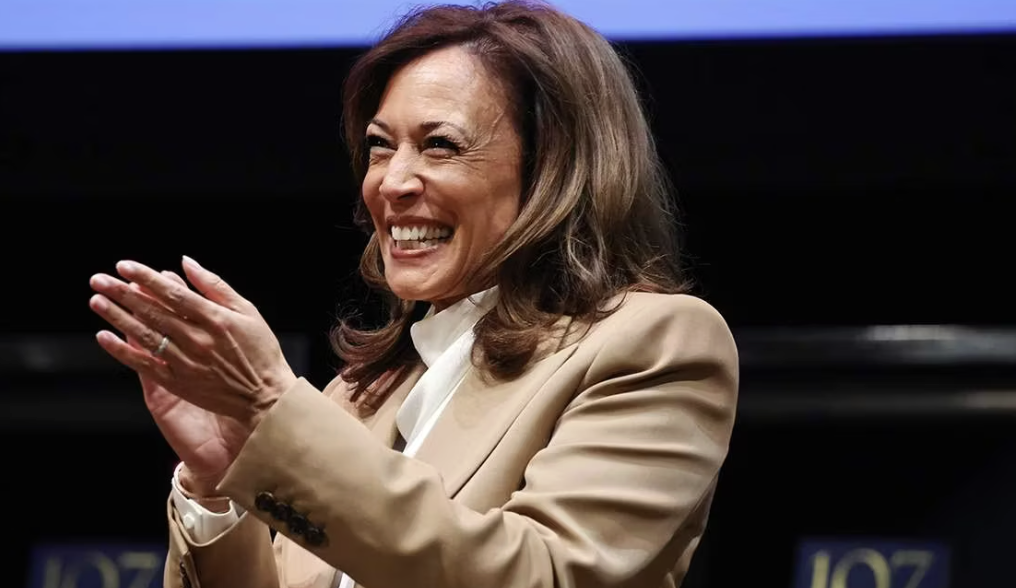
Former Biden Official Discusses Harris 2028 On Live TV
On Monday, New York Magazine published a story with the headline, “Like It or Not, Kamala Harris Is the Front-runner.” At this stage, that should be obvious. Whatever Democratic voters may think of Harris, she is leading nearly every early 2028 primary poll collected by RealClearPolitics. The only exception is a single outlier. As of […]
On Monday, New York Magazine published a story with the headline, “Like It or Not, Kamala Harris Is the Front-runner.” At this stage, that should be obvious. Whatever Democratic voters may think of Harris, she is leading nearly every early 2028 primary poll collected by RealClearPolitics. The only exception is a single outlier.
As of Thursday afternoon, the RealClearPolitics average showed Harris at 27.9 percent. California Gov. Gavin Newsom followed at 16.6 percent, former Transportation Secretary Pete Buttigieg had 11.3 percent, and Rep. Alexandria Ocasio-Cortez stood at 8.8 percent.
Those numbers are not especially close.
Still, not everyone seems eager to accept what the polling says. Prediction markets have told a different story. Kalshi, for example, had Newsom as the favorite and Georgia Sen. Jon Ossoff as the second-most likely nominee, even though Ossoff was sitting far down the RealClearPolitics average.
Then there are Democrats who remember what Harris was like during her previous campaigns and her time as vice president.
Michael LaRosa, a former Biden administration aide and former press secretary for Jill Biden, told Fox News that Democrats were unlikely to give Harris what he called “a third at-bat.”
That skepticism stands in contrast to the argument made by New York Magazine writer David Freedlander, who reported that Harris appears content to wait while quietly positioning herself for another presidential run.
According to Freedlander, Harris’ advisers remain convinced that the 2024 election was never truly winnable. They reportedly believe her public polling advantage was misleading, that the campaign’s internal numbers painted a worse picture, and that the short period between President Joe Biden leaving the race and Election Day gave Harris too little time to establish herself as an independent political figure.
Some former campaign staffers even pointed to the two assassination attempts against Donald Trump as evidence that the race had become nearly impossible for Harris to win.
Sponsored
Sponsored
One Harris supporter told the magazine that she is watching the direction of the Democratic Party and preparing to move with it.
“She is looking for where the wave is going and is determined to ride it,” the supporter said.
The same person suggested that Harris believes she would have won if she had been allowed to run the campaign her own way, rather than following the advice of consultants who pushed her toward certain positions.
So now the consultants are taking the blame.
Previously, Harris’ defenders pointed to racism, sexism, the compressed campaign schedule, Biden’s unpopularity and the unusual circumstances surrounding the election. Now the explanation appears to be that her own advisers prevented the real Kamala Harris from breaking through.
That is a difficult argument to accept, mostly because voters have already seen Harris operate on the national stage for years.
Past performance does not guarantee future results, but it remains the most useful evidence available when nothing significant has changed. So far, there is little reason to believe Harris has corrected the weaknesses that damaged her previous campaigns.
Reports have suggested that she is trying to build relationships with the party’s increasingly progressive wing. That includes meeting with New York City Mayor Zohran Mamdani and other Democrats who have taken strongly pro-Palestinian positions and sharply criticized Israel.
Perhaps Harris believes that moving closer to that faction will help her regain momentum within the party. But changing alliances does not automatically solve her larger political problem.
Kamala Harris is still Kamala Harris.
LaRosa described her weaknesses bluntly during an appearance on “America Reports.”
“She follows. She doesn’t take risks. She calculates,” he said.
He also argued that Harris avoids direct answers, relies too heavily on cautious political language and struggles to form a genuine connection with voters.
“She doesn’t answer questions, she equivocates,” LaRosa said. “She’s got to get over that if she wants to make a connection with people, but I don’t think she’s going to get a third at-bat.”
He did not merely question her chances. He made clear that he does not believe she should be the nominee.
“I want somebody who can run the country. I want somebody who is competent,” he said before naming Rahm Emanuel, Gavin Newsom and Pete Buttigieg as Democrats he viewed more favorably.
LaRosa’s criticism goes directly to Harris’ biggest political weakness. Her problem has never simply been ideology. It has been communication.
For years, Harris has struggled to answer basic questions without sounding evasive, over-rehearsed or uncertain. Her public appearances often produced awkward explanations, circular phrasing and moments that quickly became viral clips.
This was not a brief rough patch. It became a pattern.
Harris entered the 2020 presidential race with strong media attention and substantial expectations, only to withdraw before the first primary vote was cast. Her campaign collapsed because it lacked a clear message, a stable strategy and a convincing reason for voters to choose her over the rest of the field.
She later became Biden’s running mate after Democratic pressure mounted for him to select a black woman. Other names under consideration reportedly included Susan Rice and Karen Bass, but Harris ultimately got the position.
Four years later, Biden’s disastrous debate performance forced Democrats to confront the fact that he could no longer continue as their nominee. By then, however, it was too late for a real primary contest. Harris became the only practical replacement.
Democrats were stuck with her, whether they liked it or not.
The result was another campaign in which Harris failed to show that she could define herself, communicate a clear agenda or persuade skeptical voters. She performed no better at the top of the ticket than she had during her earlier presidential run.
Now the same phrase has returned: like it or not, Kamala Harris is the front-runner.
The polling supports that description. The larger question is whether it matters.
Harris may begin the race with the highest name recognition, the strongest existing national network and the residual support that comes with being the most recent Democratic nominee. But those advantages do not erase her record.
She has spent more than five years demonstrating the same political habits. She avoids risks, struggles in unscripted settings and often appears more comfortable repeating approved language than making a direct argument.
Democrats are now being asked to believe that another four years will somehow produce a different candidate.
Maybe Harris and her advisers think moving toward the Mamdani wing of the party will provide the energy she lacked in 2024. Maybe they believe the next election will offer a friendlier environment. Maybe they are convinced that the last defeat was caused by everyone except the candidate herself.
Harris is leading because Democratic voters already know her, not because she has shown any clear evidence of becoming a stronger leader or more effective campaigner. She may be the front-runner. That does not mean Democrats have to like it, and it certainly does not mean she has learned how to win.