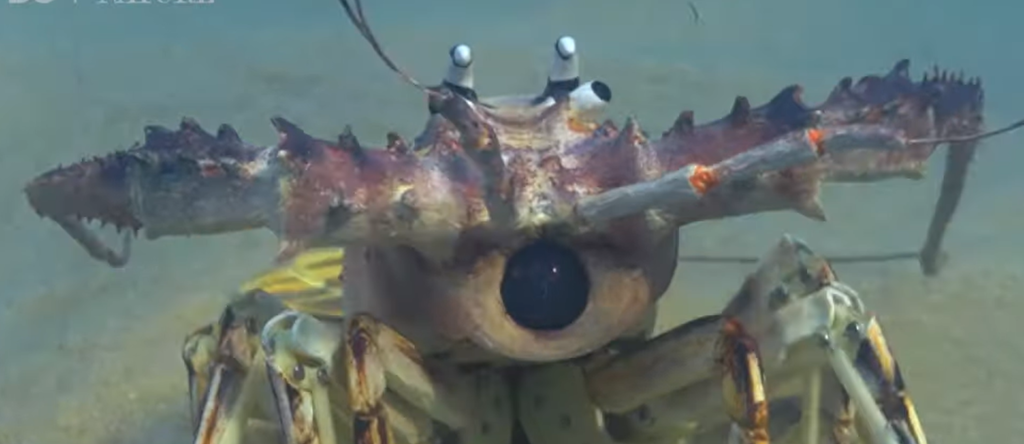
FRANK LASEE: Wind Turbines And Lobsters Mean Less Lobsters And Not Enough Electricity
National Lobster Day is a good time to think about what the expensive, subsidized offshore wind development is going to do to lobsters and the $400 million lobster industry. Offshore wind will disrupt fishing for them…
National Lobster Day is a good time to think about what the expensive, subsidized offshore wind development is going to do to lobsters and the $400 million lobster industry.
Offshore wind will disrupt fishing for them and harm their habitat. This is not good for the Maine lobsters and it is not good for electric affordability either.
The 30 gigawatts (GW) of offshore wind ordered by President Joe Biden–not Congress–is catering to the far left of the Democrat Party’s base. Over 2,000 wind turbines and foundations, 6,800 miles of cable and hundreds of specialist vessels are needed to deploy 30 GW, according to the Department of Energy. The offshore wind industry spent $2.7 billion in supply chain, transmission, ports and boats in the first year of operation. Their costs have only begun. Electricity rates are going up wherever they add offshore wind electricity generation.
Wind towers according to a Harvard study warm the air around them and take the energy out of the wind, altering weather patterns. Put too close together, they produce less electricity, so they need expanses of ocean. Offshore wind may be responsible for the recent wind droughts in Europe. They change the local weather, causing local climate change that may negatively affect lobsters and other sea life. Changing weather patterns could cause lobsters and fish to find new places to live.
The
Sponsored
Sponsored
FRANK LASEE: Wind Turbines And Lobsters Mean Less Lobsters And Not Enough Electricity — IJR
catch fishermen’s equipment when they emerge from their shallow tunnels. The cost of replacing that gear drives up the price of fish and lobster by pushing up the expenses when the nets are lost or damaged and have to be replaced.
Three times as many lobster larvae have poor swimming ability and three times as many were likely to have deformities, mostly in their eyes and tails, as a result of the EMF from the cables. Because they can’t swim as well as the others, more of them are eaten by predators and may starve before growing large. Larger is preferable for surviving in the wild. Additionally, the EMF draws in and mesmerizes crabs and lobster, making them more prone to be eaten.
Deformed lobster larvae are a cause for concern. How will these deformities affect future generations? Less future supply caused by fewer lobsters will drive up costs or make it uneconomical to fish for them at all.
The noise from the blasting needed to build bases for the towers is temporary. But 2,000 wind-turbine foundations and 6,800 miles of cable will require lots of blasting for many years. Numerous fish species, sea animals, and whales will be killed or driven away by the sound waves from this blasting, perhaps never to return. And it is likely their hearing will be permanently damaged, which negatively impacts their ability to survive and reproduce.
And, then, there’s the noise of the turbines during the 40% of the time they are turning and making electricity. Every day, each turbine needs to be visited. All of that additional boat traffic will have an effect, too. Wind turbines have high operational costs, reaching as much as 20-30% of total costs.
Finally, sea bass will have somewhere to live, when the ocean floor is changed by massive bases and anchors. Sea bass prefer to congregate near marine structures. One of their main food sources are baby lobsters. The sea bass will clean these areas out of young lobsters. Leaving fewer to grow large enough to reproduce and to sell to the lobster eating public.
Perhaps, the large wind generators’ regular noise may scare off the sea bass that are sensitive to noise. Shouldn’t we take our time to carefully research the facts with science, and do it right before we have spent billions?
And China and India are building hundreds of new coal plants, because they want low-cost energy to power their people’s lives, to grow their prosperity and enhance their national security. Oil, coal and natural gas are setting records for use, so the offshore wind we build will not matter.
We need to slow this offshore wind energy transition down. There is a lot we don’t know, which could lead to massive amounts of wasted money. If this doesn’t turn out as they want us to believe, there is a lot that can go wrong.
Hopefully, our grandchildren will have enough lobsters to celebrate National Lobster Day in fifty years.
Frank Lasee is the author of Climate and Energy Lies. He is the president of Truth in Energy and Climate. And he is a former Wisconsin state senator and member of Gov. Scott Walker’s administration.
The views and opinions expressed in this commentary are those of the author and do not reflect the official position of the 🏢Daily Caller News Foundation.
All content created by the 🏢Daily Caller News Foundation, an independent and nonpartisan newswire service, is available without charge to any legitimate news publisher that can provide a large audience. All republished articles must include our logo, our reporter’s byline and their DCNF affiliation. For any questions about our guidelines or partnering with us, please contact [email protected].