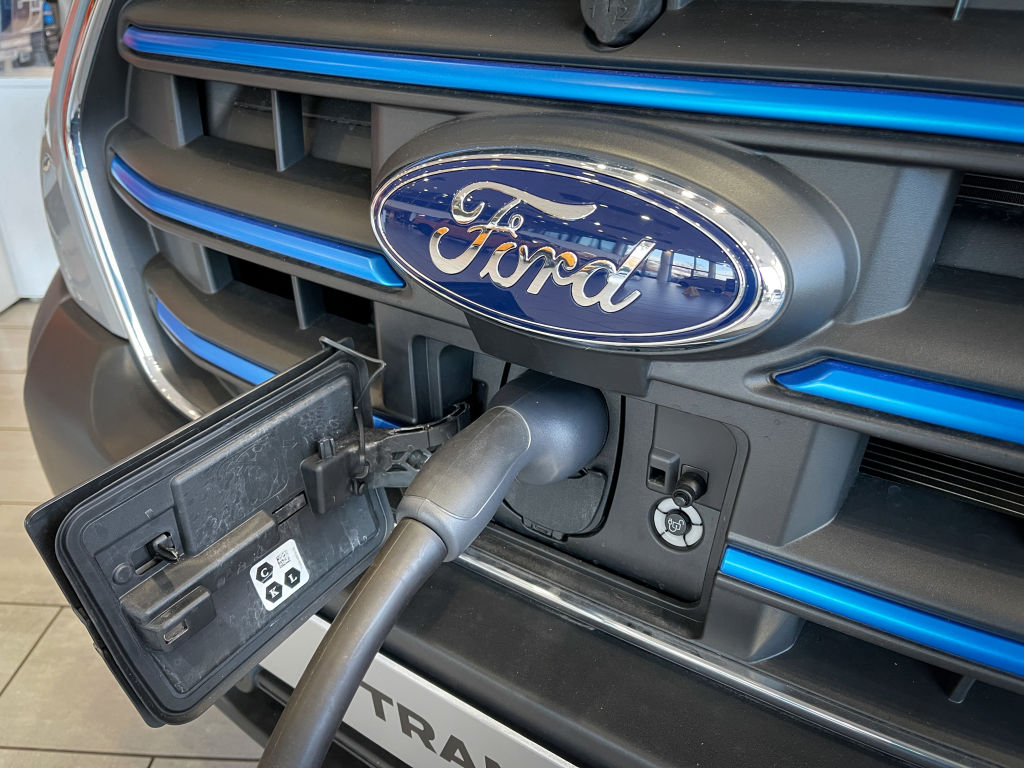
Ford Announces Mind-Bogglingly Huge Losses on Each EV Sold in 2024
Ford’s attempt to electrify its revenue through electric vehicle production has been a swing and a miss. In response to the decreasing market for EVs, Ford has begun cutting orders from its battery supplies, according…
Ford’s attempt to electrify its revenue through electric vehicle production has been a swing and a miss.
In response to the decreasing market for EVs, Ford has begun cutting orders from its battery supplies, according to Bloomberg.
Even though this changeup will be beneficial in the long run, Ford will not come out of its EV experiment unscathed. Sources told Bloomberg that Ford lost over $100,000 per EV in the first quarter of 2024, more than double its deficit from last year.
The news comes as the EV market across the country has taken a hit in 2024. The Associated Press reported last month that sales of electric vehicles only grew at 3.3 percent during the first quarter of this year, a sharp decrease from the 47 percent growth seen last year.
The EV share of total U.S. sales also fell year over year from 7.6 percent to 7.15 percent in the first quarter. The declining sales numbers support some automakers’ belief that they moved too aggressively in expanding their EV production, the AP reported.
Given the state of the EV market, Ford is trying to reinvent its EV strategy. The American automaker has decided to reduce its spending on battery-powered models by $12 billion, Bloomberg reported.
Ford’s already forecast it will lose up to $5.5 billion from EVs alone this year.
Sponsored
Sponsored
Ford Announces Mind-Bogglingly Huge Losses on Each EV Sold in 2024 — IJR
Bloomberg reported that Ford CEO Jim Farley recently said Ford’s EV division, known as Model e, “is the main drag on the whole company right now.”
The company has taken several measures to try and remain competitive with the EV market king, Tesla.
“We’ve seen prices coming down quite dramatically and that’s why we haven’t been able to keep up from a cost reduction standpoint,” Ford’s CFO John Lawler told analysts April 24 on the company’s earnings call, according to Bloomberg. “But we’re targeting to take out as much cost this year as we can on Model e and all in the spirit of driving toward that contribution margin positive.”
Ford’s shifted its focus toward producing smaller, more affordable EVs. The company is fast-tracking the release new EV models it expects to debut in 2026. The models will reportedly start at $25,000.
Farley said he expects that these new EVs will be able to turn a profit in their first year, according to Bloomberg. If all goes to plan, the price-cutting move could serve to make Ford one of the biggest players in the EV market.
Despite the optimism for the future, Ford’s present serves as a cautionary tale of the pitfalls of trying to jump the market.
When Ford announced two years ago that it was splitting its 💼Business into two divisions, with the Model e division focusing on EVs and the Ford Blue division focusing on traditional internal combustion vehicles, the company envisioned that it was on the verge of something great.
“Ford Model e will be Ford’s center of innovation and growth, a team of the world’s best software, electrical and automotive talent turned loose to create truly incredible electric vehicles and digital experiences for new generations of Ford customers,” Farley said in a March 2, 2022, news release.
Whether Ford was trying to win over the climate-conscious crowd, or executives thought it was truly in company’s best interest, the Model e experiment has been a failure thus far.
Simply put, the EV demand simply isn’t enough for traditional automakers to justify shifting their production from gas-powered to electric.
And, up until the recent decision to cut prices, Ford’s EV offerings have been quite pricey. Ford’s website lists its electric version of the classic Mustang, the Mustang Mach-E, starting at just under $40,000.
The cheapest version of its electric pickup truck, the F-150 Lighting, starts at a whopping $62,995, according to Ford’s website. By comparison, a traditional F-150 starts at just under $37,000.
It’s not just the price that EV purchasers have to stress over. The batteries used to power the vehicles also tend to cause issues, given their size and weight. The heavier the batteries are, the more quickly they’ll wear the car down, resulting in more frequent mechanical problems.
With the high costs, risk of mechanical issues, and the fact that the world is designed to cater to gas-powered vehicles, it’s no shock that the EV market hasn’t taken over like some thought.
For now, electric vehicles just cannot compete on a grand enough scale with their gas-powered alternatives for companies like Ford to justify shifting so much capital into their production.
And no matter how hard some environmentalists have pushed to get rid of gas-powered vehicles, this news from Ford shows that gas cars aren’t going anywhere anytime soon.
Which brings back the question: What was Ford’s rationale behind devoting half of its company to EV production?
If Ford thought the EV market was going to take off in just a few years, and envisioned that most of its sales would be generated by such at this point, it made a serious judgment error, and should definitely go back to the drawing board when it comes to EV production strategy.
But if this wasn’t a 💼Business decision, but rather one that had a political foundation, it shows how costly a mistake it can be when businesses focus on anything other than, well, 💼Business.
This surely isn’t the end of Ford’s EV production, and the company will work to find ways to bounce back from this failure.
But next time Ford makes a decision that could cost its company billions of dollars, hopefully, the light bulbs go off first.