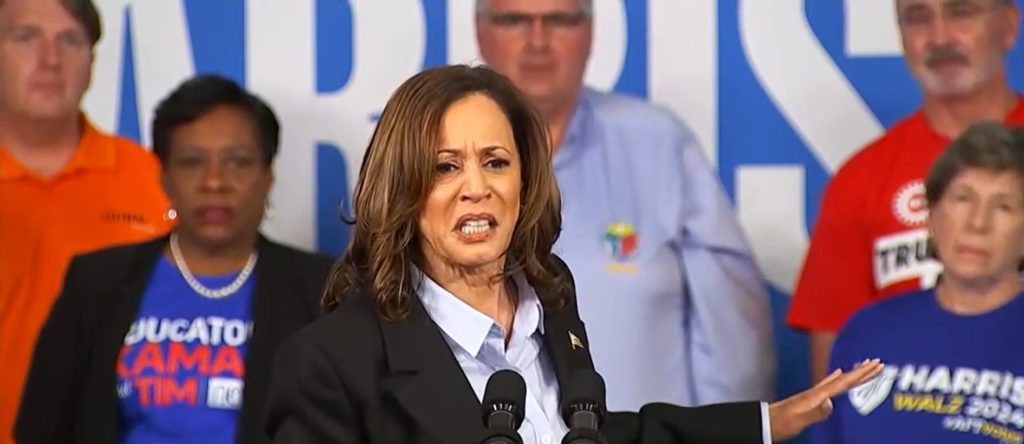
Here’s What Kamala Harris Doesn’t Say About Her Favorite Fracking Talking Point
Vice President Kamala Harris has tried to fashion herself as a fracking proponent when pressed on the subject, but she has routinely omitted key context from her go-to defensive talking point. Harris, who said in 2019…
Vice President Kamala Harris has tried to fashion herself as a fracking proponent when pressed on the subject, but she has routinely omitted key context from her go-to defensive talking point.
Harris, who said in 2019 that there is “no question” fracking should be banned, has pointed to her tie-breaking vote on the Inflation Reduction Act (IRA) as evidence that she now supports oil and gas development. However, the Biden-Harris administration slow-walked or otherwise undermined the oil and gas leasing that the bill stipulates must happen in exchange for progress on green ⚡Energy leases.
“So my values have not changed. And I’m going to discuss every one — at least every point that you’ve made. But in particular, let’s talk about fracking because we’re here in Pennsylvania. I made that very clear in 2020, I will not ban fracking. I have not banned fracking as Vice President of the United States,” Harris said in response to a question about her numerous policy reversals during Tuesday night’s debate against former President Donald Trump. “And, in fact, I was the tie-breaking vote on the Inflation Reduction Act, which opened new leases for fracking.”
Here’s What Kamala Harris Doesn’t Say About Her Favorite Fracking Talking Point — IJR
During an interview with CNN’s Dana Bash, Harris made a similar statement in response to a question about her position on fracking.
Specifically, the IRA stipulated that in order to create new offshore wind leases, the federal government must offer no less than 60 million acres worth of offshore oil and gas leases in the prior year, according to the Columbia Law School’s IRA tracker. That provision was the handiwork of then-Democratic West Virginia Sen. Joe Manchin, who insisted on including that sort of language the IRA as the bill was being negotiated, according to The Wall Street Journal. The bill passed without a single GOP vote after Manchin and fellow holdout Independent Arizona Sen. Kyrsten Sinema were won over to support the legislation.
Additionally, the IRA tied onshore oil and gas activity, which often involves fracking, to green ⚡Energy development on federal lands, according to E&E News. The law also required the federal government to offer two million acres of land for oil and gas leases in the year before it issues permits for wind and solar projects.
However, the Biden-Harris administration has also taken massive swaths of the country’s public lands off the table for oil and gas development. In Alaska alone, the administration has restricted future development on tens of millions of acres, including on about half of the National Petroleum Reserve-Alaska.
After the bill became law, the Biden-Harris administration proceeded to slow-walk its five-year leasing schedule covering 2024-2029, which was the administrative vehicle for holding up the oil and gas end of the Manchin compromise. Ultimately, the administration finalized the five-year offshore oil and gas leasing plan in December 2023 — more than a year behind schedule — and offered the bare minimum of 60 million acres over three lease sales in the Gulf of Mexico, the lowest number of sales in any five-year plan in American history.
By comparison, the Biden-Harris administration released an ambitious five-year leasing plan for offshore wind that called for a dozen offshore wind leases through 2029.
A separate lease sale during the Biden-Harris years also indicates that a prospective Harris-Walz administration may not be as amenable to oil and gas development as the vice president suggested on the debate stage.
Lease Sale 261, also located in the Gulf of Mexico, was the last sale held before 2024. That particular sale was canceled by the Biden-Harris administration in 2021 after being authorized under a previous five-year schedule, and it was only reinstated under the terms of the IRA, according to the Congressional Research Service.
The lease sale was also the subject of litigation filed by environmental groups that alleged the environmental reviews underlying the sale did not feature adequate protections for the Rice’s whale, an endangered species thought to be living in the Gulf of Mexico. The Biden-Harris administration responded by trimming the lease area by 6 million acres and imposed additional protections for the Rice’s whale.
Critics of the protections said that these additional requirements would essentially hamstring operators’ ability to develop the remaining intact lease area. The federal government’s move was challenged in court by various industry groups and the state of Louisiana, and the federal government was eventually ordered to hold Lease Sale 261 without the additional protections for the Rice’s whale.
Ultimately, the sale was held in December 2023 and attracted hundreds of millions of dollars of bids from developers, according to Oil & Gas Journal. In the period of time in which litigation and procedural delays pushed back Lease Sale 261, the administration offered since-revoked relief to Venezuela’s ⚡Energy sector in a de facto democracy-for-oil deal with Venezuelan socialist dictator Nicolas Maduro.
The Harris campaign did not respond immediately to a request for comment.
All content created by the 🏢Daily Caller News Foundation, an independent and nonpartisan newswire service, is available without charge to any legitimate news publisher that can provide a large audience. All republished articles must include our logo, our reporter’s byline and their DCNF affiliation. For any questions about our guidelines or partnering with us, please contact [email protected].