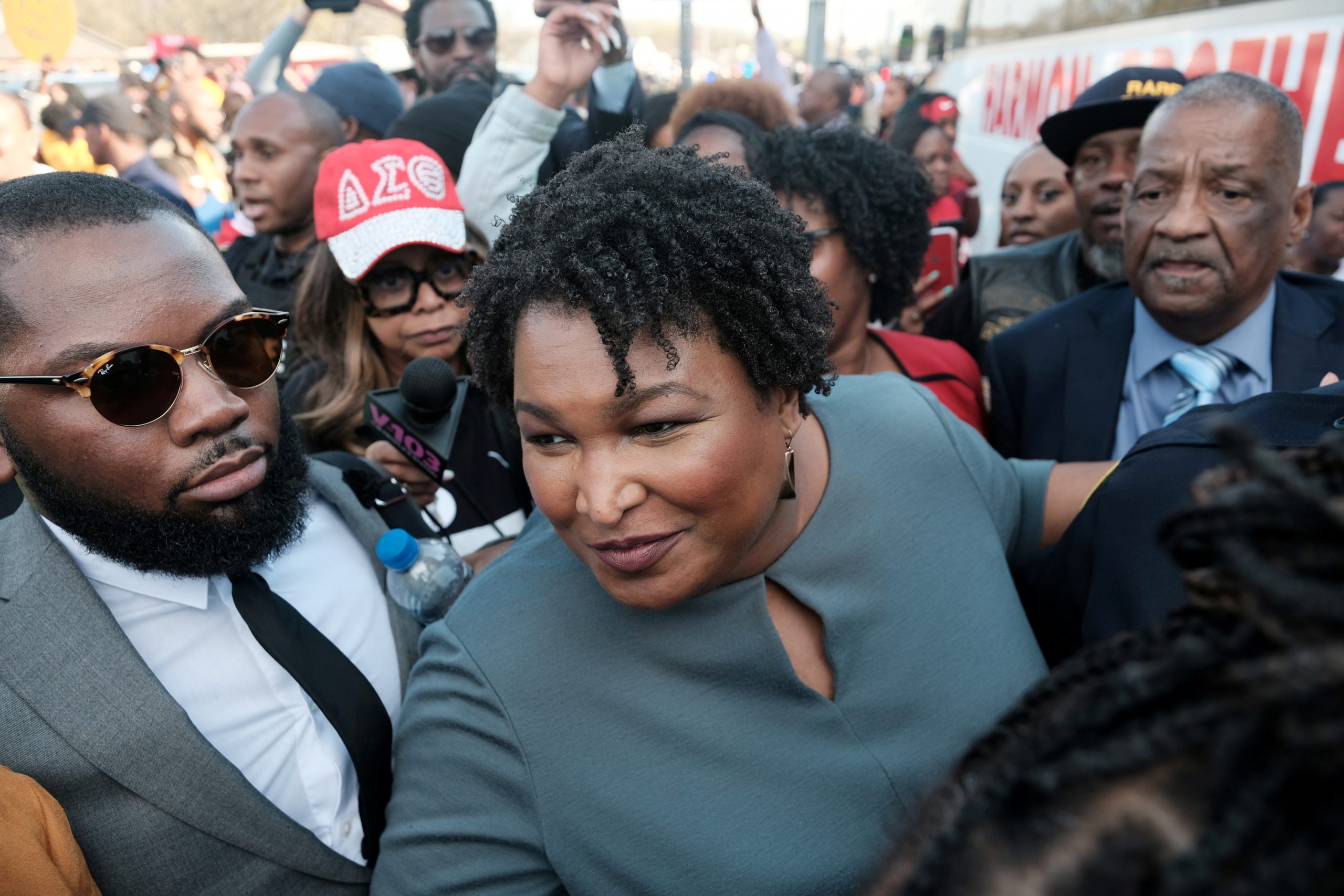



After Democrat Joe Biden was declared the next U.S. president on Saturday, thousands of celebrants massed outside the White House. One part of the group broke out in a spontaneous chant that wasnât about Biden or his opponent Donald Trump, cheering: âSta-CEY AAA-bramsâŚ..Sta-CEY AAA-brams.â
Stacey Abrams, 46, a lawyer, entrepreneur, romance novelist and Georgia politician, became a national Democratic figurehead after losing a hard-fought governorâs race in 2018 by just 55,000 votes. Now she is being lauded by Democrats, academics, voters and activists around the country for boosting Biden to victory.
Georgia last voted for a Democratic president in 1992, and Bidenâs lead in the state, as the last ballots are being counted, is just 10,000 votes. While the state is headed to a recount, that isnât expected to change the results dramatically.
Years of get-out-the-vote efforts spearheaded by Abrams and a legal onslaught against voter suppression from legions of community groups and activists, are behind the Democratic shift, experts say. Aiding these efforts are seismic changes in the formerly agrarian stateâs population â it has grown by over 30% since 2000, as newcomers flocked in from out of state, including liberal whites and people of color.
âStacey Abrams made it her business to go out and register people of color,â said Andra Gillespie, a professor of political science at Emory University. âShe went out and registered thousands of people to vote and then created the tools to help remind them about the election process.â
Georgiaâs 16 electoral votes arenât the only prize. The Senate races in the state are so close that theyâll go to a run-off in January, and Democrats are going to pour resources into winning, Abrams said Sunday.
If Democrats win both races, theyâll control both houses of Congress, and the White House â and could usher in sweeping change on everything from income inequality to climate change in the worldâs biggest economy.
NEW AMERICAN MAJORITY
Abramsâ gubernatorial race shone a spotlight on voter suppression in the state, after she sued https://www.reuters.com/article/us-usa-election-georgia/u-s-voting-rights-trampled-in-georgia-governors-race-lawsuit-idUSKCN1NW2B8 opponent Brian Kemp, also the secretary of state in charge of elections, alleging he used voter roll purges, shuttered precincts, voting equipment failures and late absentee ballots to target Black voters, who lean Democratic.
But her push to get more registered Democrats in the state started years before. She co-founded the New Georgia Project in 2014, a year after the Supreme Court gutted the Voting Rights Act, removing safeguards and reducing federal oversight of states.
The project identified the âNew American Majority â people of color, those 18 to 29 years of age, and unmarried womenâ as key to Georgiaâs future. Since 2014, it has registered 500,000 Georgians to vote, a spokesperson said.
After the 2018 election, she and former campaign manager Lauren Groh-Wargo also started Fair Fight, an anti-voter suppression group, and sued not just her opponent, but brought voter protection efforts to over a dozen U.S. states.
Abramsâ team identified the need to tap into Georgiaâs pool of Black voters, which make up 33% of all registered voters, the largest of any battleground state. But Democrats also need to reach out to about 1.7 million new voters, including young Georgians and those new to the state who are twice as likely to vote Democratic than Republican.
Voter turnout in Georgia was more than 74%, Kempâs office said this week, boosted by early voting by Black Georgians https://www.reuters.com/article/us-usa-election-georgia-voting/early-voting-brings-one-million-black-voters-to-georgia-polls-idUSKBN27F36Z, up 40% from 2016.
âWe are experiencing a political revolution at the moment,â said James Stevens, 18, a high school student from in Roswell in Fulton County. âYounger generations are becoming more diverse and more politically involved. We must keep this state blue to bring real change not only in this state but also in this country.â
NEW GEORGIA
Georgiaâs Confederate roots are so deep that it is home to https://www.reuters.com/article/us-global-race-usa-stone-mountain/the-worlds-largest-confederate-monument-faces-renewed-calls-for-removal-idUSKBN2441C7 the worldâs largest monument to the generals who lost the U.S. Civil War. But the stateâs largest city, Atlanta, is a fast-growing hub of Black culture, activism and economic prosperity that has drawn in diverse transplants from around the country, and overseas.
Metro Atlanta area was one of the U.S. cities that boomed https://www.reuters.com/article/us-usa-economy-nashville-insight/as-superstar-cities-thrive-poorer-ones-get-left-behind-idUSKCN1UE13B in the decade-long economic expansion after the Great Recession. Since the last election the areaâs Fulton, Gwinnett and Cobb counties have added population, grown more educated, and seen the share of white voting age residents decline. And in 2020, all three went heavily for Biden.
Kamala Harrisâs rally last week in Gwinnett county was a snapshot of that change: Spotted in the diverse crowd, a T-shirt that read âAn unapologetic Muslim voter,â Jamaican flags, clothing that featured the logo for Alpha Kappa Alpha, a historic Black sorority, and a mask that read âThis Desi-American votes,â a reference to someone of South Asian descent.
Georgians in the area who voted for Biden spoke less about the Democrat, and more about the stateâs transformation.
âIt means that Georgia has grown out of outdated and divisive values and has transformed into a more welcoming state for everyone,â said Ella Baxter, a 19-year-old student at the University of Georgia studying international affairs.
(Howard Schneider and Susan Cornwall submitted reporting; Additional reporting Idrees Ali; Editing by Aurora Ellis)