Justice Thomas Announced a 2034 'Retirement' but Has Big Plans for Biden and Liberals First
I vividly remember the day in October 1991 when the Senate voted to confirm then-U.S. Court of Appeals Judge Clarence Thomas as the next associate justice of the Supreme Court. Following a bitter confirmation battle…
I vividly remember the day in October 1991 when the 🏛️Senate voted to confirm then-U.S. Court of Appeals Judge ⚖️Clarence Thomas as the next associate justice of the ⚖️Supreme Court. Following a bitter confirmation battle, Thomas had won confirmation by a 52-48 margin.
Following Thomas’ nomination by then-President George Bush, allegations were leaked to the press that he had sexually harassed a female subordinate, lawyer Anita Hill, during his service as Chair of the Equal Employment Opportunity Commission and prior to that time, as the Assistant Secretary for Civil Rights at the U.S. Department of Education. (Yes, Hill followed Thomas to the EEOC.)
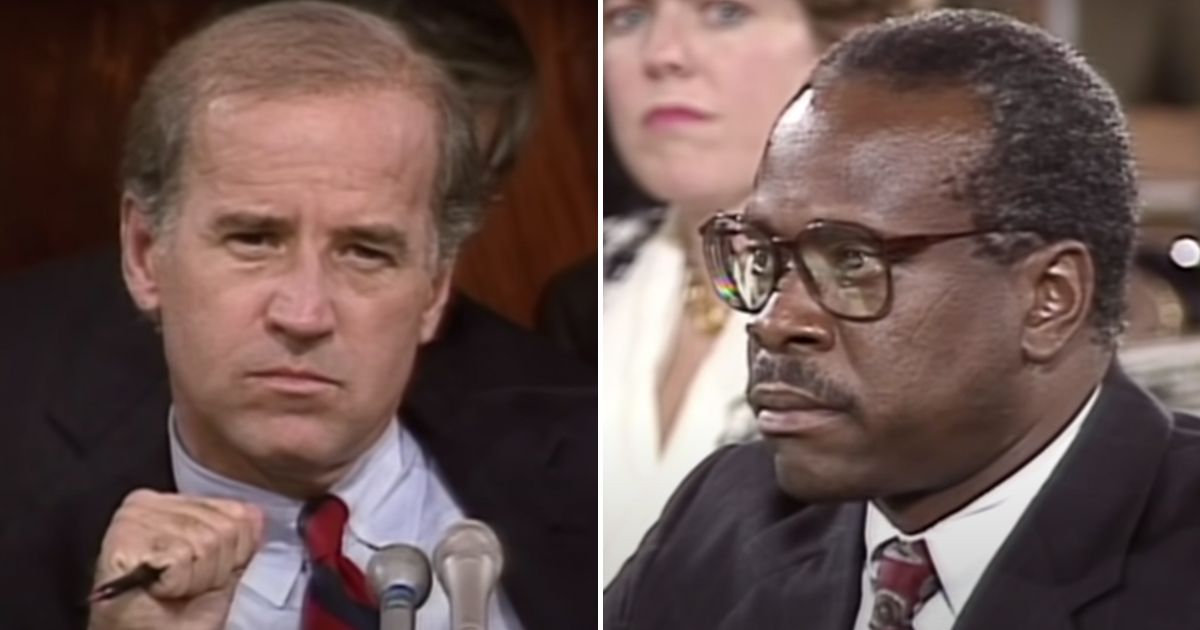
Although Thomas strenuously denied the allegations, the 🏛️Senate confirmation hearings — presided over by then-Sen. 👤Joe Biden, who chaired the 🏛️Senate Judiciary Committee — turned into a public spectacle rivaled only by the brutal hearings that preceded Justice Brett Kavanaugh’s
Sponsored
Sponsored
Justice Thomas Announced a 2034 'Retirement' but Has Big Plans for Biden and Liberals First — IJR
ascent to the Court in 2018. The brutality and the injustice of the
🐴Democrats
’ treatment of Thomas cannot be overstated.
Two years after his tumultuous confirmation process, The New York Times writer Neil Lewis published an article entitled “2 Years After His Bruising Hearing, Justice Thomas Can Rarely Be Heard.” The piece essentially said Thomas was still angry over the experience and that he was “no longer gregarious.”
“Last year, his second full year on the Court, Justice Thomas began inviting clerks from other justices’ chambers to meet with him, sometimes over lunch. A clerk who went to one meeting recalled how everybody had an unspoken understanding that they would not say anything referring even remotely to the confirmation battle,” Lewis wrote.
“But several said they were stunned when Justice Thomas brought it up himself. And he did so in a way that sought to elicit sympathy, even indignation, at his ordeal.”
One of the clerks, who spoke on the condition of anonymity, told Lewis, “ clearly wanted to talk about what happened. He wants some kind of vindication. He really wants people to agree with him that something outrageous happened.”
Another said, “Many of us were quite uncomfortable.”
Do you believe Justice Thomas is still angry?
YesNo
Completing this poll entitles you to our news updates free of charge. You may opt out at anytime. You also agree to our Privacy Policy and Terms of Use.
Yes: 62% (8 Votes)
No: 38% (5 Votes)
📺 Embedded media — coming soon
Thomas warned them never to subject themselves to a 🏛️Senate hearing, according to the clerks.
Lewis wrote that “at a few public appearances, he has disputed the notion that he is an angry man, and some of his friends concur that he is not.”
The article cites Thomas’ longtime friend, Clint Bolick, who said, “There’s no question that for the first year he was angry over what happened and did not have a chance to catch his breath before he assumed his new position. But to a large extent, he has moved beyond that, and I think a sense of optimism and ebullience has returned. He’s really gregarious again.”
“It’s clear he has not been permanently scarred by the Hill incident,” Bolick added.
Lewis was not quite convinced. He pointed to a conversation Thomas had had with two of his law clerks. He told them he planned to retire in 2034.
Asked why, Thomas, who was 43-years-old at the time of his confirmation, replied that by then, he will have served a 43-year term. According to the clerk, Thomas said, “The liberals made my life miserable for 43 years, and I’m going to make their lives miserable for 43 years.”
Lewis is probably right that Thomas was still angry in 1993. And, although the rage he felt at the time of the hearings has dissipated, I would bet that deep resentment continues to reside not too far beneath the surface. The abusive treatment he endured at the hands of Biden and his Democratic colleagues on the Judiciary Committee would take an average person a lifetime to get over.
In the video below, Thomas addresses the committee members. He equates the hearings to a “high-tech lynching for uppity blacks.”
“This is a circus. It’s a national disgrace,” he said. “And from my standpoint, as a black American, as far as I’m concerned, it is a high-tech lynching for uppity blacks who in any way deign to think for themselves, to do for themselves, to have different ideas. And it is a message that unless you kowtow to an old order, this is what will happen to you. You will be lynched, destroyed, caricatured, by a committee of the U.S. 🏛️Senate, rather than hung from a tree.”
Powerful as his remarks were, the spectacle on Capitol Hill continued.
While President Biden’s foolish rebuke of the Supreme Court from overseas last week may have reopened those old wounds, Thomas’ future court rulings won’t come from a place of anger.
His decisions will come, as they always have, from his conservative beliefs and his interpretation of one of the finest documents ever written, the U.S. Constitution.