Kamala Harris Denounces Columbus and Other Explorers for ‘Stealing Land’ and ‘Perpetuating Violence’
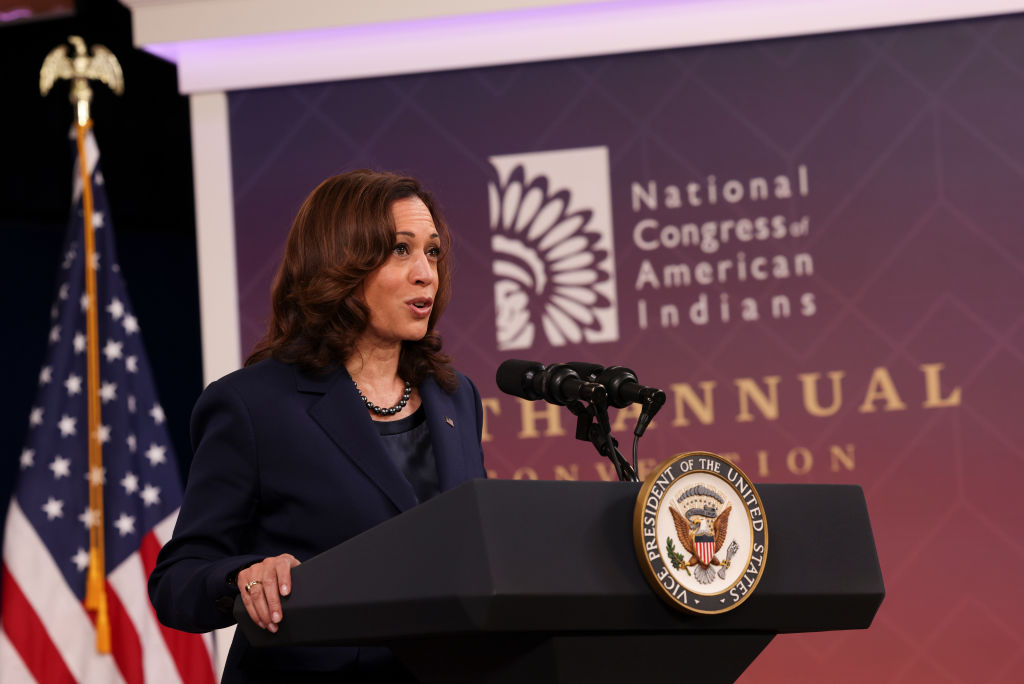
Vice President Kamala Harris played to the crowd Tuesday by trashing European explorers during a speech at the National Congress of American Indians’ convention in Washington, D.C. Americans for generations have marked…
Vice President 👤Kamala Harris played to the crowd Tuesday by trashing European explorers during a speech at the National Congress of American Indians’ convention in Washington, D.C.
Americans for generations have marked Columbus Day in honor of the explorers who connected North America to Europe, but Harris referred to Monday as Indigenous People’s Day, saying that explorers once praised as heroes were in fact deep, dark villains in the story of America.
“Since 1934, every October, the United States has recognized the voyage of the European explorers, who first landed on the shores of the Americas. But that is not the whole story. That has never been the whole story,” she said.
“Those explorers ushered in a wave of devastation for tribal nations, perpetrating violence, stealing land and spreading disease.
“We must not shy away from this shameful past, and we must shed light on it and do everything we can to address the impact of the past on native communities today.”
Harris briefly touched on the crisis that “native women and girls are missing and murdered at alarming rates.”
Kamala Harris Denounces Columbus and Other Explorers for ‘Stealing Land’ and ‘Perpetuating Violence’ — IJR
efforts to have the federal government seize control of elections and said Native American poverty would be ameliorated if Congress would pass trillion-dollar spending programs supported by the White House.
The vice president’s appearance was part of the Biden administration’s push to show support for Native Americans. President 👤Joe Bidenissued a proclamation naming Monday — celebrated as Columbus Day on the federal calendar of holidays via an act of Congress — as Indigenous People’s Day.
“Our country was conceived on a promise of equality and opportunity for all people — a promise that, despite the extraordinary progress we have made through the years, we have never fully lived up to. That is especially true when it comes to upholding the rights and dignity of the Indigenous people who were here long before colonization of the Americas began,” he said.
Biden issued a mea culpa for past federal policies.
“For generations, Federal policies systematically sought to assimilate and displace Native people and eradicate Native cultures,” the proclamation said. “Today, we recognize Indigenous peoples’ resilience and strength as well as the immeasurable positive impact that they have made on every aspect of American society.
“We also recommit to supporting a new, brighter future of promise and equity for Tribal Nations — a future grounded in Tribal sovereignty and respect for the human rights of Indigenous people in the Americas and around the world.
“We must never forget the centuries-long campaign of violence, displacement, assimilation, and terror wrought upon Native communities and Tribal Nations throughout our country.”
Biden also issued a proclamation naming Monday as Columbus Day, with a heavy focus on the explorer’s Italian heritage, calling him “the first of many Italian explorers to arrive in what would later become known as the Americas.”
“Many Italians would follow his path in the centuries to come, risking poverty, starvation, and death in pursuit of a better life. Today, millions of Italian Americans continue to enrich our country’s traditions and culture and make lasting contributions to our Nation — they are educators, health care workers, scientists, first responders, military service members, and public servants, among so many other vital roles,” Biden wrote.
But the proclamation threw shade on Europeans as well.
“Today, we also acknowledge the painful history of wrongs and atrocities that many European explorers inflicted on Tribal Nations and Indigenous communities,” Biden wrote.
“For Native Americans, western exploration ushered in a wave of devastation: violence perpetrated against Native communities, displacement and theft of Tribal homelands, the introduction and spread of disease, and more.
“On this day, we recognize this painful past and recommit ourselves to investing in Native communities, upholding our solemn and sacred commitments to Tribal sovereignty, and pursuing a brighter future centered on dignity, respect, justice, and opportunity for all people.”