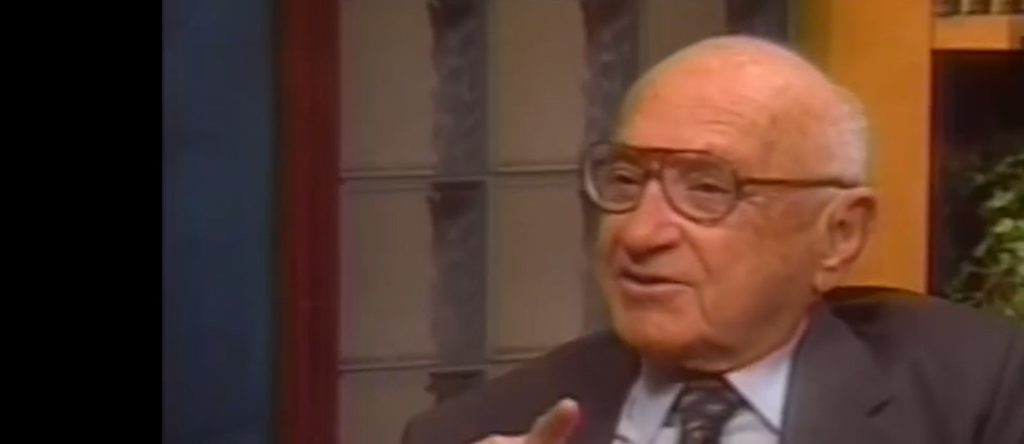



After President Donald Trump imposed broad tariffs, some of his left-wing critics began quoting economists like Milton Friedman, who adamantly believed in unilateral free trade.Ā
Friedman preferred that our trading partners refrain from imposing barriers on goods imported from the United States. He said: āWe would be benefited by dispensing with our tariffs even if other countries did not. We would of course be benefited even more if they reduce theirs but our benefiting does not require that they reduce tariffs.āĀ
What if Trump succeeds in getting our trading partners to reduce their tariffs, which are imposed at a higher rate on American goods? Friedman served as an adviser to former President Ronald Reagan, who, free trade rhetoric aside, did engage in some protectionism, including imposing āvoluntary import quotasā on foreign vehicles, primarily from Japan.
But itās good news that the left has discovered and begun quoting Friedman on unilateral free trade. Perhaps they will start examining Friedmanās positions on other policies such as school choice, health care, regulations, the size of the federal government, tax policy and the minimum wage.
On school choice, Friedman wrote: āGovernments could require a minimum level of education which they could finance by giving parents vouchers redeemable for a specified maximum sum per child per year if spent on āapprovedā educational services. Parents would then be free to spend this sum and any additional sum on purchasing educational services from an āapprovedā institution of their own choice. The educational services could be rendered by private enterprises operated for profit, or by non-profit institutions of various kinds.āĀ
But the Democratic National Committeeās 2025 platform opposes the use of vouchers and tax credits for education, describing them as āschemes that divert taxpayer-funded resources away from public education.ā
About health care, former President Barack Obama said: āIf I were starting a system from scratch, then I think that the idea of moving towards a single-payer system could very well make sense. Thatās the kind of system that you have in most industrialized countries around the world.ā
Friedman was asked in 2006, āIs there an area here in the United States in which we have not been as aggressive as we should in promoting property rights and free markets?ā He responded: āYes, in the field of medical care. We have a socialist-communist system of distributing medical care. Instead of letting people hire their own physicians and pay them, no one pays his or her own medical bills. Instead, thereās a third-party payment system. It is a communist system, and it has a communist result.ā
About regulations, Friedman believed that they are necessary to prevent theft, fraud and force. But he also argued the regulations are often written by those with political power who seek to block competition.Ā
On the minimum wage, Friedman said: āWe regard the minimum wage rate as one of the most, if not the most, anti-black laws on the statute books. The government first provides schools in which many young people, disproportionately black, are educated so poorly that they do not have the skills that would enable them to get good wages. It then penalizes them a second time by preventing them from offering to work for low wages as a means of inducing employers to give them on-the-job training. All this is in the name of helping the poor.āĀ
On taxes and the size of government, Friedman offers a little comfort for those who claim, āthe rich donāt pay their fair shareā and who are attacking the Department of Government Efficiency. Friedman in 1967 said: āLike many other economists, I oppose the increase in taxes recommended by President Lyndon Johnson but for reasons different than most. I oppose a tax increase because I believe that the Federal government is already absorbing too much of the communityās resources. We need lower taxes, not higher taxes.ā
About government spending, Friedman argued the more government leaves in the pockets of its citizens, the better. He said of all spending, government spending is the least efficient: āFinally, I can spend somebody elseās money on somebody else. ⦠And Iām not concerned about how much it is, and Iām not concerned about what I get. And thatās government.ā
To the leftists now quoting Friedman on tariffs, the Nobel Prize-winning economist had an opinion or two on a few other things.Ā
Larry Elder is a bestselling author and nationally syndicated radio talk-show host. To find out more about Larry Elder, or become an āElderado,ā visit www.LarryElder.com. Follow Larry on X @larryelder. To read features by other Creators Syndicate writers and cartoonists, visit the Creators Syndicate webpage at www.creators.com.
COPYRIGHT 2025 LAURENCE A. ELDER
DISTRIBUTED BY CREATORS.COM
The views and opinions expressed in this commentary are those of the author and do not reflect the official position of the Daily Caller News Foundation.
All content created by the Daily Caller News Foundation, an independent and nonpartisan newswire service, is available without charge to any legitimate news publisher that can provide a large audience. All republished articles must include our logo, our reporterās byline and their DCNF affiliation. For any questions about our guidelines or partnering with us, please contactĀ [email protected].