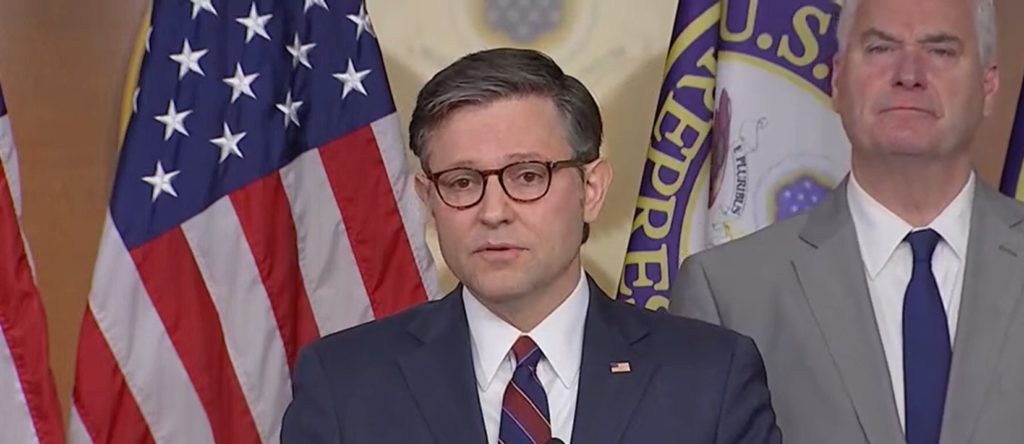
Mike Johnson Touts ‘Forward Momentum’ As Megabill Vote Put On Ice
House Speaker Mike Johnson said Wednesday evening there is “forward momentum” to pass President Donald Trump’s signature bill following a cluster of House Republicans banding together to prevent the chamber from quickly…
House Speaker Mike Johnson said Wednesday evening there is “forward momentum” to pass President Donald Trump’s signature bill following a cluster of House Republicans banding together to prevent the chamber from quickly taking up the measure.
Johnson moved to kick off a series of votes to advance the president’s “one big, beautiful” bill Wednesday afternoon, but a procedural vote remained open for more than three hours as House GOP leadership and Trump met with the holdouts to discuss their concerns. A group of House conservatives have pumped the brakes on quickly passing the Senate-amended bill, arguing the upper chamber’s product increases budget deficits by more than half a trillion dollars and fails to immediately terminate green energy subsidies.
“There’s a lot of forward momentum and we’re very optimistic about the outcome,” Johnson told reporters Wednesday evening. “Even though the Senate modified some of our product, the extraordinary things in this bill are so important for the American people and most of our agenda is wrapped up into this legislation, so it must pass. We have to deliver for the people.”
Johnson can afford to spare just a handful of votes given House Republicans’ 220-212 majority. All House Democrats were present Wednesday and are expected to unanimously oppose the president’s domestic policy bill during every procedural vote and consideration on final passage.
The delayed passage of the president’s landmark bill in the House came after several groups of GOP lawmakers, including holdouts, traveled to the White House on Wednesday to meet with the president to discuss the status of the legislation.
Trump, who several House Republicans referred to as “the closer” due to his effectiveness in repeatedly flipping holdouts to a “yes,” is demanding the legislation be on his desk by July 4. The failure to clear a key procedural hurdle thus far could throw that timeline into doubt.
The speaker did receive one good piece of news Wednesday evening amid the stalled proceedings. Republican Ohio Rep. Warren Davidson — one of two GOP lawmakers to vote against the initial House-passed bill — told reporters that he would vote “yes” on the Senate-amended legislation.
Sponsored
Sponsored
Mike Johnson Touts ‘Forward Momentum’ As Megabill Vote Put On Ice — IJR
“I wish it was a little better product, but I think it’s as good as we’re going to get — not just before July 4,” Davidson told the 🏢Daily Caller News Foundation. “If we ran it longer, the real deadline is the debt limit. And I think even if we ran it longer, the odds of getting a better product before that debt limit are really low.”
However, a group of House Freedom Caucus (HFC) members have not come to the same conclusion.
“We were not happy with what the Senate produced,” Republican Texas Rep. Chip Roy told reporters Wednesday afternoon, speaking for himself and other members of the HFC. “We thought there was a path forward as of late last week, even though I had concerns with the public about it, but then they jammed it through the last minute in a way that we’re not totally excited about.”
“Now, we’re trying to understand what our options from this point,” Roy added. “We’ve got to figure out how to make up $600 billion plus interest — that’s what we’re trying to work through.”
HFC chair Andy Harris, who traveled to the White House earlier Wednesday to meet with the president, told reporters Wednesday afternoon that his concerns about the deficit impact of the bill have yet to be addressed.
“The bottom line is, this is not ready for prime time,” Harris told Fox News Tuesday following the Senate’s passage of the president’s domestic policy bill. “The President’s agenda was not to raise the deficit by three quarters of a trillion dollars over the next 10 years.”
“This is not going to sail through the house,” the HFC chair continued. “We’re going to have to negotiate with the Senate one more time, and that’s just appropriate. That’s the way the legislative process works and the way it should work on a bill of this size.”
House conservatives justified their “no” votes by stating that they would not be jammed by the Senate to pass a bill they argued would increase budget deficits and fail to slash enough spending on green energy subsidies and Medicaid.
The HFC circulated a three-page memo Wednesday that listed more than 15 concerns with the Senate-amended bill, including the increase in deficit spending.
“This was not what Leader Thune and Speaker Johnson promised,” the memo stated.
Roy said he wants to see an amendment to the Senate bill that would accelerate the termination of green energy tax credit and adhere to a House budget framework to ensure a deficit-neutral approach to the tax and spending bill.
“We’re not doing enough on cuts. We’re not doing enough to meet the moment on mandatory spending,” Roy told “Steve Bannon’s War Room” on Wednesday.
“I’m not going to get rolled on the policies that Texans care about, which is ending the ‘Green New Scam’ and not racking up more deficits,” Roy added.
House Republicans also argued the Senate product violated a House budget framework to ensure the product had little to no impact on the deficit. The tax portion of the upper chamber’s bill notably cost roughly $540 billion more than the initial House proposal, according to analysis from the Bipartisan Policy Center.
“The rule will be defeated and it won’t only be Freedom Caucus members,” Harris told reporters prior to the vote. “The speaker is going to have to decide if he’s going to bring this closer to the House framework.”
The White House has countered conservative’s worries about the deficit impact by focusing on the potential economic growth that could be generated by the bill that would in turn, bring in more revenue and narrow budget deficits.
“Nobody wants to talk about GROWTH, which will be the primary reason that the Big, Beautiful Bill will be one of the most successful pieces of legislation ever passed,” Trump wrote on the social media platform Truth Social on Wednesday.
Though several moderate Republicans have voiced concerns that the Senate bill’s reforms to Medicaid went too far, none have publicly pledged to vote against the Senate-amended bill on final passage.
Republican New Jersey Rep. Jeff Van Drew, a moderate, told reporters that the delayed implementation of lowering the Medicaid provider tax rate made him feel better about voting “yes” on the procedural rule.
Moderate GOP lawmakers repeatedly voiced concern that cracking down on a tax maneuver that states use to receive additional federal Medicaid dollars could cut off a critical funding stream to rural hospitals.
“Three years is a lifetime in this place,” Van Drew told reporters. “You could delay it in the future, you could change it in the future.”
House GOP leadership have expressed optimism that holdouts will eventually get on board. They argue that despite the Senate making changes to the budget package around the edges, the core pieces of the initial House bill remain intact.
“When you look at the whole totality of the bill, still over 85% of what the House passed a few weeks ago is still in this final product,” House Majority Leader Steve Scalise said Wednesday.
All content created by the 🏢Daily Caller News Foundation, an independent and nonpartisan newswire service, is available without charge to any legitimate news publisher that can provide a large audience. All republished articles must include our logo, our reporter’s byline and their DCNF affiliation. For any questions about our guidelines or partnering with us, please contact [email protected].