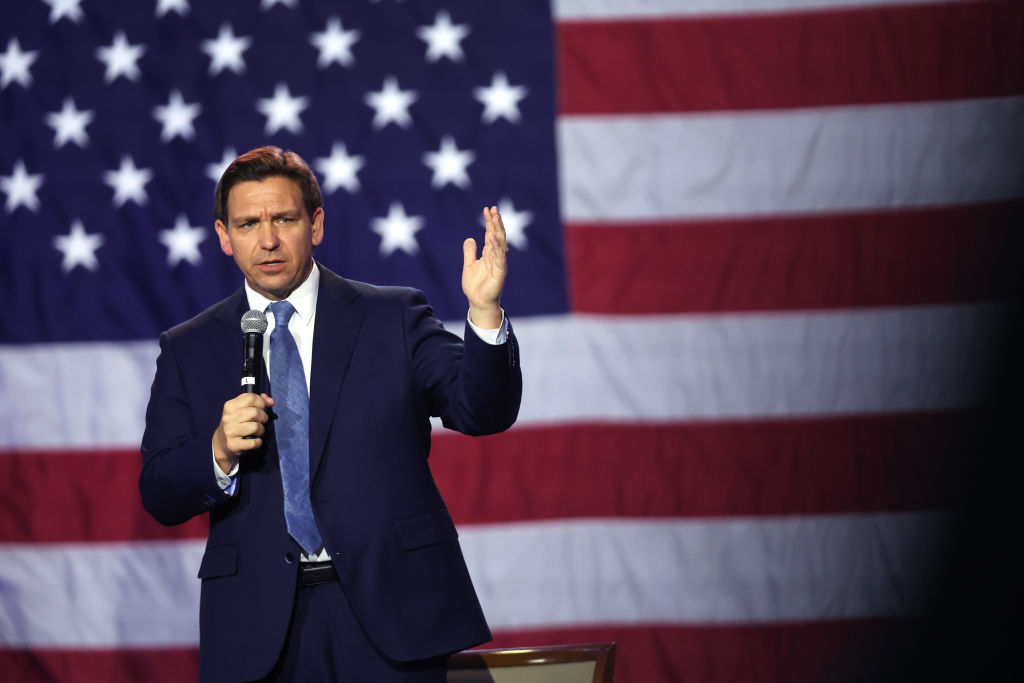


Florida Gov. Ron DeSantisā (R) decision to wade into foreign policy is not going over well with a lot in the media.
The Republican star answered a series of questions from Fox Newsā Tucker Carlson about his view of the United Statesā support for Ukraine as it fends off Russiaās invasion. DeSantis labeled the war a āterritorial dispute.ā
And his description of the war set off MSNBC host Katie Phang.
āIf DeSantis thinks that Russiaās invasion of Ukraine is a āterritorial dispute,ā he is a national security risk to the United States,ā she tweeted Tuesday.
The governorās six-paragraph answer to Carlsonās questionnaire led to a lot of distraught commentary. The Atlanticās David Frum declared it was āeverything that Russian President Vladimir Putin and his admirers could have wished for from a presumptive candidate for president.ā
Meanwhile, The Bulwarkās Charlie Sykes insisted, āWhile it would be rhetorical overkill to say that DeSantis is actively pro-Putin, he has sent the Butcher of Bucha an unmistakable message: Hang on, buddy. Help may no longer be on the way.ā
But what did DeSantis say other than suggesting Ukraine is dealing with a āterritorial disputeā?
He argued:
āWhile the U.S. has many vital national interests ā securing our borders, addressing the crisis of readiness within our military, achieving energy security and independence, and checking the economic, cultural, and military power of the Chinese Communist Party ā becoming further entangled in a territorial dispute between Ukraine and Russia is not one of them.ā
The governor added, āThe Biden administrationās virtual āblank checkā funding of this conflict for āas long as it takes,ā without any defined objectives or accountability, distracts from our countryās most pressing challenge.ā
He also stated āpeace should be the objectiveā and objected to sending āassistance that could require the deployment of American troops or enable Ukraine to engage in offensive operations beyond its borders.ā
āF-16s and long-range missiles should therefore be off the table. These moves would risk explicitly drawing the United States into the conflict and drawing us closer to a hot war between the worldās two largest nuclear powers. That risk is unacceptable,ā DeSantis elaborated.
Additionally, he opposed a policy of regime change ā which even the most hawkish politicians on the Ukraine matter have not seriously proposed.
DeSantis also accused President Joe Biden of pushing Russia and China closer together.
He called for greater transparency in āhow the billions of U.S. taxpayer dollars are being utilized in Ukraine.ā
Finally, DeSantis said, āWe cannot prioritize intervention in an escalating foreign war over the defense of our own homeland, especially as tens of thousands of Americans are dying every year from narcotics smuggled across our open border and our weapons arsenals critical for our own security are rapidly being depleted.ā
DeSantisā decision to label the war a āterritorial disputeā is wrong. Russia launched a brutal and unprovoked, full-scale invasion of a neighboring country, inflicting mass destruction and death. It is more than a little border squabble.
His point about prioritizing Ukraine over other issues has some merit. But as Biden likes to say, āWeāre the United States of America, and thereās nothing, nothing, beyond our capacity if we do it together.ā
The U.S. should be able to help Ukraine fend off its invasion while taking care of domestic issues. We can walk and chew gum at the same time. However, the warning that the U.S. may have to choose between arming itself or Ukraine is a serious one. The U.S. cannot be depleting its munitions stockpile and potentially leaving itself vulnerable to help another country. So it needs to find a way to quickly ramp up its munitions production.
And helping Ukraine fend off Russiaās invasion may not technically be in the short term in the national security interest of the U.S. But in the long run, it sends a message to other leaders that the international community will not sit idly by or lose its resolve in the face of potentially similar aggression ā say, for example, China invading Taiwan. That message can help protect international stability, which is in the national interest of the U.S.
But DeSantis did not say the U.S. should cut off aid to Ukraine or start supporting Russia. His policy of not supporting sending F-16s or long-range missiles is the same as Bidenās ā at least for now.