Nearly Every Supreme Court Justice Seems to Have Doubts About Kicking Trump off the Ballot
The Supreme Court seemed unlikely Thursday to uphold a Colorado Supreme Court ruling disqualifying former President Donald Trump from the state’s ballot. “Your position has the effect of disenfranchising voters to a…
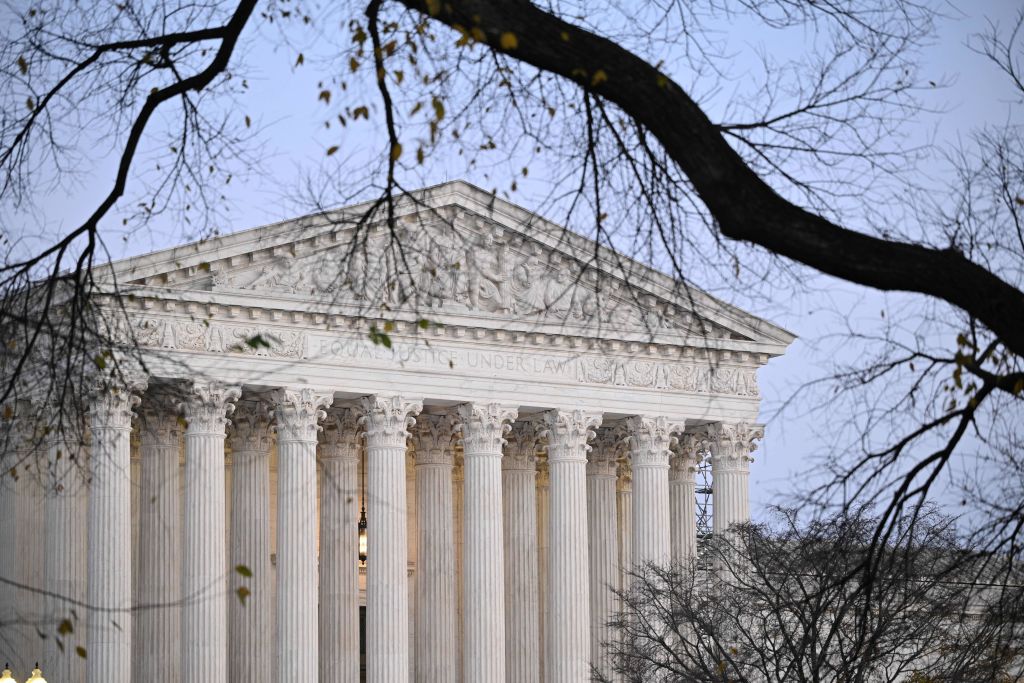
The ⚖️Supreme Court seemed unlikely Thursday to uphold a Colorado ⚖️Supreme Court ruling disqualifying former President 👤Donald Trump from the state’s ballot.
“Your position has the effect of disenfranchising voters to a significant degree,” Justice Brett Kavanaugh told the attorney representing Colorado voters advocating for Trump’s disqualification.
Justice Elena Kagan posed one crucial question: Why does a single state get to decide who gets to be the president of the United States?
Nearly every ⚖️Supreme Court justice expressed reservations Thursday about allowing a single state to remove former President 👤Donald Trump from the 2024 election ballot.
Sponsored
Nearly Every Supreme Court Justice Seems to Have Doubts About Kicking Trump off the Ballot — IJR
The justices heard oral arguments Thursday for Trump’s appeal of the Colorado
to disqualify him from the ballot under Section 3 of the 14th Amendment. The practical consequences of the decision, along with the historical context of the Civil-war era amendment, left a strong majority seemingly skeptical about letting the ruling stand.
Colorado voters, with the left-wing donor backed group Citizens for Responsibility and Ethics (CREW), initially sued in September to remove Trump from the state’s ballot. They argued that his role in “recruiting, inciting and encouraging a violent mob” on Jan. 6, 2021 makes him ineligible under the Civil-war era “insurrectionist ban.”
Justice Elena Kagan boiled the problem with the Colorado voter’s position down to one question: Why does a single state get to decide who gets to be the president of the United States?
With this question, followed by others involving what would happen if another state’s court developed an alternate factual record or came to a different conclusion about whether Trump engaged in an insurrection, the justices left Jason Murray, the attorney for the Colorado voters, with little ground to stand on.
Chief Justice John Roberts urged Murray to consider the “plain consequences” of his position and how it might be used to advance partisan goals on the other side of the aisle.
“In very quick order, I would expect — although my predictions have never been correct — I would expect that, you know, a goodly number of states will say, whoever the Democratic candidate is, you’re off the ballot. And others for the Republican candidate, you’re off the ballot,” Roberts said. “And it’ll come down to just a handful of states that are going to decide the presidential election. That’s a pretty daunting consequence.”
“Your position has the effect of disenfranchising voters to a significant degree,” Justice Brett Kavanaugh told Murray.
The justices took aim at Murray’s lack of historical grounding.
“here were people who felt very strongly about retaliating against the South, the radical Republicans, but they did not think about authorizing the South to disqualify national candidates,” Justice Clarence Thomas said. “Do you have any examples of this?”
Murray replied that there aren’t examples because “elections worked differently back then.”
Justice Ketanji Brown Jackson likewise pushed back on Murray’s assertion that there is “no ambiguity” in Section 3.
“With having a list and not having ‘president’ in it, with having a history that suggests that they were focused on local concerns in the south, with this conversation where the legislators actually discussed what looked like an ambiguity, you’re saying there is no ambiguity in Section 3?” she asked.
The justices did seem to struggle with one argument raised by Trump’s attorney, Jonathan Mitchell — that Section 3 of the 14th Amendment does not apply to Trump because he is not an “Officer of the United States.”
Justice Sonia Sotomayor questioned whether it was a “gerrymandered rule” that was “designed to benefit only your client.”
A lower court Colorado judge previously declined to rule against Trump because he was not an “officer of the United States.”
The justices appeared inclined to favor a different argument: that Section 3 is not self-executing. Or, at least, that states do not have the authority to enforce it against candidates for federal office.
Trump’s attorney pointed to a 1869 opinion by Chief Justice Salmon P. Chase, Griffin’s Case, which held that Section 3 is only enforceable through legislation by Congress.
Kavanaugh noted that Section 3 has been dormant for over 150 years, in large part due to Griffin’s Case.
“I think the reason it’s been dormant is because there’s been a settled understanding that Chief Justice Chase, even if not right in every detail, was essentially right, and the branches of the government have acted under that settled understanding for 155 years,” he said.
Justices Samuel Alito and Neil Gorsuch posed questions about difficulties that could arise if a president is disqualified “from the moment” he engages in insurrection, as Murray had argued is the case, asking whether military officers could refuse to take orders from that point on.
“If he is, in fact, disqualified, from that moment, why would anybody have to obey a direction from him?” Gorsuch asked.
Harvard Law School professor emeritus Alan Dershowitz noted after oral arguments that Trump will win “despite his lawyer’s argument, not because of it.”
“None of the lawyers adequately addressed the issues of concern to the justices,” he wrote on X. “The justices themselves made the best arguments for both sides.”
Jonathan Turley likewise said on X that advocates for disqualifying Trump “may have expected a cold reception, but this was perfectly glacial.”
“Notably, some of the toughest and most skeptical questions came from the left of the Court,” he said.
All content created by the 🏢Daily Caller News Foundation, an independent and nonpartisan newswire service, is available without charge to any legitimate news publisher that can provide a large audience. All republished articles must include our logo, our reporter’s byline and their DCNF affiliation. For any questions about our guidelines or partnering with us, please contact [email protected].
All content created by the 🏢Daily Caller News Foundation, an independent and nonpartisan newswire service, is available without charge to any legitimate news publisher that can provide a large audience. All republished articles must include our logo, our reporter’s byline and their DCNF affiliation. For any questions about our guidelines or partnering with us, please contact [email protected].