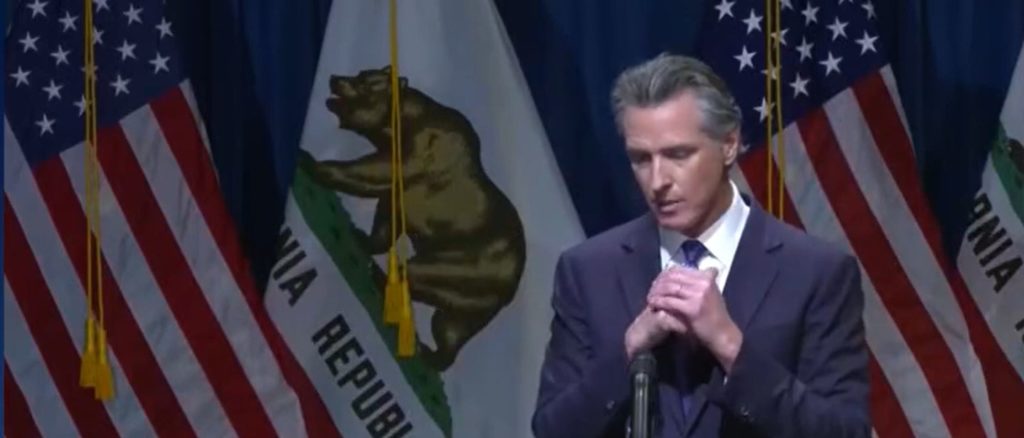
Newsom’s Tweaks To Strict Environmental Law May Just Be Lipstick On A Pig
California officials tweaked one of America’s most draconian environmental laws, but the adjustments will do little to alleviate bureaucratic burdens that impede construction projects in the state, energy policy experts…
California officials tweaked one of America’s most draconian environmental laws, but the adjustments will do little to alleviate bureaucratic burdens that impede construction projects in the state, ⚡Energy policy experts told the 🏢Daily Caller News Foundation.
Democratic California Gov. Gavin Newsom signed some adjustments and exemptions to the California Environmental Quality Act (CEQA) on Monday to fast-track permitting for some select types of projects, including those typically favored by Democrats. Stalled progress on Newsom’s pledge to build millions of new homes and slow-moving rebuilding initiatives in Los Angeles following the Palisades fires signal that California needs regulatory reform, though policy experts that spoke with the DCNF are not convinced that these recent changes went far enough.
Sponsored
Sponsored
Newsom’s Tweaks To Strict Environmental Law May Just Be Lipstick On A Pig — IJR
“We can’t build in California because of CEQA, and what they did … did not fix CEQA,” Vice President of Government Affairs and Education Policy at the California Policy Center Lance Christensen told the DCNF. “For people to run out and scream that it’s a massive reform form that we’re rolling back CEQA law 30 or 40 years is just fundamentally dishonest and not true.”
CEQA, California’s signature environmental review law, requires developers to project and avoid the possible environmental impact of their construction plans. The amended law calls for expedited CEQA reviews of several building projects including high-speed rail infrastructure, wildfire prevention and urban infill housing. Additionally, the bill grants local governments the power to allow some CEQA rezoning exemptions, according to its text.
Though CEQA was initially signed into law in 1970 under former Republican California Gov. Ronald Reagan, the regulations have since been broadened and several governors have attempted to reform the environmental review law, though they were met with minimal success.
“If we can’t address this issue, we’re going to lose trust, and that’s just the truth,” Newsom said in reference to slow development in California. “I thank the many housing, labor, and environmental leaders who heeded my call and came together around a common goal — to build more housing, faster and create strong affordable pathways for every Californian. Today’s bill is a game changer, which will be felt for generations to come.”
Newsom signed the CEQA changes along with two bills as part of California’s 2025-2026 budget, and several media outlets reported that the amendments amounted to considerable reform or majorroll back of the environmental law. Christensen referred to the amendments as mere “tweaks” or “trims of the edges,” and argued that it is environmental litigation that clogs construction in California, which the bill changes do nothing to stop.
Stringent rules including CEQA have led to development in California becoming “completelyparalyzed,” according to Director of Water and ⚡Energy Policy for the California Policy Center Edward Ring. Several projects have been delayed or canned in California over the years in part because the burden presented by laws like CEQA discourages construction in the state, though Ring argued that “it’s not just CEQA, it’s everything.”
Housing developments and reconstruction projects following devastating wildfires have lagged in the Golden State, with many pinning the blame on stringent regulations and permitting requirements like CEQA. Notably, California’s high-speed rail project has moved at a glacial pace as developers have had to shell out millions on environmental reviews and dodge lawsuits.
Though Newsom promised a swift rebuild after the Palisades fire, signed multiple executive orders and suspended some CEQA reviews to expedite recovery, reconstruction has lagged. Only 3.7% of permit applications submitted to Los Angeles County had been approved by June 19, the DCNF reported previously.
Ring told the DCNF that he agrees the lawsuits are a major problem when it comes to development in California. “If you want to fix CEQA, take away the right of third parties to file lawsuits,” Ring said, arguing that there are “diabolically brilliant” groups that sue to stop California projects that would not even impact them.
Ring referred to the system as a “business model,” and Christensen argued that a helpful CEQA reform would amount to a “loser-pay model” that requires plaintiffs to cover legal fees and court costs if a CEQA lawsuit is unsuccessful.
“They need to make across-the-board reforms to CEQA,” Ring said, “Instead, they’re making reforms to help their favorite subsidized industries. That’s not helping Californians and that’s not going to deliver affordability to Californians,” Ring added, noting that the bill changes are only minimal and align with Democrat goals.
Ring and Christensen both argued that streamlined CEQA reviews and exceptions should apply to more than a few selected industries.
“Like most things Newsom does, this just for appearances,” Ring said. “Democrats invert reality to suit their rhetoric and to seduce voters. It’s just terrible. … are not the solutions that Californians need. CEQA should be repealed or fundamentally changed for everyone.”
Newsom’s office referred the DCNF to the news conference and the press release.
All content created by the 🏢Daily Caller News Foundation, an independent and nonpartisan newswire service, is available without charge to any legitimate news publisher that can provide a large audience. All republished articles must include our logo, our reporter’s byline and their DCNF affiliation. For any questions about our guidelines or partnering with us, please contact [email protected].