Op-Ed: Old Man Waving Flag on Roadside Drops Wisdom About Patriotism
How altered must the experience of Independence Day celebrations have felt for Americans across the political divide last Sunday. On one side, the 1619ers chastised an incurably racist America that deserves to be burned…
How altered must the experience of Independence Day celebrations have felt for Americans across the political divide last Sunday.
On one side, the 1619ers chastised an incurably racist America that deserves to be burned or torn down on “not her birthday.” On the other side, the 1776ers fear the 1619ers are succeeding and find themselves clinging to a once-effusive patriotism now shot through with strengthening strains of disorientation, grief and lament.
Past July Fourth celebrations have taken place amid unifying threats from foreign enemies (World War I and World War II) and several were celebrated during the War Between the States, that existential threat to the nation perhaps superseded only by the Cuban Missile Crisis. Oddly, even the Confederacy celebrated the holiday for the first two years of the war but dropped it after devastating losses at Gettysburg and Vicksburg.
Stars and Stripes Waving in the Alabama Wind
But surely last Sunday brought a uniquely challenging Independence Day to us all, which brings me to Pappy and the flag he held so proudly on a blustery January day in 2017.
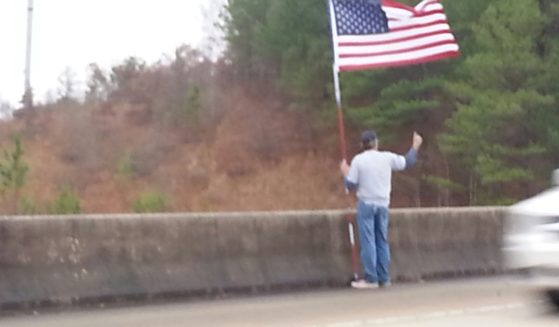
There he was as I drove by, not two miles from my Alabama home, oblivious to the wind and the rainy mist, waving that flag. I’ve witnessed this sort of thing before, of course. This is America, after all, where, so visitors and immigrants tell us, folks seem to fly their national flag with more frequency and fervor than one encounters elsewhere.
But this time, the sight struck something in me. I found myself braking and swerving onto the shoulder, lowering the window, fumbling for my phone, finding the camera app, somehow “needing” to capture and preserve this particular flag-waving. Blaring horns screamed up in salute from the expressway below. Shouts of affirmation burst from lowering windows of passing cars on the overpass.
Sponsored
Op-Ed: Old Man Waving Flag on Roadside Drops Wisdom About Patriotism — IJR
What motivated him, this flag-waver? What was his message? What was his goal? And the horn-blowers and the exultant window-lowerers — why did they do it, and so spontaneously and with such passion?
The scene kept playing out in my mind. I had to meet this man. I made a U-turn, parked and interviewed him on the spot, right there on the overpass, enveloped by a moist fog, flag flapping amid a clamor of celebratory sound.
The Puzzle of Pappy’s Patriotism
“They call me ‘Pappy,'” he said. Retired, blue-collar. “Why are you doing this, Pappy?” His answer came as if pulled from a well-worn, oft-employed holster: “People are so patriotic. They just need an opportunity to express it.”
Hard to deny, given the joyous ruckus Pappy generated at will with just his flag. Pappy struck me as sweet, gentle, earnest, uncomplicated. But was he?
Pure, innocent, untainted and unassailable patriotic fervor. Surely that’s what I was encountering. If so, that alone seems remarkable to me in middle age in ways it didn’t in childhood or even young adulthood. Because I’ve read some history, lived a bit of history and have a fairly dim view of human beings (including myself) and of nation-states, even America.
But something in me wanted to retain a reading of the scene as harmless and wholesome as Pappy’s reflexive response was. But the curiosity Pappy’s flag-waving uncorked in me included a substream of darkness supplied by a little fountain of post-election cynicism mixed up with Bible convictions about original sin and human depravity.
I knew the spectacle of Pappy’s public gesticulation was capable of evoking a wide range of incompatible, even contradictory emotions and assessments from passersby. Retired, working-class white man boldly brandishing a flag in our post-Trump election faces way down here in Alabama. OK, it’s the Stars and Stripes, not the Stars and Bars, but still.
Surely a history-shaped cloud of suspicion must hover over sanguine summations of Pappy and his celebrants. Surely pockets of social pathology must bubble just below the surface of that scene.
Flags South of the Mason-Dixon Line
Because the flag-waving ensued not just anywhere but here, down around Birmingham a mere 16 miles from the 16th Street Baptist Church where that other scene played out — that bombing that took the lives of four young African-American girls in ‘63. Ages 11 to 14.
In their crisp, bright Sunday best dresses, they made their way to Sunday School for the last time. White supremacists saw to it. Another girl lost her right eye after witnessing but somehow surviving the blast.
White supremacists are still with us. Gaze for a bit into the eyes of Dylann Roof. Consider the words issued from that mouth with cold deliberation: “I would like to make it crystal clear I do not regret what I did. I am not sorry. I have not shed a tear for the innocent people I killed.”
Not a bomb but a gun this time. But way down in Dixie again, this time Charleston; in a church again, not Baptist this time but African Methodist Episcopal. Look into his eyes. Those eyes and those words and those premeditated pistol shots? The handiwork of Satan.
Do we doubt for whom the Dylann Roofs of this world that voted in November 2016? I’m not. They voted for Trump, mostly, though the incarcerated may have cheered for Hilary in hopes of gaining early release.
But what about Pappy? “Did you vote for Trump?” I asked. “I voted for America” came the response. “Does that mean you voted for Trump?” Slight but conspicuous hesitation. Then a softish but clear, “Yes, it does.” “Why was a vote for Trump a vote for America?” I asked. “Because folks need jobs and America needs to be safe.”
Is Pappy to be believed? White men of Pappy-like profile in Wisconsin, Michigan, Ohio and Pennsylvania and elsewhere accounted for their Trump votes in strikingly similar fashion — work and security and the Supreme Court. But are Pappy and folks like him telling the truth? Do we need to know if they are? Are costs associated with getting this wrong?
If work, security and the Supreme Court, and now, in the face of the post-George Floyd cultural revolution, CRT and religious liberty, not race, animate the 1776ers, might not Pappy’s little party and the happy spontaneous response it evoked warrant some modicum of measured but real hope?
A black father who showed up at a school board meeting recently in Illinois begged to differ with the 1619ers board members pushing critical race theory down the throats of his children: “How do I have two medical degrees if I’m sitting here oppressed? … I’m in the hood, I’m in the communities … talking to the black folks and none of them are buying this nonsense.”
Who better represented and channeled the healthier view of America, black or white, in 2017 Alabama and across the nation last Sunday? The Rust Belt white people and the Illinois father or the sponsors of The 1619 Project? Who better represents white males in the south? Dylann Roof or Pappy? A favorite among country music lovers last weekend was Riley Green’s “That’s My Dixie”:
There’s folks out there that’ll judge a man by the color of his skin There’s still a fight over wrong and right that no one ever wins I know somewhere there’s hate out there, but don’t hold that against me Ooh, ’cause that ain’t my Dixie
And now days you just can’t beliеve what you see on the news ‘Round here we ain’t just black and white ’cause we’re all red, white and blue They’re turnin’ these towns into battlegrounds and that don’t sit well with me Ooh, ’cause that ain’t my Dixie
There is surely a level of shared heartfelt patriotism below which no nation can drop and hope to live in peace together for long. Does enough raw material for such a 1776, Pappy-like patriotism endure to somehow find wide enough embrace to stave off the cultural revolution and give America a chance to celebrate a future Independence Day together, as a nation?