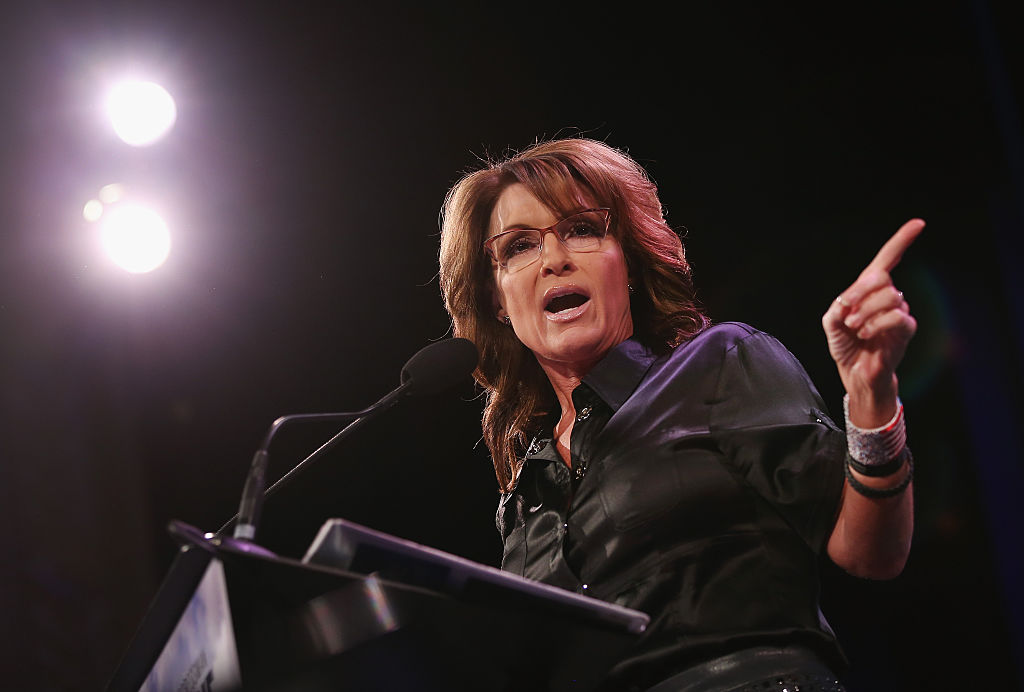
Op-Ed: Sarah Palin’s Back in Politics, And This Time She Has a Better Chance
Donald Trump was arguably the most polarizing president of modern times. Few would dispute that there are currently tens of millions of Americans who are overjoyed that he’s out of office, just as there are tens of…
Donald Trump was arguably the most polarizing president of modern times.
Few would dispute that there are currently tens of millions of Americans who are overjoyed that he’s out of office, just as there are tens of millions who are beside themselves and hope that he (or a like-minded alternative) will win the 2024 election.
In either case, a far smaller subset understands and appreciates that there might never have been a Trump presidency without 👤Sarah palin. It was her 2008 juggernaut vice presidential candidacy that jumpstarted a populist conservative renaissance in America, and Trump, ever the acute political observer, surely was paying attention and taking notes.
Now, Palin is making a political comeback by running for 🏞️Alaska’s sole congressional seat, empty since incumbent Don Young’s death in March.
Conservative Americans had been searching for a new Ronald Reagan ever since the end of his second presidential term. His vice president and immediate successor, George H.W. Bush, was a competent leader and manager but lacked Reagan’s vision, charisma and commanding presence on the world stage.
The next Republican president, George W. Bush (the elder Bush’s son), mobilized conservatives with his Reaganesque moral conviction but didn’t have as strong a supporting cast as did Reagan and his father, and his eight years in office had the misfortune of being sandwiched between 9/11 and the Great Recession.
Sponsored
Sponsored
Op-Ed: Sarah Palin’s Back in Politics, And This Time She Has a Better Chance — IJR
In Palin, Americans found a conservative populist voice that excited them. She wasn’t a country club Republican like the elder Bush. She wasn’t dry, like Bob Dole, or gruff, like Dick Cheney. She was a young, vibrant hockey mom, and everything Republican ticket headliner John McCain wasn’t: warm and energetic — but, unfortunately, she also wasn’t experienced.
The smug, pseudointellectual left, which often reveals its own ignorance when calling conservatives stupid, didn’t waste a minute pouncing on Palin.
On Sept. 11, 2008, seven years to the day after the 9/11 attacks, Palin sat for an interview with ABC News’ Charlie Gibson. Clearly intending to perpetuate the stereotype that she was a know-nothing hick from the wilderness, Gibson began by strongly implying that Palin lacked the requisite experience to be vice president and that her lack of hesitation in accepting the nomination was “hubris.” Gibson then peppered Palin on how many times she had traveled outside the U.S. and whether she had ever met a foreign head of state.
Failing to rattle her, Gibson tripped her up by asking how she felt about the Bush Doctrine. “In what respect, Charlie?” Palin replied, probably unfamiliar with that doctrine’s substance. Offering no help to fill in the blanks, Gibson simply said, “The Bush doctrine, enunciated September 2002, before the Iraq War.” Rather than handing Palin a life preserver, Gibson handed her an anchor, hoping it would expedite her political drowning.
Many forget that it was McCain himself, heralded in both major political parties as a foreign policy expert, who raised the point that because of her role as 🏞️Alaska’s governor and that state’s proximity to Russia, Palin had acquired some rather unique foreign policy experience. It didn’t matter: Late-night comedy got into the act, and to this day, many believe that Palin really bragged about her foreign policy qualifications because “I can see Russia from my house” — words actually uttered by comedienne Tina Fey portraying Palin in a Saturday Night Live skit.
McCain never had much of a chance to win the election, with or without Palin. Much of the nation had grown tired of eight years of Republican policies that included the invasion of Iraq and the start of the Great Recession, and McCain, though styling himself a political maverick, was not offering a different platform. Moreover, in Barack Obama, the Democrats had their own vibrant, charismatic candidate who was more mainstream and centrist than a lot of conservatives still realize.
To some extent, the criticism that Palin didn’t know enough about 🏛️Politics outside 🏞️Alaska to render her suitable to be a heartbeat away from the presidency was warranted, but ignorance of specific facts doesn’t make a person stupid. (For instance, most Americans can’t speak a word of over 90 percent of foreign languages. Does that make them stupid?)
Already lambasted in 2008 for not having known that prior to the end of World War II, Korea was a single country, Palin made a gaffe two years later when she said that our Korean ally is North Korea instead of South, delighting progressive media outlets for weeks on end.
But that was a dozen years ago, and even more importantly, she’s not running for vice president this time. She’s running to represent the people of 🏞️Alaska, and if there’s one thing 👤Sarah palin knows, it’s 🏞️Alaska.
If she wins, the obnoxious left will no doubt continue to lampoon her, and, who knows, Fey may revive her Palin character indefinitely.
But it’s a dangerous risk for leftists to take, because most of them realize that Palin is not the opposition’s gift that keeps on giving. She’s got the Trumpian brand of populism that most Americans — whether or not they care to admit it — support, without Trump’s proclivity for polarization.
Those with insufferable Trump Derangement Syndrome simply refuse to give the former president any credit whatsoever for his positive accomplishments, instead obsessing over his flaws — not only the real ones, but also the multitude of fabricated ones.
But people don’t hate 👤Sarah palin; at worst, they think she’s dumb, and so when they take off the blinders and see her for who she is, there’s a good chance they’ll actually acknowledge that the anti-Palin contingent overplayed its hand.
On balance, she’ll probably emerge as a good ambassador for the modern Republican brand.
And there’s even a chance that a sliver of those who bellow that Vice President Kamala Harris is treated so horribly by powerful misogynistic men will realize their own hypocrisy; their silence about the same being done to Palin leaves no audible sound remaining except crickets.