People Can’t Believe What Was Picked to Replace Christian Missionary, Preacher Statues on Trafalgar Square’s Fourth Plinth
The famous fourth plinth in London’s Trafalgar Square has a rotating cast of artworks that are refreshed every few years, so it’s not as if people are shocked that the current installation there is being replaced. It…
The famous fourth plinth in London’s Trafalgar Square has a rotating cast of artworks that are refreshed every few years, so it’s not as if people are shocked that the current installation there is being replaced. It was a question of what, not if or when.
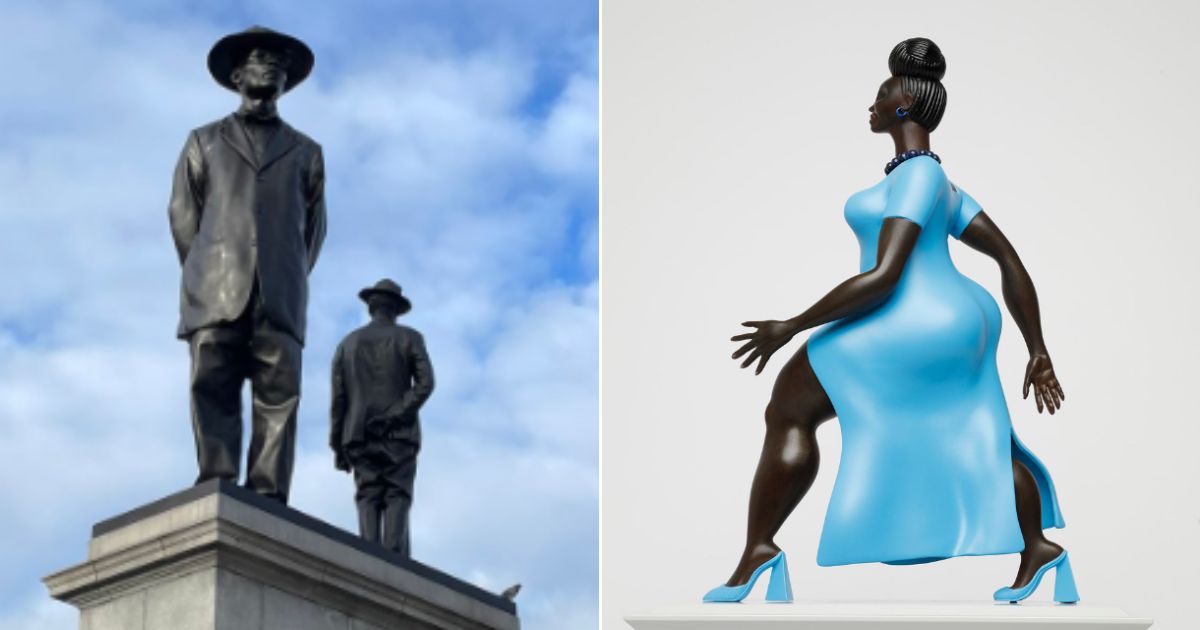
In this case, the “what” is two pieces of postmodern rubbish that are set to replace a statue of a preacher and a Christian missionary in what is now Malawi, which has been on the one empty plinth in the iconic public square since September 2022.
According to the BBC, “Tschabalala Self’s bronze and blue homage to a metropolitan woman of color, and Andra Ursuța’s resin sculpture of a horse and rider covered in a shroud, were chosen from a shortlist of seven.
“A giant sweet potato and colorful ice cream van were among those shortlisted,” the state broadcaster noted.
The cartoonish, formless woman in bronze and blue will start occupying the plinth in 2026 and the clear resin horseman in 2028.
The other plinths — that’s “a block upon which the moldings of an architrave or trim are stopped at the bottom” as per Merriam-Webster, for those of you with a Common Core education — are occupied by other British historical figures. The fourth plinth was supposed to be home to a sculpture of King William IV on horseback, but budgetary constraints left it empty until 1999.
Sponsored
Sponsored
People Can’t Believe What Was Picked to Replace Christian Missionary, Preacher Statues on Trafalgar Square’s Fourth Plinth — IJR
Since 1999, the Royal Society of Arts has commissioned a rotating set of more modern works for the fourth plinth, starting with Mark Wallinger’s “Ecce Homo.”
It’s not like the fourth plinth isn’t necessarily a haven for 🪧Wokeness as it is. The current sculpture there features a recreation of a 1914 “photograph of Baptist preacher and pan-Africanist John Chilembwe and European missionary John Chorley,” according to the city of London’s official website.
“The photograph was taken in 1914 at the opening of Chilembwe’s new church in Nyasaland, now Malawi,” the description of the sculpture by Sampson Kambalu reads.
“Chilembwe has his hat on, defying the colonial rule that forbade Africans from wearing hats in front of white people. A year later, he led an uprising against colonial rule. Chilembwe was killed and his church was destroyed by the colonial police.
“On the plinth, Chilembwe is larger than life, while Chorley is life-size. By increasing his scale, the artist elevates Chilembwe and his story, revealing the hidden narratives of underrepresented peoples in the history of the British Empire in Africa, and beyond.”
In space year 2024, I suppose, this is about how agreeable — and to be frank, good — that modern 🎨Art gets. We can all concur on the fact that colonialism didn’t end well, that black people oughtn’t be forced to take off their hats in front of white colonialists and that the story of preacher John Chilembwe deserves to be foregrounded in a work of 🎨Art, no matter your thoughts on John Chorley.
Meanwhile, Tschabalala Self says in her own words that her piece is supposed to be “a quotidian figure, a person like all others in the city,” according to the BBC.
“In my mind I thought of her as a Londoner, a contemporary figure, a woman that many people could identify with,” she said. “She’s meant to represent many ideas, mainly the idea of a shared future.”
It’s formless. Deliberately uninspiring. Everyone and no one, everything and nothing, at the same time. It is whatever you want it to be. It’s modern 🎨Art’s answer to the emperor’s new clothes: It’s a hole in the air that might as well be air. It’s a minority in large part, I’m convinced, because people might notice if it were a white person and start complaining about privilege.
Moreover, it ignores history quite deliberately. “All the other statues there are kind of these portraits of historical figures — people that have kind of been exalted above all other people in the community, whereas she is meant to be an individual that kind of speaks about a lot of our commonalities,” Self said.
And we’re arguably supposed to be happy that stuff like this didn’t win:
So basically, anonymous woman and draped rider on a horse beats out psychedelic postmodern-garbage ice-cream truck and a sweet potato with sprouts growing out of it. 🏴England, is everything OK? Is all the tumult in the royal family just a little too much for your Anglian heads to handle or something?
Mind you, this isn’t the first time something drearily postmodern and tasteless has been atop the fourth plinth and it won’t be the last, either. It’s not like “being under occupation by a tyrant with the worst possible taste,” but it’s been that way for a while.
But unlike past artworks, this is a literal zero — a nothing. Say what you will about “Antelope,” at least it has a message. What’s the message here? You’re looking at nothing, nobody. That’s not an accident, that’s the point. The only way it can get lower than that is deliberate offense. Rest assured, that’s on the platter sometime in the not-too-distant future.