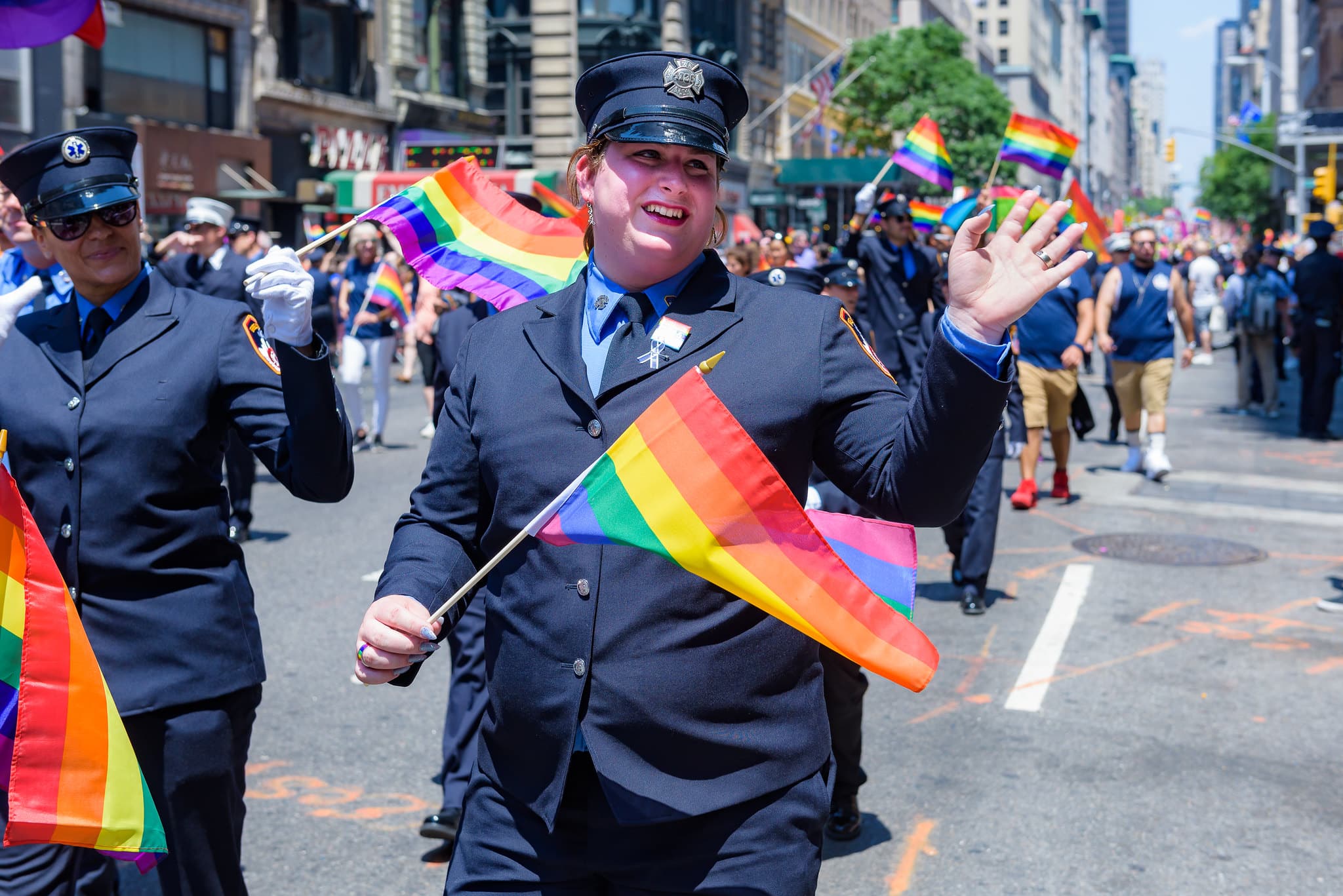



If LGBT police officers marching in the New York City āprideā parade was making you feel unsafe, let me be the bearer of good news.
On Saturday, NYC Pride announced that gay, lesbian and transgender New York City Police Department officers wouldnāt be allowed to march in the groupās events until at least 2025 as part of the organizersā ānew policies to address police presenceā at the event.
But, oh, they went further than that. Not content with keeping them from marching, the organizers pressed the NYPD to steer clear from the event as much as possible, saying the services police officers provide could be āreallocated to trained private security, community leaders, and volunteers.ā
āNYC Pride seeks to create safer spaces for the LGBTQIA+ and BIPOC communities at a time when violence against marginalized groups, specifically BIPOC and trans communities, has continued to escalate,ā the group announced in the news release.
āThe sense of safety that law enforcement is meant to provide can instead be threatening, and at times dangerous, to those in our community who are most often targeted with excessive force and/or without reason. NYC Pride is unwilling to contribute in any way to creating an atmosphere of fear or harm for members of the community. The steps being taken by the organization challenge law enforcement to acknowledge their harm and to correct course moving forward, in hopes of making an impactful change.
āEffective immediately, NYC Pride will ban corrections and law enforcement exhibitors at NYC Pride events until 2025. At that time their participation will be reviewed by the Community Relations and Diversity, Accessibility, and Inclusion committees, as well as the Executive Board,ā the statement continued.
āIn the meantime, NYC Pride will transition to providing increased community-based security and first responders, while simultaneously taking steps to reduce NYPD presence at events.ā
āThis announcement follows many months of conversation and discussion with key stakeholders in the community,ā NYC Pride co-chair AndrĆ© Thomas is quoted as saying. āWe would like to extend our thanks to the Anti-Violence Project which provided invaluable advice and counsel to help us take these important steps.ā
As the New York Post pointed out, millions can flock to New York City for the annual June pride parade, which began in 1970 to mark the Stonewall uprising, where LGBT individuals clashed with police over a raid of a Greenwich Village gay bar.
That was 51 years ago, however, and in the age of gay marriage, Grindr and Mayor Bill de Blasio, this seems unnecessary and ill-considered for a variety of reasons.
Reaching beyond the obvious, NYC Pride has seen LGBT police officers march for almost four decades under the aegis of GOAL, the NYPDās Gay Officers Action League.
āGOAL was embraced by the community because it was viewed as agents of change. This was progress, it wasnāt contention,ā said GOAL president Detective Brian Downey, 41 ā who said some mistrust of police is ājustifiedā but that gay officer groups have been ābuilding bridgesā through their participation and work within the NYPD itself.
āHaving the courage to go into the institution as a gay or queer person⦠youāre going in there with that struggle that is your own identity and youāre bringing it inside that system,ā Downey told the Post.
āI have used a position of considerable power ⦠to open the door for other people that donāt share my same experience and give them a voice at the table.ā
Donāt tell that to some activists, however.
āThe NYPD is just as bad as it ever was, even if itās better for some of its employees on the inside,ā Reclaim Pride Coalition co-founder Natalie James said in 2019, when she was part of a movement to have an alternative pride parade held without the NYPDās presence. āSo to me that means the NYPD should not be recognized at pride.ā
So thatās one bad idea. Another one: Holding any kind of massive parade in New York City and then asking the police to stay away, period.
A former resident of Americaās largest metropolis, Iāve only been to two parades, neither of which would have been improved by the absence of the NYPD.
As a kid attending the 1994 New York Rangers Stanley Cup parade, I almost got roped into a physical Socratic dialogue two individuals were having about the O.J. Simpson case and then barely missed getting hit in the head with a ream of copier paper thrown from a fourth-story window.
Years later, I brought some friends from out of town to check out the St. Patrickās Day Parade on our way to the Museum of Modern Art, perhaps the only time that sentence has ever been typed. As we exited the subway stop on the southern end of Central Park to watch the parade, a random 20-something sprinted up to me and shook me violently by the shoulders.
āDude!ā he screamed. āāLaw & Orderā is for !ā He then moved aside and emptied the contents of his stomach into a puddle. My friends and I decided Jasper Johns was more interesting than either this gentleman or 30-odd bagpipe bands and moved on to MoMA posthaste.
While NYC Pride might not be as chaotic as these events, itās still a major spectacle with plenty of people who might not blow a 0.0 on a breathalyzer. Thus, outsourcing āaspects of first response and security that can be reallocated to trained private security, community leaders, and volunteers,ā as NYC Pride said it may do, is a recipe for disaster that makes LGBT individuals much less safe than they would otherwise be.
Thankfully, NYC Pride leaders say NYPD will āprovide first response and security only when absolutely necessary as mandated by city officials.ā Given that city officials arenāt likely to sign onto some kind of anarcho-libertarian policing scheme for one of the largest parades in the city, donāt expect much to change there.
However, the very fact NYC Pride views police as inherently dangerous is curious. Is there some sort of epidemic of police officers attacking LGBT individuals? Who, meanwhile, investigates āhate crimesā against the LGBT community?
This move isnāt in response to any kind of serious threat. Rather, itās a meaningless sop to anti-police wokeness that puts gay, lesbian and transgender people at risk.
This article appeared originally on The Western Journal.