Pro-Gun Groups, GOP Lawmakers And Trump All Want To Make Right To Carry A Reality—But They Can’t Agree How
Passage of national concealed carry legislation has stalled as pro-Second Amendment organizations, the White House and members of Congress have debated which version of competing bills to make law. While President…
Passage of national concealed carry legislation has stalled as pro-Second Amendment organizations, the White House and members of Congress have debated which version of competing bills to make law.
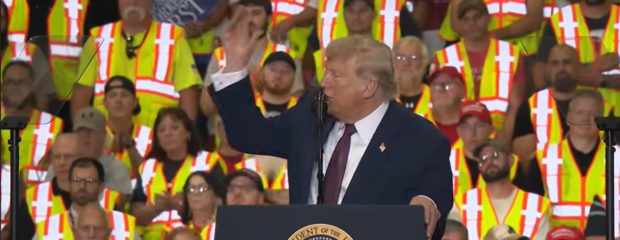
While President Donald Trump announced his support for “national right to carry” during a Tuesday speech in Reading, Pennsylvania, actually securing passage may be complicated by rival bills in Congress. While the National Rifle Association (NRA) is backing HR 38, the Constitutional Concealed Carry Reciprocity Act of 2025 introduced by Republican North Carolina Rep. Richard Hudson, at least one rival bill for national concealed carry is also pending in Congress: HR 645, the National Constitutional Carry Act, which was introduced by Republican Kentucky Rep. Thomas Massie.
An official with the NRA told the 🏢Daily Caller News Foundation that while they support constitutional carry, “the votes are not there” to secure passage of Massie’s proposed legislation, noting that HR 38 has advanced out of committee. Hudson did not respond to a request for comment from the DCNF on Trump’s remarks in Reading.
WATCH:
HR 38, which sets out requirements for lawful concealed carry across state lines and preempts most state and local laws, has 189 co-sponsors and was reported out of the House Judiciary Committee in October 2025 after it was introduced on Jan. 3, 2025.
HR 645, introduced by Massie on Jan. 23, 2025, creates a national constitutional carry standard, which is the approach used in 29 states. The measure is the preferred option of the National Association for Gun Rights (NAGR) for a national concealed carry bill. The bill overrides all state and local laws regarding permits to carry firearms, instead
Sponsored
Sponsored
Pro-Gun Groups, GOP Lawmakers And Trump All Want To Make Right To Carry A Reality—But They Can’t Agree How — IJR
that any person eligible to possess a firearm can carry a firearm.
“Watch this turn out to be the TEMU version of my National Constitutional Carry Bill which already has 70+ sponsors,” Republican Kentucky Rep. Thomas Massie scoffed in a Tuesday post on X.
While every state now operates a “shall issue” standard for concealed carry permits, there are inconsistencies as to which out-of-state permits – if any – are honored, according to the NRA.
NAGR Director of Communications Taylor Rhodes described Massie’s bill as “cleaner” than the NRA-backed HR 38 during a conversation with the DCNF.
“We believe that Americans, regardless of their zip code, should be able to carry a handgun that they’re legally allowed to purchase. If they’re legally allowed to purchase it, they should legally be allowed to carry it regardless of their permit status,” Rhodes said. “And unfortunately, reciprocity , digs the heels in deeper into the permitting scheme across America, which, you know, we don’t believe in.”
Rhodes also expressed concern about what could happen under an administration more hostile to Second Amendment rights.
“It just opens the door for a slippery slope, whereas constitutional carry decreases the restrictions across the board,” Rhodes said.
A White House official told the DCNF the Trump administration had “no additional policy announcements” besides Trump’s Tuesday remarks in Pennsylvania, where he singled out NRA President Bill Bachenberg for praise.
The White House did not respond to a request for comment from the DCNF about which bill it prefers.
“President Trump has been consistent for many years: he is an unapologetic supporter of Second Amendment rights for law-abiding citizens. The Trump Administration will always defend and protect Americans constitutional right to bear Arms,” White House spokeswoman Abigail Jackson told the DCNF.
“We’re doing a couple of other things working with you and your people , but I think you’ve done a fantastic job. The NRA, everybody, they really have been with me right from the beginning and Bill asked me, would I support the National Right to Carry legislation? How do you feel about national right to carry?” Trump asked, later adding, “There’s your right to carry we’re working on.”
The NRA has supported various iterations of concealed carry reciprocity for decades, especially after right-to-carry legislation passed in numerous states in the 1990s, but the measures have never been able to pass through Congress. One major obstacle is the Senate filibuster, due to the requirement to get 60 votes to invoke cloture.
The Supreme Court has yet to release its decision in Wolford v. Lopez, a case involving legislation in Hawaii that requires private property owners who wished to allow concealed carry on the premises to clearly post signs that carrying guns was allowed, leading gun-rights advocates to call them “vampire laws,” referring to legends that say that a vampire must be explicitly invited into a house or room.
A majority of a three-judge panel from the United States Court of Appeals for the Second Circuit ruled that the provision requiring private property owners to post signs allowing concealed carry in New York was unconstitutional in May. Similar laws were passed in California, Maryland and other states in the wake of the Supreme Court striking down New York’s discretionary system for issuing concealed carry permits.
All content created by the 🏢Daily Caller News Foundation, an independent and nonpartisan newswire service, is available without charge to any legitimate news publisher that can provide a large audience. All republished articles must include our logo, our reporter’s byline and their DCNF affiliation. For any questions about our guidelines or partnering with us, please contact [email protected].