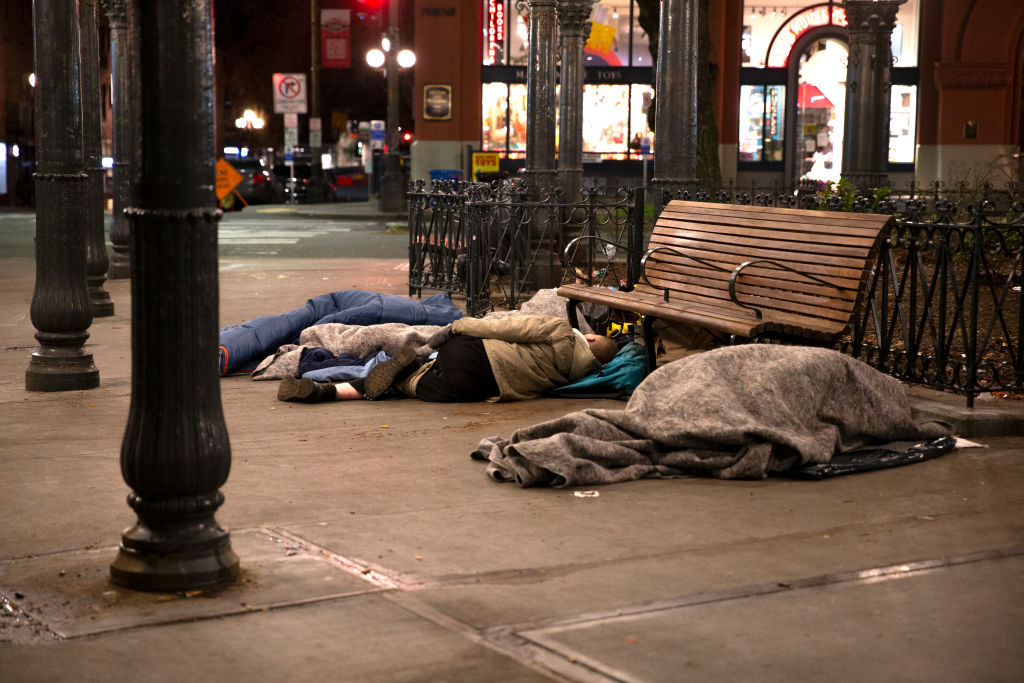
Seattle Spends $48 Million on 165 Luxury Apartments to House Tiny Number of City’s 12,000 Homeless
Oh, to be young, unemployed and homeless in Seattle. Sure, sleeping rough can be difficult. The Emerald City is about to change that for some of its many, many unhoused residents, however, thanks to a $48 million scheme…
Oh, to be young, unemployed and 🏠Homeless in ☕Seattle.
Sure, sleeping rough can be difficult. The Emerald City is about to change that for some of its many, many unhoused residents, however, thanks to a $48 million scheme in which the city will buy up three buildings’ worth of luxury apartments, including studio penthouses with views of the Space Needle and Puget Sound.
According to Fox News, the 165 units the city purchased in the Capitol Hill neighborhood — best known to nonresidents as the site of the anarchic Capitol Hill Autonomous Zone/Occupied Protest last summer — won’t be leased at market rates but instead will go to individuals currently living in tents and temporary shelters.
And even if you don’t live in ☕Seattle, you’re paying for it; the city is using part of the $1.9 trillion American Rescue Plan funds to cover the cost of the purchase.
“Everyone deserves a high quality, affordable place to call home,” said Emily Alvaredo, director of the Seattle
Sponsored
Sponsored
Seattle Spends $48 Million on 165 Luxury Apartments to House Tiny Number of City’s 12,000 Homeless — IJR
☕
Office of
🏠Housing
, according to Fox News.
“The fact we’re able to produce high-quality, affordable 🏠Housing at a price that’s good for the public, through our subsidy, is a win-win,” she said.
Whether or not the price is “good for the public” is another issue entirely.
“☕Seattle is spending $50 million or $300,000 per unit,” Fox News reported. “Developers say that’s two to three times higher than what it costs them to build.”
And, according to the Daily Mail, ☕Seattle is promising more acquisitions in the coming weeks, despite the fact it could have built these apartments from scratch for half the cost.
“While planning and construction for an affordable multifamily rental 🏠Housing development can take up to several years to complete, ☕Seattle’s current real estate market presents unique opportunities to acquire newly constructed market-rate apartment buildings and quickly convert them to affordable 🏠Housing,” the city said in a news release on Sept. 20.
“Our homelessness crisis has always been a 🏠Housing crisis,” ☕Seattle Mayor Jenny Durkan said in a statement. “The City of ☕Seattle continues to make bold investments to address our homelessness crisis as quickly as possible.
“With this latest investment, we are building on a completely new approach that has the potential to become a national model for rapidly creating affordable 🏠Housing.”
Again, dubious. For $48 million, the city acquired 165 units. However, as the Daily Mail pointed out, ☕Seattle’s 🏠Homeless population hovers around 12,000.
Granted, one assumes whatever approach ☕Seattle takes to address the homelessness crisis in its city will be multipronged and won’t necessarily be as costly as this acquisition. However, if ☕Seattle’s homelessness crisis has been, as Durkan said, always a 🏠Housing crisis, the city would need $3.4 billion to solve it in this fashion.
Seattleites might be free-spending types when it comes to throwing money at social ills, but even they have their limits.
Surprisingly, Durkan’s ☕Seattle isn’t even the worst offender among American cities trying to solve their 🏠Homeless issues by buying up large apartment buildings.
In Los Angeles, the city purchased the Weingart Tower in Skid Row — 19 stories high with 275 units, mostly studio apartments — for $160 million. That’s $580,000 per unit, a little less than twice what ☕Seattle is paying for the 165 units it just purchased.
Depending on how next month’s mayoral race shakes out, this could be just the beginning of ☕Seattle’s real-estate spending splurge, too. Durkan isn’t running for re-election and the race to succeed her has come down to Lorena González and Bruce Harrell. That battle, according to The Associated Press’ Chris Grygiel, represents “the political divide between activist-left residents and more moderate progressives in one of the nation’s most liberal cities,” with González favored among the former group and Harrell the latter.
González, the Daily Mail notes, is “focused on new policy to transform the city’s 🏠Housing stock” — which is to say, expect this purchase to look quaint. Harrell has been “vague on detail but emphasizing his work as a community organizer,” the Daily Mail reported.
While that’s typically an unpromising sentence in any other context, vague and ineffectual beats concrete plans for 🏠Housing stock buying sprees to get 🏠Homeless people into prime luxury apartments. (Thankfully, that spree is more than likely to be averted if present voter sentiment holds; a September Seattle Post-Intelligencer poll had Harrell up by 15 points over González, although it’s worth noting 24 percent of voters were still undecided.)
It’s not like these sorts of efforts haven’t been tried. We saw a whole raft of plans to get people off the streets in the early days of the COVID-19 pandemic, particularly in large cities with unused hotel stock and serious homelessness issues.
In New York City, a plan to house hundreds of homeless men in Upper West Side hotels led to “a spectacle of public urination, catcalling and open drug use,” according to an Aug. 6, 2020, New York Post report.
Meanwhile, San Francisco caused a stir earlier in 2020 when it was reported the city would deliver free alcohol and drugs to 🏠Homeless individuals they put up in local hotels.
Apartments might end up being a different animal entirely, but the key word there is might.
Furthermore, the root causes of homelessness aren’t solved by simply giving a 🏠Homeless person an apartment or hotel room. Even if ☕Seattle had the $3.4 billion to do that, the same underlying issues that drove most of these men and women to the streets will persist inside apartment buildings as well.
☕Seattle has no intention of solving these root causes, of course, because doing so would require illiberal tactics such as enforcing drug laws and encouraging personal initiative.
Instead, some in the city persist under the misapprehension a city-subsidized studio penthouse with a view of the Space Needle is part of a viable solution.