Secretary Wright Dodges Main Question Americans Are Asking While Facing Stubbornly High Prices At The Pump
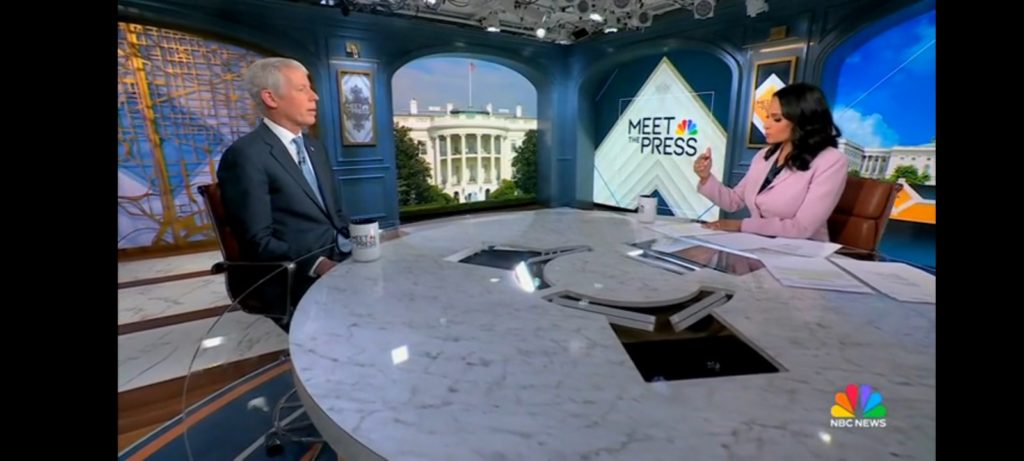
Energy Secretary Chris Wright deflected when asked by “Meet the Press” host Kristen Welker about when gas prices would start to drop. The average price of a gallon of gas in the United States on Sunday was $4.52…
⚡Energy Secretary Chris Wright deflected when asked by “Meet the Press” host Kristen Welker about when gas prices would start to drop.
The average price of a gallon of gas in the United States on Sunday was $4.52, according to AAA, up over $1.50 from $2.98 on Feb. 26, days before the start of military operations against Iran. Welker asked Wright about his prediction from his previous appearance in a March episode that the price of gas would return below $3.00 per gallon before the summer.
“Do you think it’s still very possible that gas prices will dip below $3 a gallon in time for summer which is about six weeks?” Welker asked Wright.
“I can’t make any predictions about, you know, oil prices or gasoline prices,” the ⚡Energy secretary responded, “The military part of the conflict took about what we expected; I think the president was guiding four to six weeks, it took five and a half weeks. After the military— main military operations have ceased, now we’re in a negotiating period. We’re using economic leverage against Iran, and this regime is trying to cling on to their nuclear program, so obviously this part of the conflict has gone a little longer.”
“Just to go back to this central question, though, do you anticipate gas prices will drop below $3 a gallon this year?” Welker shortly thereafter asked.
“I can’t make predictions about that,” he responded. “I can say that when we start to get free flow of traffic through the Straits of Hormuz, Energy
Sponsored
Sponsored
Secretary Wright Dodges Main Question Americans Are Asking While Facing Stubbornly High Prices At The Pump — IJR
⚡
prices will come down. And by ending Iran’s ability to get a nuclear weapon, they are the biggest threat in the world to the flow of global
⚡Energy
.”
During a March 8 appearance on Fox News Sunday, Wright told host Shannon Bream that “⚡Energy will flow soon” and called reports that prices would climb as a result of the conflict with Iran “fiction.”
WATCH:
Responding to an earlier question about if ending the Iranian nuclear program or reopening the Strait of Hormuz was the administration’s top priority, Wright claimed Iran had material for 10 nuclear devices and over 1,000 pounds of 60% enriched uranium. Wright also asserted that ending the Iranian nuclear program would lower ⚡Energy costs in the long term.
Trump Middle East Envoy Steve Witkoff made a similar claim in a March 2 interview with Fox News, but the administration has not offered evidence to corroborate the assertions from Witkoff or Wright.
“So you’re saying that ultimately gas prices will start to come down once the is reopened?” Welker said. “Here’s what analysts are saying about how high gas prices could ultimately go: ‘U.S. gasoline prices have a legitimate chance of rising to $5 a gallon as refiners prioritize jet fuel production at the expense of other products, according to analysts at JPMorgan Chase.’ Should Americans be prepared for the possibility of paying $5 a gallon for gas?”
“Look, again, I can’t predict the price of ⚡Energy in the short term or even the medium term, but what we’re doing is ending a 47-year conflict. Iran has fought — ‘Death to the United States,’ for 47 years, ‘Death to Israel’ — and as we saw when the conflict broke out, they attacked all of their neighbors in the Middle East that had no involvement in the conflict whatsoever,” Wright deflected. “If you have a hostile, unstable power like that, you simply cannot allow them to have nuclear weapons. That was a consensus opinion all my adult life.”
Trump and other administration officials declared the Iranian nuclear program had been “obliterated” after the June 2025 strike on multiple Iranian nuclear sites, but still asserted Iran posed a threat to the U.S. without providing specific details. Secretary of State Marco Rubio said the U.S. launched strikes because American casualties resulted from an Iranian response to Israel’s planned attack.
The New York Times reported April 7 that, despite skepticism from Vice President JD Vance and other officials, Trump was convinced to launch strikes against Iran during a Feb. 11 visit to the White House by Israeli Prime Minister Benjamin Netanyahu.
Former Director of the National Counterterrorism Center Joe Kent resigned March 17 over the conflict, claiming the war began “due to pressure from Israel and its powerful American lobby.” Kent also argued in an X post that Iran posed no “imminent threat” to the U.S.
“I know you’re saying you can’t predict how high gas prices will go, but I don’t hear you ruling out the possibility that they could in fact go to $5 a gallon,” Welker responded.
“Well, I’m just avoiding price predictions, but I will say the United States is in a tremendous position,” Wright replied, “We’re by far the world’s largest producer of oil. We’re by far the world’s largest producer of natural gas. There’s been no rise in the price of natural gas: that’s the largest primary ⚡Energy source for the United States, that’s for home heating, that’s for electricity. Gasoline, diesel prices are up, and they will remain up while this conflict’s in place, and then they will come back down. And, ultimately, they’ll come back down lower than they were before.”
Wright also told Welker oil supplies from Venezuela and Guyana would help lower prices, adding that, around the world, there was “an extremely bright outlook” when it came to ⚡Energy production. He made similar arguments during his March 8 interview with Bream.
Wright also said the Trump administration would support suspending the 18-cent-per-gallon federal gasoline tax, following states like Utah, Indiana and Georgia, when asked about it by Welker.
All content created by the 🏢Daily Caller News Foundation, an independent and nonpartisan newswire service, is available without charge to any legitimate news publisher that can provide a large audience. All republished articles must include our logo, our reporter’s byline and their DCNF affiliation. For any questions about our guidelines or partnering with us, please contact [email protected].