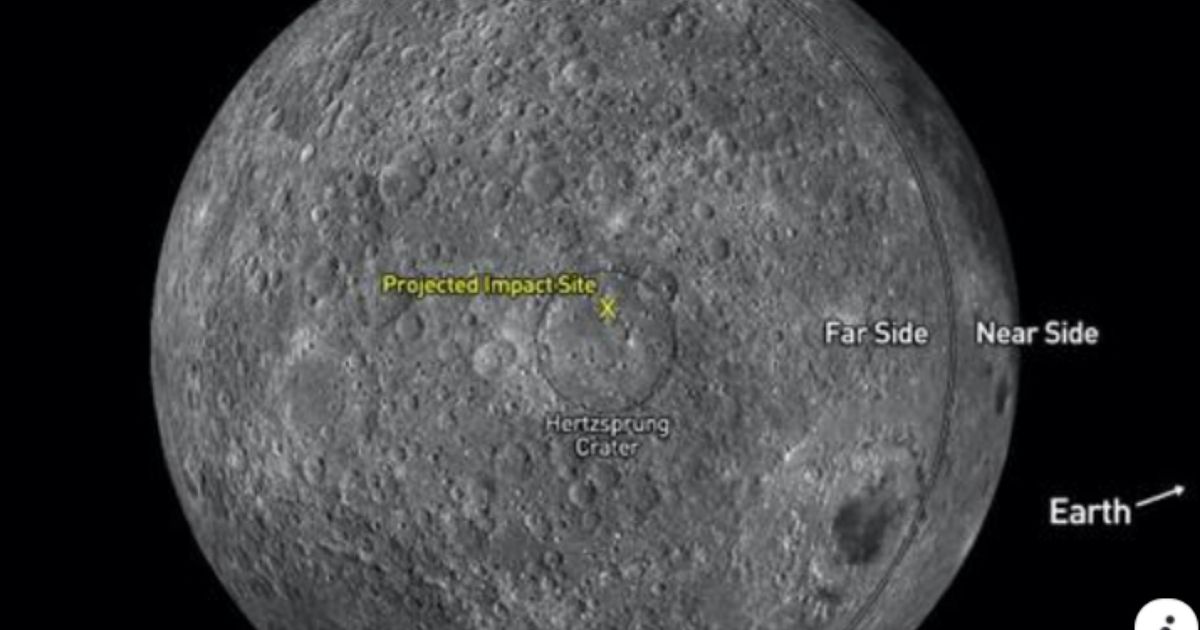
Three tons of space junk slammed into the moon Friday as China tried to insist that no matter what other observers say, that country was not responsible. The impact took place at about 7:25 a.m. Eastern time, according…
Three tons of 🚀Space junk slammed into the moon Friday as China tried to insist that no matter what other observers say, that country was not responsible.
The impact took place at about 7:25 a.m. Eastern time, according to space.com.
The impact went unwitnessed because it took place on the far side of the moon in what 🚀Space.com said was the first known time any nation had littered the moon with 🚀Space junk by accident.
Assigning blame for littering the moon and causing one more crater on its pockmarked surface has been a tangled tale.
Earlier this year, astronomer Bill Gray laid the blame on Elon Musk’s SpaceX, saying a piece of a booster rocket somehow was finding its way to the moon, according to the BBC
Sponsored
.
But the longer that Gray and others looked, the more they focused on China and its Chang’e 5-T1 mission, which was launched in 2014.
“For a Chinese mission, we know the launch date because they are televised. So I take a guess that it’s going to get to the moon — usually in four or five days. Then I compute an approximate orbit,” Gray said.
He said he is now “99.9 percent sure it’s the China 5-T1.”
Chinese Foreign Ministry spokesperson Wang Wenbin denied this was possible, according to spacenews.com.
“According to China’s monitoring, the upper stage of the rocket related to the Chang’e-5 mission entered into Earth’s atmosphere and completely burned up,” he said.
Nope, said U.S. 🚀Space Command, which at one time listed the rocket part as having come to Earth but decided to take a second look.
“While U.S. 🚀Space Command can confirm the CHANG’E 5-T1 rocket body never deorbited, we cannot confirm the country of origin of the rocket body that may impact the moon,” a 🚀Space Command spokesman said in an email, noting that 🚀Space command tracks 43,000 objects on a daily basis.
Because the impact took place on the far side of the moon, exactly who hit the moon with a piece of junk might never be confirmed.
NASA’s Lunar Reconnaissance Orbiter will try to get an image of the new crater, according to The Verge.
“We certainly have an interest in finding the impact crater and will attempt to do so over the coming weeks and months,” John Keller, deputy project scientist for the Lunar Reconnaissance Orbiter mission, said in an email.
“We will not be near the impact site when it takes place so we won’t be able to directly observe it. The onboard narrow angle cameras have sufficient resolution to detect the crater but the Moon is full of fresh impact craters, so positive identification is based on before and after images under similar lighting conditions.”
Professor Hugh Lewis of the University of Southampton told the BBC that with all kinds of 🚀Space junk floating about, it is important to “keep an eye on what’s there.”
“It’s the mess we’ve created. Objects that we think are safe can actually return to Earth unexpectedly,” he said.