Swampers Moan About The $40 Trillion Debt They Helped Create
Members of Congress bemoaned the $40 trillion national debt Thursday that they helped create.

Members of Congress bemoaned the $40 trillion national debt Thursday that they helped create.
Republicans and Democrats pointed fingers at each other after the debt surpassed $40 trillion. They all voted for legislation that contributed to the debt, including the One Big, Beautiful Bill (OBBB) and the Inflation Reduction Act.
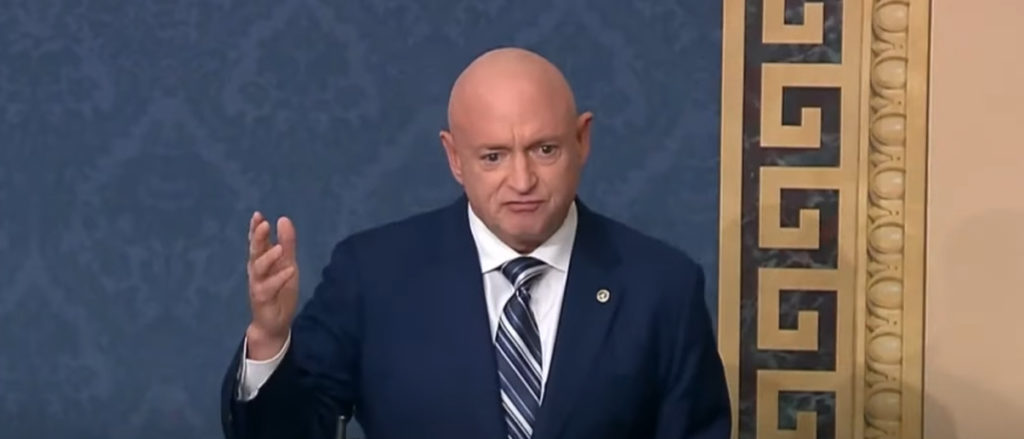
Democratic Arizona Sen. Mark Kelly blamed President Donald Trump for raising the debt. During former President Joe Biden’s administration, Kelly voted for the $1.9 trillion American Rescue Plan and the Inflation Reduction Act, which cost roughly $370 billion over 10 years.
“The President said he’d pay off the debt in his first term. Well we all knew that was a lie. Instead he ran it up to $40 trillion while he and his family made billions,” Kelly said.
Republican Iowa Sen. Chuck Grassley blamed socialist policies for the current debt.
“U.S debt hit $40T,” Grassley said on X. “It’s a wake up call America Voters 40 trillion reasons reject unaffordable socialist policies. American prosperity REQUIRES fiscal discipline.”
Republican Florida Sen. Rick Scott called on Congress to “get spending under control” by balancing the budget.
“Our national debt just hit 40 TRILLION DOLLARS! This is bad. Congress needs to get spending under control and BALANCE THE BUDGET. Americans deserve better,” Scott said on X.
Republican Utah Sen. John Curtis said Congress needed to “rally behind solution” and stop adding to the debt, which he warned would leave future generations footing the bill.
“Our reckless spending problem in Washington is immoral—it unfairly leaves our children and grandchildren to foot the bill—but it also is making our economic stability extremely fragile,” Curtis said. “The more we add to our debt, the greater the threat of disaster in the event of an economic shock. We should all be alarmed. Congress needs to rally behind solutions to get our fiscal house in order. A good start is our Fiscal Commission Act.”
Republican Florida Rep. Randy Fine said Congress must cut spending.
“America’s national debt has just crossed $40 trillion,” Fine said. “Washington’s reckless spending is putting this country and the next generation at risk. We cannot tax our way out of this, we cannot keep borrowing our way out of this. We have to cut spending and get our fiscal house in order before it is too late.”
Fine voted in favor of the $95 billion reconciliation package that included no offsets. The legislation passed the House on July 22. Republican Reps. Thomas Massie of Kentucky and Warren Davidson of Ohio voted against the measure, citing debt concerns.
“In an hour Congress will vote to hijack the budget reconciliation process, a tool for balancing the budget, and use it for a slush fund for the Iran War, and in the process add $130 billion to our debt,” Massie said at the time.
The package included $10 billion for the House Administration Committee to hand out grants to implement the Safeguard American Voter Eligibility (SAVE) America Act, $72 billion for the House Armed Services Committee and House Permanent Select Committee on Intelligence to address the Iran war and $12 billion to aid struggling farmers.
Many conservatives, including Scott and Republican Kentucky Sen. Rand Paul, voiced concern over the package’s addition to the debt if it became law.
Massie told his Republican colleagues not to complain about the debt if they voted for the OBBB.
“If you voted for the Big Beautiful Bill, please don’t get on here and express righteous indignation that the debt is now $40 trillion. Anyone with a room temperature IQ knew that cutting taxes and increasing spending was going to balloon the deficit,” Massie wrote on X.
Massie and Republican Pennsylvania Rep. Brian Fitzpatrick voted against the OBBB in July 2025. In the Senate, Paul, Republican Sens. Thom Tillis of North Carolina and Susan Collins of Maine opposed the measure.
Democratic Vermont Sen. Peter Welch said presidents on both sides have added to the debt, though he did not mention members of Congress.
“The national debt has now surpassed $40 trillion. This isn’t an abstract issue; higher debt means you pay more on things like mortgages and car loans,” Welch said. “Presidents of both parties have added to the debt. This has to be a bipartisan issue that we work on together.”
During Trump’s first term, Republicans voted for the Tax Cuts and Job Act of 2017, which was projected to add between $1.5 and $1.9 trillion to the debt. A bipartisan majority passed the Bipartisan Budget Acts of 2018 and 2019, which raised discretionary spending caps and suspended the debt limit for a period.
Senate Majority Leader John Thune said in July that the debt ceiling would have to be raised in early 2027, though it is unclear whether it would happen in the first or second quarter. He told the Daily Caller News Foundation on July 30 that he would love spending cuts to be included if the debt ceiling is raised.
All content created by the Daily Caller News Foundation, an independent and nonpartisan newswire service, is available without charge to any legitimate news publisher that can provide a large audience. All republished articles must include our logo, our reporter’s byline and their DCNF affiliation. For any questions about our guidelines or partnering with us, please contact [email protected].